
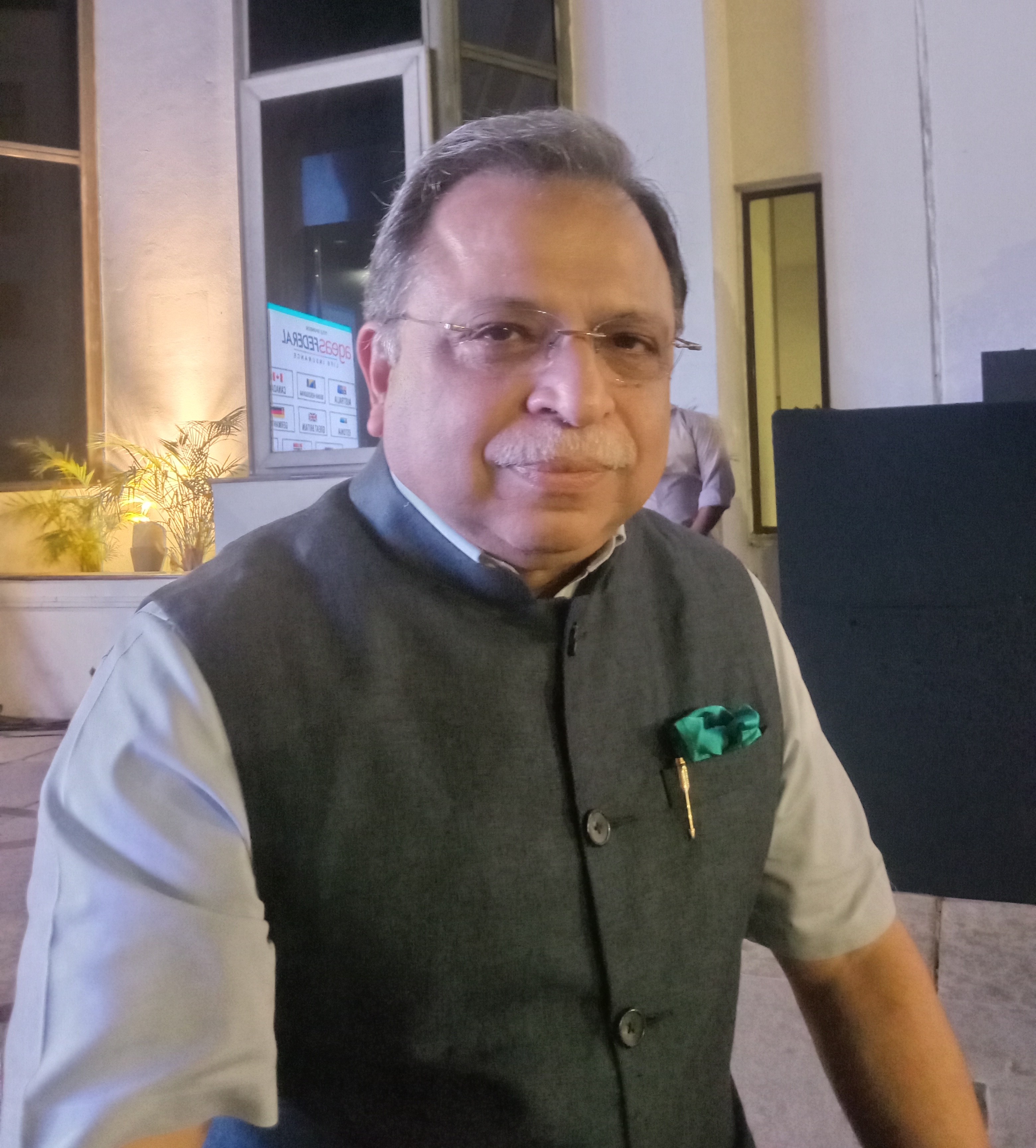
The level of interest shown by India’s corporate sector in the country’s athlete nurturing program for track and field events at the junior level, has been disappointing, Adille Sumariwalla, president, Athletics Federation of India (AFI), said.
“ Everybody wants a Neeraj Chopra. Nobody wants to put money into the grassroot building of athletes,’’ he told this blog on November 4, eve of the 2023 IAU 50KM World Championships, held recently in Hyderabad. Chopra won gold in javelin throw at the 2020 Tokyo Olympics (held in July-August, 2021) to become the second Indian after Abhinav Bindra to earn an individual gold medal at the Olympics. Bindra had won gold in the men’s 10 metre air rifle, at the 2008 Olympics. While gold medal-winning elite athletes are sought after by companies wishing to feature them in their marketing campaigns, efforts to spot, nurture and grow talent at the grassroot junior level – basically, the foundation on which the story of elite achievements rests – has eluded the support of corporates.
Sumariwalla pointed out that so far, the junior programme for scouting and grooming potential in track and field events has been funded by the AFI itself. It is among the largest such programs in the world and many senior level performers owe their discovery and subsequent passage to limelight, to the program. Yet, companies have overlooked the sustained engagement that is required to support this program. They prefer instead, the ease of returns found in marketing campaigns featuring elite athletes. This is when, according to Sumariwalla, a mere spoonful of the total Corporate Social Responsibility (CSR) outlay of the top 20 Indian corporates exceeds the government’s annual sports budget. “Companies want to use corporate social responsibility money for advertising. They want to know how many eyeballs they will fetch by sponsoring the athletes. Therefore, they have no interest in supporting grassroot level athlete development programs. They are not interested in sustained engagement,” he said.
AFI has been organising the National Inter District Junior Athletics Meet (NIDJAM) since 2003. “ The way it goes is that first, 600 districts organise the district championships in two age groups – under 14 and under 16 years. The smallest districts have about 300-350 participants. The bigger districts have anything between 3,500 and 4,500 participants. The district championships are first held. Then they select 13 athletes to come for the National Inter District Junior Athletics Meet (NIDJAM). Last time, 599 districts took part. We had 6,500 children who were selected from roughly 10 lakh children who take part,” Sumariwalla said, outlining the scale of the program.
Among the state governments, Bihar government had offered limited funds. Recently, REC Ltd, a state-owned company, came aboard, offering funds for NIDJAM. But these are exceptions. “ In these 17 years, hardly any corporate evinced interest in funding or partially supporting NIDJAM. A couple of companies helped in a brief manner. AFI has supported the program internally for the last 17 years. Children get their train fare, free accommodation and free food. They come with their parents. We also feed the parents. At times we are feeding about 10,000 people each day,” Sumariwalla said. Last year, the Bihar government took up a portion of that expenditure, mainly food and accommodation. REC Ltd took up the train fare expenses partly.
AFI has sought corporate support for the program. Unfortunately, as the federation discovered, corporate interest in sports is more around marketing campaigns featuring successful elite athletes and less in sustained, long term engagement. “ We have been reaching out to corporates. The constant question from companies is: can we get Neeraj or for how many days can we get Neeraj? My answer has always been: no, you can’t get Neeraj,” he said, reiterating that sponsors need to support sports at the grassroot level. Without grassroot level programs, the pipeline feeding talent to senior athletics gets weakened.
There is also an emergent need to reimagine and support the junior program. At the last NIDJAM, 599 districts took part and 6,500 children were selected from among 10 lakh who took part in the district championships. AFI’s focus for these young athletes is to allow them to explore at least three different sports. “ We want them to have an overall development. We don’t want them to start specialisation at the age of 13, 14 and 15 and probably till the age of 17. We found that those who specialise early burn out fast. Those who took up completely different sports have done well,’’ he said.
What worries is that the conversion ratio from junior to senior athletics is very low at three to five percent. “ If we are going to lose all our athletes by the time, they are 18 years old, the program is of no use. Therefore, we do not want them to specialise in events too early on. We are even thinking of changing the national structure of the events to make sure that they participate in all kinds of odd events,” he said. The above illustrates the challenges the junior program faces and also the need to support it in a sustained fashion such that the rates of successful transition to senior athletics don’t hover at discouraging levels. AFI’s talent nurturing program at the junior level is among the best in the world. “ Supporting it is the most important thing for the development of athletics. Some of our top-notch athletes have come out of this program,” Sumariwalla said.
Notwithstanding his disappointment at corporates’ obsession with successful senior athletes, Sumariwalla believes that senior athletes’ performance has a salutary effect on the performance of junior athletes and the interest in them. For instance, the lustre around a Neeraj Chopra brushes off positively on a whole world of athletics in India. Brands such as Adidas, Puma and Asics have shown interest in AFI. “ We have been able to convince HSBC to look at the women’s program. We now have its support for the women’s program. Reliance has come in but not as large as it should be. If we do a valuation of AFI we are not even getting 10 percent of that by way of support,” he said.
With reference to the ultramarathon (Sumariwalla was in Hyderabad in connection with the 2023 IAU 50KM World Championships), he said that AFI will try to secure official recognition for the sport. Such recognition helps events and athletes to be supported by government (airfare, daily allowance etc may be possible). The classical route to recognition was the admission of a given sport to the Olympics. Ultrarunning is yet to be a part of the Olympic Games. However, at present, the Indian government also recognizes and supports sports that are not part of the Olympics. For example, squash wasn’t part of the Olympics for a long time but it was recognized by the government (recent news reports said, squash will be there in the 2028 Los Angeles Olympic Games). The way to obtain such recognition is via better performance by athletes. Once athletes return great performances and the same grabs public attention, support and traction, the government will feel motivated to recognize and back ultrarunning. Podium finishes are thus critical. The 2023 IAU 50KM World Championships witnessed a silver medal for India in the men’s team category. Further in the past, India has won podium positions in the team category at the continental championships.
According to Sumariwalla, ultrarunning is an extension of athletics and the government needs to support it. “ I think it will happen. It’s just a matter of time,’’ he said.
(The authors, Latha Venkatraman and Shyam G Menon, are independent journalists based in Mumbai)

 Outrigger