
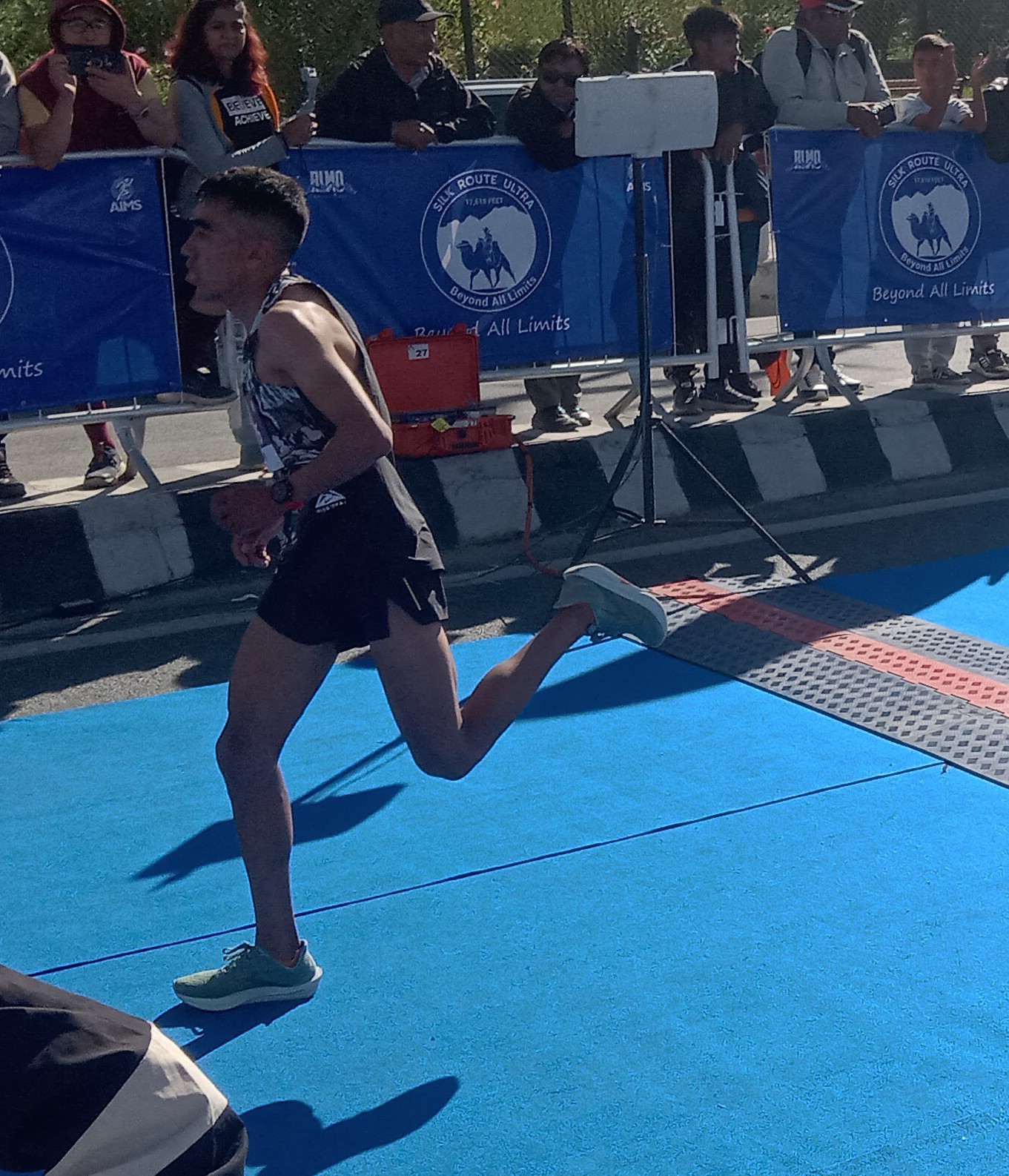
The data in the phone-camera gives the time of the photograph as 8.42AM.
That was when on September 10, a wiry runner blew past the finish line of the 2023 Ladakh Marathon and won the race. A few steps past the finish, he lay down exhausted. Helped up by volunteers, he then picked his way to Leh’s NDS Stadium nearby, where the awards presentation was due.
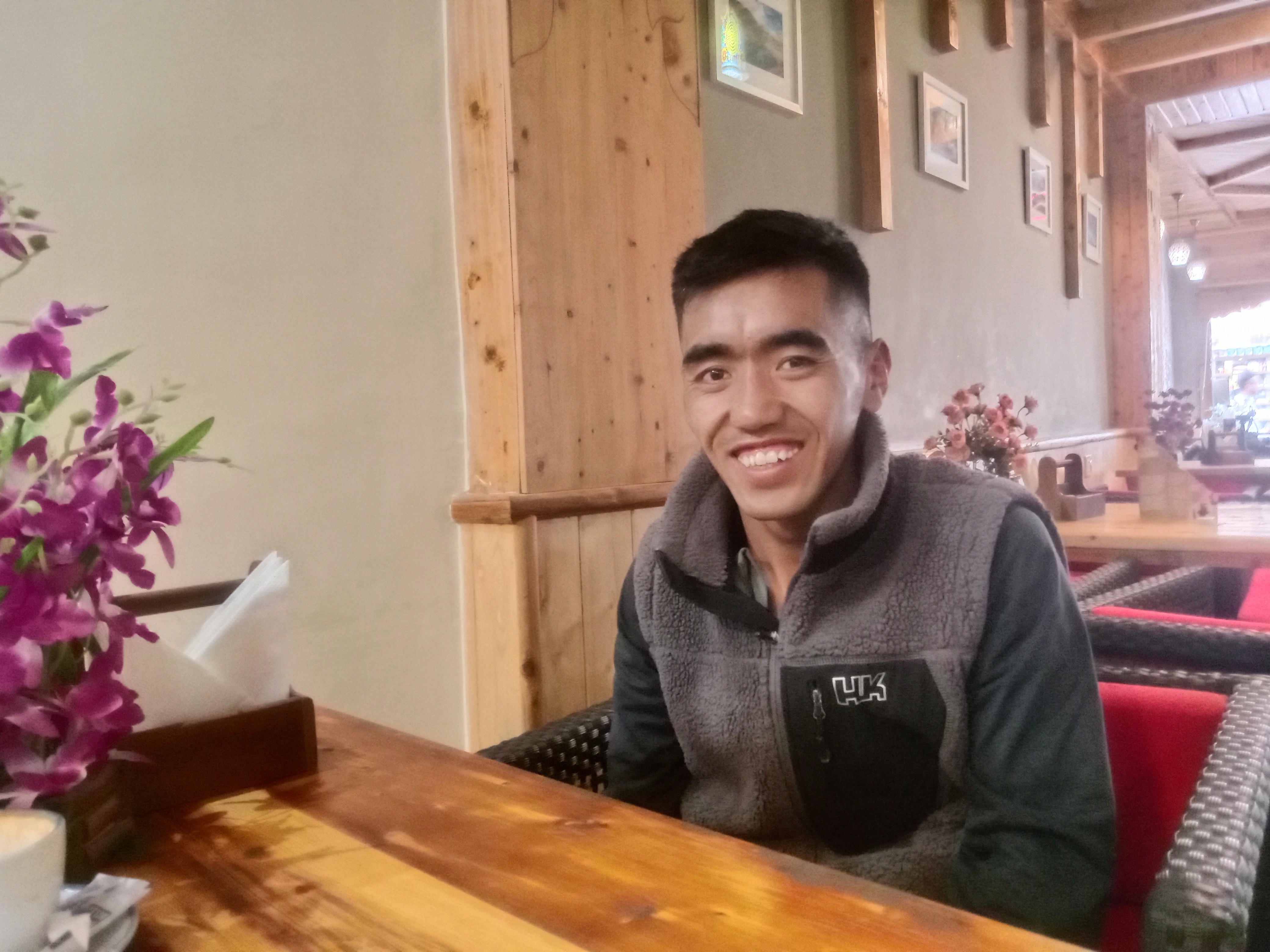
A couple of days later, when this writer met him at a café in Leh, he still seemed a light, breezy presence on the planet. Soft spoken, mostly answering to the point and if a wind blew – likely to float off. Meet Nawang Tsering or as at 8.42AM on September 10 – two hours, 42 minutes and two seconds. And for this spectator from Mumbai, such timing at 11,500 feet elevation, where many of us find it difficult to jog!
Still when Nawang won the 2023 Ladakh Marathon, it wasn’t his best timing so far. He was marginally short of his own course record in Leh; 2:41:42, set in 2022. His personal best was 2:39:39, set at the 2022 New Delhi Marathon. At that time, it (2:39:39) appeared the best timing yet by a Ladakhi marathon runner (source: Administration of Union Territory of Ladakh, press statement dated March 29, 2022). However, it’s a long way off from the timings reported by top Indian marathon runners (for comparison: Shivnath Singh’s longstanding national record is 2:12:00 and Gopi T of the Indian Army who has since been the closest to that mark, clocked a personal best of 2:13:39 at the 2019 Seoul Marathon [source: World Athletics]). On the bright side, Nawang is 24 years old and only getting started. Besides, just as runners from the plains may be stretched doing a sub-three hour-marathon at altitude in Ladakh’s dry weather, a Ladakhi runner like Nawang, takes time to adjust to the heat and humidity of lower altitudes. All of which points to engaging discoveries and twists and turns ahead, in India’s marathon story.
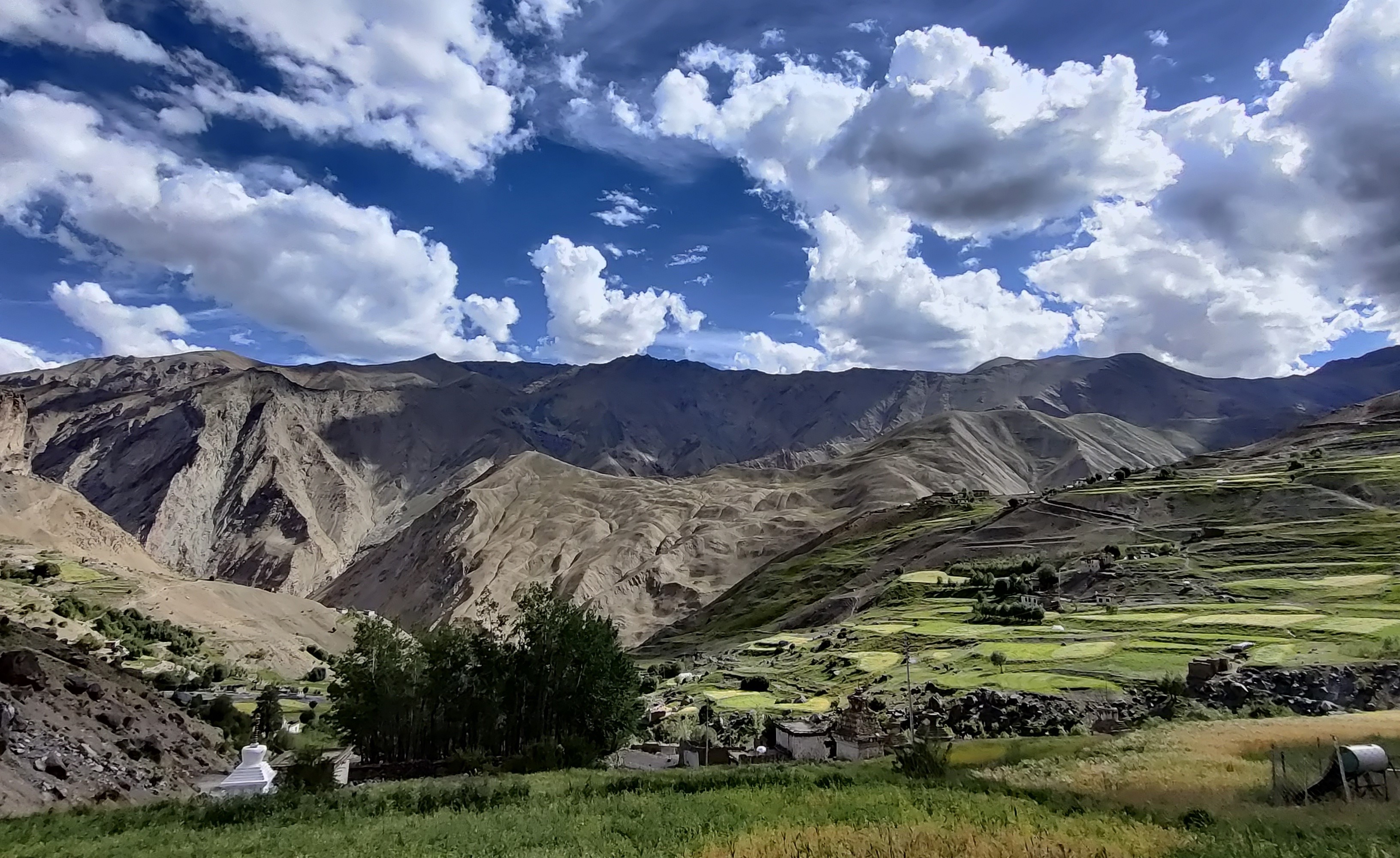
Nawang hails from Lingshet, a village in the Sham region of Ladakh. It is a long way from Leh, to the south west. Although technically a part of Leh district, enquiries in Leh revealed that culturally, Lingshet used to be closer to Zanskar. For long, Lingshet was a remote place. There wasn’t a road leading right up to the village. Nawang’s father worked as a labourer. His mother died when he was in the third standard. He has two brothers and a sister. Nawang studied at Leh’s Lamdon Model Senior Secondary School. Even after he competed his twelfth standard some years ago, the school continues to be second home. He stays in the school hostel.
In his early childhood, Nawang recalled, it took three days to reach home from Leh. And in winter, passage to Lingshet entailed trekking on the frozen Zanskar River. Known as the Chadar Trek, it was until recently a much-coveted objective in adventure tourism with people paying a lot of money to experience walking on the frozen river in sub-zero temperatures. Global warming and consequent unreliability around the strength of the ice cover and problems associated with too many people arriving for the bragging rights of having walked the frozen river, have since taken the sheen off the trek. For Nawang though, the Chadar Trek was a winter reality. It was the only way he could go home during vacations (in Ladakh, the winter school break is longer than the summer one). As he grew up, the visits home appear to have dwindled. During the ninth and tenth standards, tuitions kept him in Leh. In the following years, it was running. Lingshet is now connected by road. But the boy, since become a man and devoted to a life in running, rarely goes home. Leh and Lamdon have become his address.
For much of his years in school, Nawang wasn’t into running. The bug bit in the eleventh standard. His inspiration was his friends – Tsering Stobgais and Jigmet Norbu – who had been to Mumbai (home of India’s biggest city marathon) and on their return begun to train. There was even a running club operated by his friends; they called it Cosmos. According to Stobgais, Cosmos was one among clubs of that sort, formed by the inmates of the school hostel to have informal tournaments. “ Back then, Leh did not have many sports tournaments. We had to devise our own,” Stobgais said, adding efforts are now afoot by former Cosmos members to recast the club into a body that spans both competitions at school and outside. At the time Nawang first saw his friends train, he didn’t have running shoes. His friends had visited Mumbai as part of the running team sponsored by Rimo Expeditions. The company provided team members new pairs of shoes. When his friends’ shoes became old, Nawang got to borrow a pair for his training runs. Then in 2014 or so, when the year’s edition of the Ladakh Marathon was due, Nawang bought his friend’s old running shoes – a pair of Kalenji from Decathlon. At the event in Leh, he participated in the half marathon and finished eighth. From 2015 onwards, he started getting podium finishes at the Ladakh Marathon; he opened his account with a second position in the half marathon in the open category. Archived results show his 2015 timing as 1:23:26.
That year he made his first trip to Mumbai as part of the team dispatched annually by Rimo Expeditions to participate in the Mumbai Marathon. Thereby, he got his first pair of new running shoes – a pair of Nike. In Mumbai, he trained under coach Savio D’Souza (Savio also visited Leh periodically to oversee his wards’ training). Contacted in mid-September 2023, after Nawang’s latest victory in Leh, the coach remembered the youngster he met in 2015 as a hardworking, good runner who was short on big race experience. Nawang’s first half marathon in Mumbai didn’t yield any podium finish. He found the heat and humidity challenging. But it was the beginning of a pattern in life – start the running season with the Ladakh Marathon in September and spend the winter months running the marathons of the plains with Rimo. In 2016, he successfully defended his second place in the half marathon in Leh and while he travelled with Rimo to Mumbai, Goa and Delhi and improved his timing, he could secure no podium finish anywhere outside of Ladakh.
Next year – 2017 – he became the winner (first place) of the half marathon in Leh with timing of 1:21:23 and followed that up with a second place in his age category at the Tata Steel 25K in Kolkata, his first podium finish outside Ladakh. However, his participation in the 2017 Airtel Delhi Half Marathon and the 2018 Mumbai Marathon yielded no podium finish, Nawang said. It was a spell of no encouraging results. Through the 2019 Tata Mumbai Marathon and the New Delhi Marathon, he continued to run the half marathon to no memorable finishes outside Ladakh. Barring exceptions, his timing in the half marathon was stuck in the range of 1:20 to 1:21. There were some near podium finishes but no real podium. His performance at home too, seemed unsteady. At the 2018 Ladakh Marathon, he completed the half marathon in 1:18:48 to secure first place. But in 2019, it was 1:22:34 and a third place on the podium. Then COVID-19 struck. The world slipped into pandemic and lockdown. Races were cancelled globally.
The intervening period till the resumption of races, was a period of reflection. Nawang had to figure out how to break free from entrapment in a plateauing half marathon performance and dearth of podium finishes. “ I was stuck in the 1:20 – 1:21 range,” Nawang said, portraying the frustration. It was from the consequent churn that the switch to the full marathon happened. Savio explained the logic and process. According to him, two angles counted. First, there were limitations in Ladakh to improving athletes’ speed because the required number of short distance races were not yet a major part of the region’s running ecosystem. Second, what runners like Nawang required was not merely speed but “ speed-endurance.’’ Or simply put, sustaining what speed they could whip up over a longer distance, which in turn helped them when running the the shorter distance races too. A kind of benign, synergic loop. “ For me, it was logical that Nawang should increase the distance of his long runs,’’ Savio said of the drift to full marathon. In his estimation (the whole thing viewed as developing speed-endurance), Nawang learning to be good at the marathon would have beneficial impact on his performance in the half marathon as well.
In Leh, Nawang did some of his training runs for the full marathon with Ladakh’s leading woman marathon runner, Jigmet Dolma (another of Savio’s Ladakhi students), and also with her fellow marathon runners, Tsetan Dolkar and Disket Dolma (they were all part of Rimo’s team). “ He did some of the easier runs with us. Beyond a point, our respective pace is different,’’ Jigmet said. In training, Nawang’s long runs typically touched 35 to 38 kilometres. “ In 2021, there was a marathon in Delhi. That is where I competed in the full marathon for the first time. I had timing of two hours, 42 minutes,’’ he said (the reference here is most likely to the 2021 New Delhi Marathon, where Nawang timed 2:42:49 to place sixth among men in the open category). The next event he recalled, was the 2022 New Delhi Marathon, where he got his personal best of 2:39:39. In September that year came his course record at the Ladakh Marathon.
Then the impact of the switch to full marathon, on the half, also manifested. At the 2022 Vedanta Half Marathon in Delhi, Nawang narrowly missed a podium position in his age category (in the half marathon) but gained a personal best of 1:14:45. In December 2022, he ran the Tata Steel 25K in Kolkata and placed third in the 18-24 years age group with timing of 1:31:28. Roughly a month later, at the 2023 Tata Mumbai Marathon, he placed fourth in the men’s 18-24 years age category of the full marathon with timing of two hours, 39 minutes, 49 seconds. What effect, better circumstances of training and being with runners of matching and superior ability can have on Nawang, is anyone’s guess.
Going ahead, Nawang wishes to alternate between the full and half marathon. He plans to improve his timing. Many Ladakhi runners concede that while they have faith in their endurance, they find themselves challenged for speed in the races of India’s plains. Nawang trains as his coach, Savio, tells him to. He does his training runs, does free hand exercises and has generally avoided gyms. “ I have only one weight in my hostel room. Four kilos, that’s all,’’ Nawang said laughing. The bulk of his training is a composite of warm-up, running and stretching. Asked what he thought were essential to get closer to the timings reported at marathons elsewhere, he thought for a while and said: an improved diet, coach close by and perhaps access to some strength training. But what sets Nawang apart from the regular crop of Ladakhi runners is how he has imagined his life’s work.
Nawang currently holds a temporary job with the Ladakh Police. He also helps out at Rimo. Most male runners in Ladakh, once they become proficient in the sport, join the Ladakh Scouts or get picked up by this regiment of the Indian Army (the Scouts are known to treat their podium finishes at races in Ladakh as a regimental honour). According to Nawang, he was approached. But he held back for two important reasons. First, he is clear that whatever job he does should provide him room to train and grow further in running. It cannot be job above running; it should be a job that enables his future in running. To that extent, within the gamut of government jobs (including jobs in the military and paramilitary), he prefers establishments with a clear-cut sports quota and equally clear provisions for sportsperson to train. Second, he would like to contribute to running’s growth in Ladakh. “ I want to popularize running amongst my people,’’ he said. Outside the café, there was a quiet calm descended on Leh’s main market, also its much loved meeting spot; with the annual marathon over, the last flush of tourists to town had departed. Conversation completed, Nawang left for Lamdon.
“ Nawang Tsering is a star of Lamdon School. In fact, he is a Ladakh-star. He belongs to a very humble family. At an early stage itself, we saw his potential in long distance running. He has stayed on in the school hostel even after passing out. For Lamdon’s boarding school students, he is like an elder brother. He coaches and mentors students,” Dr Stanzin Dawa, principal, Lamdon Model Senior Secondary School, said when contacted. According to him, the Leh-based institution has its own imprint on the annual marathon with many who finish in the top ranks of the Ladakh Marathon’s various races, belonging to the school or its alumni.
The weekend after this writer met Nawang, it was the Sunday of the 6th Kargil International Marathon 2023. Nawang was due to run there. He did and secured the first place, covering the 42 kilometre-distance in a new personal best of 2:38:47 on September 17, 2023. That 2:39:39 from 2022, had become history. The union territory’s administration may need to put out a new press statement.
(The author, Shyam G Menon, is a freelance journalist based in Mumbai.)
 Outrigger