After five podium finishes in the 72 km-Khardung La Challenge (including a hat-trick) and two podium finishes in the 122 km-Silk Route Ultra, Shabbir Hussain wishes he had more opportunities in the ultramarathon
An ultramarathon at altitude, is a bit like a mountaineering expedition.
As the race approaches, each participant withdraws into a cocoon, unique to one’s wiring. By September 6, 2023, the day of departure from Leh to Kyagar in Nubra Valley, it was clear that an element of imminent rendezvous with reality was beginning to wash over those set to attempt the 122-kilometer-long Silk Route Ultra (SRU). In Kyagar, some rested in their hotel rooms and stayed unseen. Some walked around, conversed and chatted, ostensibly to ease the gravity of the countdown. Among the less visible was Shabbir Hussain. He must be resting. Tomorrow is his, isn’t it? – although not verbatim, that was the tenor in response from his colleagues in the military and paramilitary; at least three of them – Stanzen Phuntsog, Tsewang Kundan (from Ladakh Scouts) and Phunchok Tashi (from the Indo-Tibetan Border Police [ITBP]) – stayed in circulation, playing the occasional game of table tennis to keep themselves occupied and distracted. The day before an important race and the hours leading to it, can be testing. Staying relaxed is easier said than done. Shabbir appeared only on and off. Would the ones to watch out for tomorrow be the ones seen the least today? – I wondered.
Several hours earlier, at the NDS Stadium in Leh, a small fleet of buses had manifested to transport the runners. I had chosen my bus for Kyagar at random and discovered a self-effacing runner conscious of his importance and yet wishing to be away from the glare it fetched, take his place in the seat in front. His credentials in running were clear from his physical appearance. Here comes the winner. Take us also up the pass along with you, Shabbir – that, yet again not verbatim, was however the substance of the greeting he received from the other runners in the bus. From different parts of India, some of them attempting the race again after being unable to complete in 2022, they all knew Shabbir as the man to watch out for. With Kundan, Stanzen and Tashi too in the same bus, our vehicle felt special. Turbo-charged?
Shabbir Hussain’s significance to the two ultramarathons – Khardung La Challenge (KC / 72 km) and SRU – that are part of the family of races constituting the Ladakh Marathon, may be understood from the event’s archived results. Both these races come up and over the 17,618 feet-high Khardung La, among the world’s highest motorable passes. It is an altitude with less oxygen; running becomes quite difficult. Additionally, the SRU has a start that is 50 kilometers farther away from the start line of KC. In other words, a SRU participant is more than a marathon old in terrain gaining elevation towards Khardung La by the time he reaches the village of Khardung, start point of KC. The 72 kilometer-KC made its debut in 2012. Shabbir started running KC in 2014. As per results available on Wikipedia (at the time of writing, the KC results of 2012, 2013 and 2014 didn’t feature on the Ladakh Marathon website), he finished first in six hours and 35 minutes. In 2015, Shabbir finished fourth with timing of seven hours, 16 minutes and 13 seconds. The winner in 2015 was Tsewang Tokdan (6:33:41). By 2016, Shabbir was back on the podium at KC, he placed second (6:53:35.04); the results indicate a photo-finish with Tokdan (6:53:35.04). The next year was clearly Shabbir’s; he finished first (6:23:50.26) in KC. He stayed first (6:50:38) at KC, in 2018. In 2019, he made it a hat-trick of triumphs, securing the top position with timing of 6:53:34. In 2022, he shifted to competing in SRU. He finished second (14:57:57) in the race.
View of Darket (photo: courtesy Shabbir Hussain)
Shabbir was born and raised in Darket, a village roughly 20 kilometers away from Kargil towards the Leh side. Kargil is about 2700 feet lower in elevation compared to Leh (11,500 feet); it has an altitude of around 8780 feet (source: Wikipedia). He has three brothers and two sisters. Shabbir’s father worked as a laborer. The boy studied till tenth standard. As is widespread practice in Ladakh, he later joined the Ladakh Scouts regiment of the Indian Army. According to Shabbir, during his days in school, there wasn’t any indulgence in sports worth mentioning. However, soon after his acceptance into the Scouts, his ability to run was recognized. That was how he started landing up at the races of the Ladakh Marathon.
The event commenced in Leh, in 2012. That year, the men’s marathon (42 km) was won by Tsering Gyatso (3:36:18). In 2013, archived results show the men’s marathon sporting a new winner – Shabbir Hussain (3:25:33). “ I just ran the marathon and ended up first,’’ he said. In 2014, he shifted from the marathon to KC. Outside of Ladakh, Shabbir’s participation at races has been very limited and he has enjoyed no podium position. He travelled a couple of times with the team of Ladakhi runners Rimo Expeditions sent to the marathons of the plains. Away from the Ladakh Marathon, he also participated once in the 111 kilometer-race of La Ultra The High (also held in Ladakh) and secured a third place. “ When we train, we don’t think of podium position. We think of improving our timing. If you lost a position but gained in timing – it is fine. Similarly, a good position without good timing does not enthrall,’’ he said.
At Kyagar, Shabbir explained why he progressively drifted away from the marathon and stuck to KC and SRU. “ My forte is stamina. I find speed tough to generate,’’ he said. That was a day before the 2023 SRU set off late evening September 7 and Shabbir, running in the second batch of runners (the Ladakhi elites started one and a half hours after the rest of the field), showed that even in the ultramarathon, his pace – and that of the other runners from Ladakh Scouts – can be hard to match. They headed off into the night at a steady pace. Villagers who had lined up at road junctions to cheer the first batch, stayed back to encourage the local heroes. Shabbir felt that Ladakhi athletes like Jigmet Dolma and Nawang Tsering, who have embraced the marathon, have actually taken the tougher challenge of chasing speed. In comparison, he chose the path of less resistance – pursuing stamina. And yet that doesn’t totally sum up Shabbir for he digs a good challenge. In both the shift from the marathon to KC and the subsequent shift from KC to SRU, the main motivation he conceded, was “ challenge.’’ It’s probably why after winning the 2023 SRU, it isn’t a return to the same race that is playing on his mind. He wonders whether he should try the shorter KC next time, for in 2023, the KC winner, Rigzin Gyurmeth (6:31:41) of the army’s special forces, had come close to Shabbir’s timing from 2017 – 6:23:50.26. “ I would like to keep the course record,’’ Shabbir, 29, said smiling. He will take a decision on KC or SRU for 2024, closer to the event.
Shabbir Hussain finishing first in the 2023 Silk Route Ultra (photo: Shyam G Menon)
Morning of September 8. Fifteen hours, 27 minutes and 53 seconds after he set off from Kyagar, Shabbir crossed the finish line of SRU in Leh to win the 2023 edition of the race. Easily among the most iconic runners emerging from Ladakh Marathon, Shabbir would like to compete in ultramarathons outside Ladakh. Although news of races elsewhere now reaches Ladakh’s runners, Shabbir has to date not participated in an ultramarathon outside the union territory. “ I would like to attempt 100 km-races and 24-hour stadium runs,’’ he said. Top notch competitions in these disciplines, held under the auspices of the International Association of Ultrarunners (IAU), now happen in India. There are Indian teams participating. Many civilian runners also regularly take part in high profile road and trail-based ultramarathons overseas. A serving soldier, Shabbir’s future in the sport depends much on seniors empowered to take decisions. Hope they are listening.
(The author, Shyam G Menon, is a freelance journalist based in Mumbai.)
Tigst Assefa (this photo was downloaded from the Facebook page of Berlin Marathon and is being used here for representation purpose. No copyright infringement intended)
Kipchoge wins men’s title for the fifth time
Defending champion, Tigst Assefa of Ethiopia won the women’s section of the 2023 Berlin Marathon with a new world record of 2:11:53.
The timing is a considerable improvement over the previous world record of Kenya’s Brigid Kosgei (2:14:04), set at the 2019 Chicago Marathon. A year ago, at the 2022 Berlin Marathon, Tigst had finished first in a personal best of 2:15:37.
A former 800 metres-specialist, she started running marathons only in March 2022. A September 2022 profile in Runner’s World magazine, soon after her victory in the 2022 Berlin Marathon, pointed out that an Achilles tendon injury with consequent difficulty in training in spikes, had seen the talented middle distance runner shift from the track to road races. After a two year-break to recover from the injury, Tigst worked her way through the 10K and the half marathon to the marathon. She debuted in the marathon at the March 2022 Riyadh Marathon, where she finished seventh (2:34:01). Six months later, she was the winner at Berlin and a year thereafter, the world record holder.
“ I didn’t expect to run this fast that is to say to break 2:12, but it is the result of hard work. As for being now a favourite for the Olympic Marathon next year, it is up to the National Committee to select me for the team.’’ Tigst was quoted as saying on the X handle of Berlin Marathon. In Berlin on Sunday, second place among women went to Kenya’s Sheila Chepkirui (2:17:49); Tanzania’s Magdalena Shauri (2:18:41) placed third. It was an exceptional showing by Ethiopian women runners as they cornered seven of the top ten finishes in their gender category.
Link to video posted by BMW Berlin Marathon on YouTube, showing Tigst Assefa’s finishat the 2023 edition of the event.
Among men, the winner of the 2023 Berlin Marathon was yet again, Eliud Kipchoge of Kenya, albeit with timing that was the slowest from the gallery of his five wins at the event since 2013. A decade ago, in 2013, Kipchoge had placed second in the year’s Berlin Marathon, with timing of 2:04:05. In 2015, he chopped that to 2:04:00 and a win. It was 2:03:32 by 2017, 2:01:39 in 2018 and down to a spectacular 2:01:09 in 2022 (all of them, first place). On Sunday, the 38-year-old crossed the finish line of the 2023 edition of the event, in 2:02:42 to place first again. Kenya’s Vincent Kipkemoi (2:03:13) placed second while Ethiopia’s Tadese Takele (2:03:24) placed third. “ I always learn from every race and every victory. I’m very happy to win for the 5th time in Berlin. And I shall use these lessons in my preparation for the Olympics,’’ Kipchoge was quoted as saying on the X handle of Berlin Marathon.
Within the world of city marathons, the race in Berlin is much-coveted for its flat, fast course. It has witnessed several world records. Reporting on 29-year-old Tigst Assefa’s run, Reuters noted, “ She clocked an hour six minutes 20 seconds at the halfway mark and was one of six women to be on world record time at that stage as the Berlin marathon lived up to its reputation as one of the world’s fastest. She had no problem maintaining her pace and at the 37km mark she was just three seconds per kilometre slower than Kipchoge’s time at the same stage, cruising to a sensational world record.’’
Host country, Germany saw one of its runners finish in the top ten at Berlin Marathon for the first time since 2008; Amanal Petros (2:04:58) finished ninth in the race.
(The authors, Latha Venkatraman and Shyam G Menon, are independent journalists based in Mumbai. The name Tigst Assefa may be found spelt so and also as Tigist. We have gone with the spelling as available at Berlin Marathon and World Athletics.)
Corina (Cocky) Van Dam; at the Vinfast Ironman 70.3 World Championship 2023, in Lahti, Finland (photo: courtesy Cocky)
This is an article by invitation. Corina Van Dam, or Cocky as she is popularly known in Mumbai, is a football coach, a long distance runner and a triathlete. She has participated in a number of races and triathlons across India. She has also taken part in endurance swimming events. She was recently at the Vinfast Ironman 70.3 World Championship 2023 at Lahti in Finland. Here, she writes about her experience at the event.
As age category winner in Ironman 70.3 Goa in 2022, I was eligible to register for the Vinfast Ironman 70.3 World Championship 2023 in Lahti, Finland. I dreamt of participating in a world championship when I was a young girl but never thought that this dream would come true at the age of 58…!
My development from athlete to triathlete has been an organic one. I have always loved sports and through the years (and the accumulation of age) I had increasingly started loving the volume of work-outs rather than the intensity. The longer a practice or race, the more interesting I found it to be. However, in order to not finish last in the world championship (which was my goal!), I had to increase the intensity of my workouts and speed / pace in the different elements. To cut a long story short…, though I had an excellent cycling coach in Abishek Avhad, I had not been able to cut a substantial chunk of my race time when it mattered. But the success that I celebrate is that I finished as nr. 141 out of 161 in my age category (mission accomplished!). And although I feel a bit ashamed that `my fans’ celebrate me as if I am the world champion, I am proud that I have been able to finish in a world championship surrounded by excellent athletes while enjoying the event to the fullest.
The challenges that I had to overcome prior to the race, were ‘swimming in a wetsuit’ and the thought of swimming in ‘cold water.’ With my Ironman (IM) travel mate Ritesh Thakkar, I took advantage of the public open water swimming spaces in Helsinki, where residents of the city dip in the water for their morning swim. I was so relieved when the water appeared to be ‘only’ 19.5 degrees Celsius cold. The Ironman practice swim in Lahti gave me the confidence that I would manage this leg. It seemed easy: no loops, no mass start, buoys with numbers and a finish line that could be seen from a distance. However, I was seriously intimidated by all those athletic bodies in shiny black wetsuits. The three women from Singapore said to me what I thought of every other athlete present: “ We hope you’re not in our age category…!’’ I received another shock during the bike check-in, the day before the race. While I checked the simplest Scott road-bike in, the poor thing was surrounded in Transition 1 (T1) by equipment from a different family: TT bicycles, carbon frames with disk wheels, aerodynamic helmets….
Corina (Cocky) Van Dam; from the Vinfast Ironman 70.3 World Championship 2023 (photo: courtesy Cocky)
As we were commuting from Helsinki to Lahti by train, we tried to do as many of the activities on the day of our registration, such as the welcome dinner and the Parade of Nations, so that we could meet other participants. I represented the Netherlands and I joined the group of Dutch people lining up behind the red-white-blue flag. As during an Olympic Games opening, we walked through Lahti Stadium which is situated at the bottom of three spectacular ski jumping hills (with a swimming pool at the landing) and waved at everyone who wanted to wave at us. The commute also gave us a chance to talk to ordinary Finnish travellers, IM participants and their families from different countries. During one of the trips – a special morning train from Helsinki on event day (like the Tata Mumbai Marathon train but only with triathletes) – we sat with the family of Steven McKenna, one of the professional triathletes. We could not get enough of listening to stories about his preparations and attitude towards the sport.
The world championship was held over two days. The first day was for us, women. From my first step in Helsinki Central Station to the last in the evening, I was surrounded by vibrant female concentration, power and energy. Countless were the moments that I felt emotional.
Not the least, when the professionals were being introduced to the audience and lined up for the race. After the Finnish national anthem, we could hear a pin drop in anticipation of the race start. And there they went… the pros, our role models, kicking off the long-anticipated event.
I was thrilled to participate with 2000 other participants in a women’s only race. As female triathletes in India, we are always surrounded by male participants. Often, there are only a few women present and I have been in races where I was the only one registered in my age category. I cannot describe how exciting it was to stand at the starting line with 160 women of my own age: wrinkles, grey hair peeking out from under our green swimming caps and singing and dancing to the music in our tight wetsuits that showed our trained and toned bodies in all their glory. Of course, I panicked when the swim started, as I always do. This time my contact lens moved when I jumped into the water. I immediately realised that if I lost it, I would not have any replacement or glasses for the rest of the race since the start / finish (the ‘Finnish finish line’) / Transition 1 and Transition 2 were all in different places. Shubham Vanmali, one of India’s great ultra swimmers and a recipient of the Tenzing Norgay National Adventure (sport) Award once told me that cold water amplifies fear. I did not allow this to happen. I managed to control myself and started enjoying the swim though my timing was not as it could have been.
Corina (Cocky) Van Dam; from the Vinfast Ironman 70.3 World Championship 2023 (photo: courtesy Cocky)
The cycling route was one loop through a rolling landscape. We crossed forests, meadows, and a few villages. The roads were closed and we just had to pedal without fear for upcoming traffic or potholes. Of course, there are always too many hills and there is too much head wind. After 30 kilometres of cruising, the road made a sharp bend and an awful hill showed its ugly face. At the sudden start of the climb, I approached another athlete and joked: “ I did not see this coming.” It happened to be Maitreyi Bokil and we both laughed. I managed to overtake a few triathletes but have especially learnt to recognize the sound of TT bikes closing in on me from behind. After the race, I kidded that I had overtaken 10 cyclists and had been overtaken by 100. Since there were many (younger) age categories that started behind us (the 55–59-year-olds), it did not matter. But of course, it always hurts.
With the run, in sight, I was relieved that I had completed the riskier activities (being caught by fear / cold during swimming – one female triathlete died during the swim – or a mechanical issue while cycling) which can end one’s race prematurely. The half marathon was fun. As on the cycling route, the residents of Lahti were sitting in front of their houses with their families, cheering us on. They sat in their foldable chairs, ringing cowbells or banging pots and pans with spoons. The run was two laps and it was painful to see athletes keeping right and head towards the finish while we had to start our second loop. When I used a hill to consume one of my LEAP gels, I heard my name and Ketaki Sathe flew past me. Wow! My running time was the same as during my last triathlon event and my overall timing was a carbon copy of Ironman 70.3 Goa in 2022.
It is a good practice during Ironman races that every athlete is as welcomed as the winner among the professionals is. With 15,000 volunteers, all 6000 participants received the support that we needed. After the race, no idlis or upma but pizza, hotdogs, ice cream, muffins, chips and Coke….! Race day was party time.
Corina (Cocky) Van Dam; from the Vinfast Ironman 70.3 World Championship 2023 (photo: courtesy Cocky)
The next day, I had a chance to watch the 4000 men racing. I thought I would have a quiet day but as it happened, I had to run up and down Lahti to see the professionals start their swim, run to T1 to see them finish and start cycling, run back to see Ritesh start his swim 2.15 hours after the professionals started (take pictures for his family at home), run to the road to see the professionals heading to T2, run back to watch Ritesh finish his swim and transition in T1 (another picture), and in a hurry run to the finish to watch the pros completing their case… I walked 23 kilometres as recovery, the day after my race. But it was great to watch without pre-race day tension, cheer the Indian participants on and experience the race as spectator from the first to the last finisher.
I had an unforgettable time as amateur / tourist, but it became clear that I am in no position to compete with the best in my age category at a world championship. Participating has been a humbling experience. It has shown me how privileged I am that I had learnt swimming, cycling and running from a young age so that I could participate in a race like this. I could also afford to pay for the registration, flight and accommodation which is not the case for many of the age group winners in India and others in the Global South. For now, the Ironman World Championship remains an event for the privileged ones. And this privileged one needs to step up if she wants to be more than just a tourist at another Ironman 70.3 World Championship.
(The author, Corina [Cocky] Van Dam works with an NGO. She lives in Mumbai.)
The data in the phone-camera gives the time of the photograph as 8.42AM.
That was when on September 10, a wiry runner blew past the finish line of the 2023 Ladakh Marathon and won the race. A few steps past the finish, he lay down exhausted. Helped up by volunteers, he then picked his way to Leh’s NDS Stadium nearby, where the awards presentation was due.
A couple of days later, when this writer met him at a café in Leh, he still seemed a light, breezy presence on the planet. Soft spoken, mostly answering to the point and if a wind blew – likely to float off. Meet Nawang Tsering or as at 8.42AM on September 10 – two hours, 42 minutes and two seconds. And for this spectator from Mumbai, such timing at 11,500 feet elevation, where many of us find it difficult to jog!
Still when Nawang won the 2023 Ladakh Marathon, it wasn’t his best timing so far. He was marginally short of his own course record in Leh; 2:41:42, set in 2022. His personal best was 2:39:39, set at the 2022 New Delhi Marathon. At that time, it (2:39:39) appeared the best timing yet by a Ladakhi marathon runner (source: Administration of Union Territory of Ladakh, press statement dated March 29, 2022). However, it’s a long way off from the timings reported by top Indian marathon runners (for comparison: Shivnath Singh’s longstanding national record is 2:12:00 and Gopi T of the Indian Army who has since been the closest to that mark, clocked a personal best of 2:13:39 at the 2019 Seoul Marathon [source: World Athletics]). On the bright side, Nawang is 24 years old and only getting started. Besides, just as runners from the plains may be stretched doing a sub-three hour-marathon at altitude in Ladakh’s dry weather, a Ladakhi runner like Nawang, takes time to adjust to the heat and humidity of lower altitudes. All of which points to engaging discoveries and twists and turns ahead, in India’s marathon story.
Nawang hails from Lingshet, a village in the Sham region of Ladakh. It is a long way from Leh, to the south west. Although technically a part of Leh district, enquiries in Leh revealed that culturally, Lingshet used to be closer to Zanskar. For long, Lingshet was a remote place. There wasn’t a road leading right up to the village. Nawang’s father worked as a labourer. His mother died when he was in the third standard. He has two brothers and a sister. Nawang studied at Leh’s Lamdon Model Senior Secondary School. Even after he competed his twelfth standard some years ago, the school continues to be second home. He stays in the school hostel.
In his early childhood, Nawang recalled, it took three days to reach home from Leh. And in winter, passage to Lingshet entailed trekking on the frozen Zanskar River. Known as the Chadar Trek, it was until recently a much-coveted objective in adventure tourism with people paying a lot of money to experience walking on the frozen river in sub-zero temperatures. Global warming and consequent unreliability around the strength of the ice cover and problems associated with too many people arriving for the bragging rights of having walked the frozen river, have since taken the sheen off the trek. For Nawang though, the Chadar Trek was a winter reality. It was the only way he could go home during vacations (in Ladakh, the winter school break is longer than the summer one). As he grew up, the visits home appear to have dwindled. During the ninth and tenth standards, tuitions kept him in Leh. In the following years, it was running. Lingshet is now connected by road. But the boy, since become a man and devoted to a life in running, rarely goes home. Leh and Lamdon have become his address.
For much of his years in school, Nawang wasn’t into running. The bug bit in the eleventh standard. His inspiration was his friends – Tsering Stobgais and Jigmet Norbu – who had been to Mumbai (home of India’s biggest city marathon) and on their return begun to train. There was even a running club operated by his friends; they called it Cosmos. According to Stobgais, Cosmos was one among clubs of that sort, formed by the inmates of the school hostel to have informal tournaments. “ Back then, Leh did not have many sports tournaments. We had to devise our own,” Stobgais said, adding efforts are now afoot by former Cosmos members to recast the club into a body that spans both competitions at school and outside. At the time Nawang first saw his friends train, he didn’t have running shoes. His friends had visited Mumbai as part of the running team sponsored by Rimo Expeditions. The company provided team members new pairs of shoes. When his friends’ shoes became old, Nawang got to borrow a pair for his training runs. Then in 2014 or so, when the year’s edition of the Ladakh Marathon was due, Nawang bought his friend’s old running shoes – a pair of Kalenji from Decathlon. At the event in Leh, he participated in the half marathon and finished eighth. From 2015 onwards, he started getting podium finishes at the Ladakh Marathon; he opened his account with a second position in the half marathon in the open category. Archived results show his 2015 timing as 1:23:26.
A view of Lingshet (photo: courtesy Nawang Tsering)
That year he made his first trip to Mumbai as part of the team dispatched annually by Rimo Expeditions to participate in the Mumbai Marathon. Thereby, he got his first pair of new running shoes – a pair of Nike. In Mumbai, he trained under coach Savio D’Souza (Savio also visited Leh periodically to oversee his wards’ training). Contacted in mid-September 2023, after Nawang’s latest victory in Leh, the coach remembered the youngster he met in 2015 as a hardworking, good runner who was short on big race experience. Nawang’s first half marathon in Mumbai didn’t yield any podium finish. He found the heat and humidity challenging. But it was the beginning of a pattern in life – start the running season with the Ladakh Marathon in September and spend the winter months running the marathons of the plains with Rimo. In 2016, he successfully defended his second place in the half marathon in Leh and while he travelled with Rimo to Mumbai, Goa and Delhi and improved his timing, he could secure no podium finish anywhere outside of Ladakh.
Next year – 2017 – he became the winner (first place) of the half marathon in Leh with timing of 1:21:23 and followed that up with a second place in his age category at the Tata Steel 25K in Kolkata, his first podium finish outside Ladakh. However, his participation in the 2017 Airtel Delhi Half Marathon and the 2018 Mumbai Marathon yielded no podium finish, Nawang said. It was a spell of no encouraging results. Through the 2019 Tata Mumbai Marathon and the New Delhi Marathon, he continued to run the half marathon to no memorable finishes outside Ladakh. Barring exceptions, his timing in the half marathon was stuck in the range of 1:20 to 1:21. There were some near podium finishes but no real podium. His performance at home too, seemed unsteady. At the 2018 Ladakh Marathon, he completed the half marathon in 1:18:48 to secure first place. But in 2019, it was 1:22:34 and a third place on the podium. Then COVID-19 struck. The world slipped into pandemic and lockdown. Races were cancelled globally.
The intervening period till the resumption of races, was a period of reflection. Nawang had to figure out how to break free from entrapment in a plateauing half marathon performance and dearth of podium finishes. “ I was stuck in the 1:20 – 1:21 range,” Nawang said, portraying the frustration. It was from the consequent churn that the switch to the full marathon happened. Savio explained the logic and process. According to him, two angles counted. First, there were limitations in Ladakh to improving athletes’ speed because the required number of short distance races were not yet a major part of the region’s running ecosystem. Second, what runners like Nawang required was not merely speed but “ speed-endurance.’’ Or simply put, sustaining what speed they could whip up over a longer distance, which in turn helped them when running the the shorter distance races too. A kind of benign, synergic loop. “ For me, it was logical that Nawang should increase the distance of his long runs,’’ Savio said of the drift to full marathon. In his estimation (the whole thing viewed as developing speed-endurance), Nawang learning to be good at the marathon would have beneficial impact on his performance in the half marathon as well.
In Leh, Nawang did some of his training runs for the full marathon with Ladakh’s leading woman marathon runner, Jigmet Dolma (another of Savio’s Ladakhi students), and also with her fellow marathon runners, Tsetan Dolkar and Disket Dolma (they were all part of Rimo’s team). “ He did some of the easier runs with us. Beyond a point, our respective pace is different,’’ Jigmet said. In training, Nawang’s long runs typically touched 35 to 38 kilometres. “ In 2021, there was a marathon in Delhi. That is where I competed in the full marathon for the first time. I had timing of two hours, 42 minutes,’’ he said (the reference here is most likely to the 2021 New Delhi Marathon, where Nawang timed 2:42:49 to place sixth among men in the open category). The next event he recalled, was the 2022 New Delhi Marathon, where he got his personal best of 2:39:39. In September that year came his course record at the Ladakh Marathon.
Then the impact of the switch to full marathon, on the half, also manifested. At the 2022 Vedanta Half Marathon in Delhi, Nawang narrowly missed a podium position in his age category (in the half marathon) but gained a personal best of 1:14:45. In December 2022, he ran the Tata Steel 25K in Kolkata and placed third in the 18-24 years age group with timing of 1:31:28. Roughly a month later, at the 2023 Tata Mumbai Marathon, he placed fourth in the men’s 18-24 years age category of the full marathon with timing of two hours, 39 minutes, 49 seconds. What effect, better circumstances of training and being with runners of matching and superior ability can have on Nawang, is anyone’s guess.
Going ahead, Nawang wishes to alternate between the full and half marathon. He plans to improve his timing. Many Ladakhi runners concede that while they have faith in their endurance, they find themselves challenged for speed in the races of India’s plains. Nawang trains as his coach, Savio, tells him to. He does his training runs, does free hand exercises and has generally avoided gyms. “ I have only one weight in my hostel room. Four kilos, that’s all,’’ Nawang said laughing. The bulk of his training is a composite of warm-up, running and stretching. Asked what he thought were essential to get closer to the timings reported at marathons elsewhere, he thought for a while and said: an improved diet, coach close by and perhaps access to some strength training. But what sets Nawang apart from the regular crop of Ladakhi runners is how he has imagined his life’s work.
Nawang crossing the finish line at the 2023 Ladakh Marathon (photo: Shyam G Menon)
Nawang currently holds a temporary job with the Ladakh Police. He also helps out at Rimo. Most male runners in Ladakh, once they become proficient in the sport, join the Ladakh Scouts or get picked up by this regiment of the Indian Army (the Scouts are known to treat their podium finishes at races in Ladakh as a regimental honour). According to Nawang, he was approached. But he held back for two important reasons. First, he is clear that whatever job he does should provide him room to train and grow further in running. It cannot be job above running; it should be a job that enables his future in running. To that extent, within the gamut of government jobs (including jobs in the military and paramilitary), he prefers establishments with a clear-cut sports quota and equally clear provisions for sportsperson to train. Second, he would like to contribute to running’s growth in Ladakh. “ I want to popularize running amongst my people,’’ he said. Outside the café, there was a quiet calm descended on Leh’s main market, also its much loved meeting spot; with the annual marathon over, the last flush of tourists to town had departed. Conversation completed, Nawang left for Lamdon.
“ Nawang Tsering is a star of Lamdon School. In fact, he is a Ladakh-star. He belongs to a very humble family. At an early stage itself, we saw his potential in long distance running. He has stayed on in the school hostel even after passing out. For Lamdon’s boarding school students, he is like an elder brother. He coaches and mentors students,” Dr Stanzin Dawa, principal, Lamdon Model Senior Secondary School, said when contacted. According to him, the Leh-based institution has its own imprint on the annual marathon with many who finish in the top ranks of the Ladakh Marathon’s various races, belonging to the school or its alumni.
The weekend after this writer met Nawang, it was the Sunday of the 6th Kargil International Marathon 2023. Nawang was due to run there. He did and secured the first place, covering the 42 kilometre-distance in a new personal best of 2:38:47 on September 17, 2023. That 2:39:39 from 2022, had become history. The union territory’s administration may need to put out a new press statement.
(The author, Shyam G Menon, is a freelance journalist based in Mumbai.)
Nawang Tsering has won the 6th Kargil International Marathon 2023 in a new personal best (PB) of two hours, 38 minutes and 47 seconds.
Ravi Dass (2:39:20) took second place. Jigmet Namgial (2:43:48) placed third. The timing (provisional) is as published on the website of Sports Timing Solutions.
Among women, the first place in the marathon, held on September 17, went to Agnes Mueni Mutua (3:02:47). Second and third places went to Diskit Dolma (3:36:13) and Jyoti Gawate (3:52:43), respectively.
In the men’s half marathon, Ritik Sharma (1:17:59) secured the first place followed by Kulbir Singh (1:19:21) and Tsewang Nangdan (1:21:52). Among women, the first place went to Tashi Ladol (1:26:43). Stanzin Chondol (1:27:09) placed second while Stanzin Dolkar (1:30:18) placed third.
Kargil has an average altitude of 8780 feet (source: Wikipedia), lower than the 11,500 feet of Leh, where just seven days earlier, Nawang had won the 2023 Ladakh Marathon in 2:42:02. Asked about the race in Kargil, Nawang said, “ it was a bit challenging because I was yet to recover fully from the marathon in Leh. The competition was also tight.”
On March 29, 2022, the Administration of Union Territory of Ladakh had issued a press release mentioning the timing of 2:39:39, which Nawang earned at the 2022 New Delhi Marathon, as the fastest by a Ladakhi male marathon runner. The wording in that statement (it was on the performance of Ladakhi runners at the 2022 New Delhi Marathon) had been, “ Nawang Tsering clocked 2 hour 39 minutes and 39 seconds which is so far the best timing by any Ladakhi Marathon-Runner (Men) breaking his own record which was 2 hours 42 minutes and 49 seconds of last year.”
Assuming the above observation is not restricted to the universe of the said event and going by the provisional timing from Kargil on Sunday, the 2022 mark would seem improved.
Besides Nawang Tsering, the names of Jigmet Namgial, Tsewang Nangdan, Diskit Dolma, Stanzin Chondol, Tashi Ladol and Stanzin Dolkar had featured among podium finishers at the 2023 Ladakh Marathon. They have all registered an improvement in timing in Kargil, which is roughly 2700 feet lower in elevation compared to Leh.
(The author, Shyam G Menon, is a freelance journalist based in Mumbai.)
Chewang Motup (right) and his wife, Yangdu, who together anchor the team hosting the annual Ladakh Marathon (photo: courtesy Motup)
Going into the annual Ladakh Marathon, Chewang Motup’s big worry had been the impact high altitude may have on those who arrived for the event’s races.
He kept reminding participants of the need to respect acclimatization protocols. As race director, he experiences the tension that nearly 6000 people congregating for the four day-event and the potential of non-Ladakhis in the fray acquiring altitude related illness, bring. The event’s races happen across altitudes spanning Leh’s 11,500 feet to the 17,618 feet of Khardung La, among the world’s highest motorable passes. As altitude rises, oxygen level in the atmosphere reduces making athletic performance tougher. In this context, the problems organizers face (as mentioned in an earlier article on this blog) are several. There are participants who don’t disclose pre-existing medical conditions, which could worsen at altitude. To get used to functioning at altitude, some days dedicated to the purpose, including rest therein, is essential. But there are those who think that protocols for acclimatization are unimportant and treat it lightly. As this writer noticed, runners arrive late and insist on getting bibs. Friends reached early try collecting bibs for those unable to reach Leh on time. It provokes arguments, for collection of bibs in person and on time are the primary means by which organizers stay convinced (to the extent possible) that protocols are being followed.
Making matters worse, there is no hesitation on the part of some runners in throwing their weight around. Position, status, importance of self – all these come into play even as organizers emphasize that the acclimatization protocols are in place to protect participants. Holding one’s ground against such negotiators is tough. Thanks to the safety measures the organizers must take and the lengthier duration of stay demanded (due to acclimatization protocols), the Ladakh Marathon is an expensive affair. Those who paid money and registered, try to ensure money’s worth. It reminds of an Everest expedition (albeit on a much smaller scale), where the hunger for achievement risks trumping reality. It will be so unless there is awareness and ownership among runners of what they are getting into. In other words, a race at high altitude is very dissimilar to a race in the plains.
Early morning, September 8, 2023: runners on the road to Khardung La; between North Pullu and the 17,618 feet-high pass (photo: Shyam G Menon)
Unlike events at low altitude, where laxity may be accommodated without any grave consequences to one’s health, at high altitude, poor acclimatization and subsequent ailments can result in death if medical intervention is not quick. There is thus a greater degree of responsibility expected on the part of participants, as regards events at high altitude. On the last day of the marathon expo (it is where racers collect their bibs), Motup was heard telling a participant pleading for relaxation of rules around bib collection, “ I am sorry, we are now very close to the race. I can’t give the bib to someone else and without seeing you in person. Don’t tell me how supremely fit you are or what your past record at races is. I have people working for me who climbed Everest multiple times. And yet, each of them has no option but to follow protocols when freshly coming to high altitude.’’ Besides being race director of Ladakh Marathon, Motup also owns Rimo Expeditions, one of the biggest adventure travel companies in India.
To complicate things, health problems experienced at high altitude are still a subject of study in medicine. Not only does each person seem to take differently to altitude but the same person needn’t have the same response to altitude, always. Even if protocols are met, things may go wrong depending on variables ranging from conditions on race day to the physical and mental state of a participant at that instance. While this can easily strengthen the lobby trivializing acclimatization protocols, fact is – all the precautions taken and safety measures met, matter in the analysis of a mishap. Documented evidence is vital. This is among reasons why race organizers insist on protocols being followed. This is why they feel beleaguered when runners argue on critical topics like protocols around acclimatization. “ My conclusion is that runners are taking altitude lightly,’’ Motup said.
The finish line of Silk Route Ultra and Khardung La Challenge, in Leh’s main market area (photo: Shyam G Menon)
Two days after the 2023 edition of the Ladakh Marathon had concluded, this writer met Motup for a post-race chat. The stress he had accumulated dealing with the event and its participants, was still only working its way off. As with previous editions (the event is now a decade old), the 2023 race witnessed no fatal incident on its course. In the run-up to the event, a lady who had come to run the half marathon collapsed at dinner and died, in Leh (11,500 feet elevation). In another incident, a runner who completed the half marathon in Leh, passed away after reaching home in Mumbai. Whether high altitude had any role to play in these unfortunate demises, we may never know. Ahead of the Silk Route Ultra-runners setting off for Kyagar (start line of the race), there was a session by a high-altitude medicine specialist, on the challenges of performing in such rarefied atmosphere. Including what distress calls from the body to stay alert for and when to call it quits. The session concluded with a moment of silence to pay respects to one of the departed. On race day, the two ultramarathons within the Ladakh Marathon fold (Silk Route Ultra and Khardung La Challenge, both of which touch heights exceeding 17,500 feet), witnessed a few worrisome incidents. Luckily, none were fatal. Ambulances were nearby and people could be evacuated in time. Besides ambulances on the ready, the Ladakh Marathon also keeps a helicopter on stand by for speedy medical intervention.
With roots in mountaineering, Motup looks at high altitude and performance at high altitude through eyes forged in that sport. He has been involved with numerous climbing expeditions (some of them research expeditions as well) and is currently the president of the prestigious Himalayan Club. Rimo Expeditions have been guides and providers of support for many high-altitude mountaineering expeditions, all along the Indian and Nepal Himalaya and that part of the Karakoram ranges which fall in India. Motup speaks from experience. For the 2024 edition of the Ladakh Marathon, he said that he would like to see runners showing greater respect for acclimatization protocols. There will be reduced room for any special considerations. Bibs may have to be collected in person, on time. On the race front, a degree of self-support – mainly the use of hydration packs – may be made compulsory in the two ultramarathons. Since the hosts must set an example themselves, Ladakhi ultrarunners, who have so far run the ultramarathons like an extended marathon, counting on aid stations for water and nutrition, may be told to start getting acquainted with hydration packs. The organizers may look to acquire chip-based tracking devices that allow them to monitor runners’ progress and act quickly if anyone is suspected to be in trouble. And in 2024, the tiered start of the Silk Route Ultra seen so far (in 2023, the elites commenced their run one and a half hours after the rest of the field had started) may be replaced by a single, consolidated start.
Shey; where the marathon sleeps (photo: Shyam G Menon)
Motup also explained why he doesn’t support the oft heard demand for relaxed stage cut-off in the Silk Route Ultra. At 122 km, plenty of uphill, the Khardung La pass to cross and stage cut-offs that continue to challenge despite being eased a bit in 2023, the Silk Route Ultra is a pretty difficult undertaking for any runner. As Motup pointed out, a longer stage cut off simply keeps a participant at high altitude for a longer period of time. Being at high altitude and straining there anyway damages the human body. At the same time, high altitude with its accompaniment of reduced oxygen level, is not apt ambiance for the body to heal. So, longer exposure to high altitude is simply an invitation to worsen matters. This is why it’s so much better to prepare well for the race at more hospitable altitudes, follow acclimatization protocols in Ladakh, take a reasonable shot at performing in the high-altitude race and not stay around for too long in the risky heights of the course. At this point, as a matter of fairness, it should be mentioned that race arrangements must also stay sensitive to the need for runners avoiding long stays in truly high portions of the course. In 2023, for instance, some runners told this blog of a lack of order and retrievability in how drop bags were stored at one of the really high aid stations. It caused a delay in locating bags. They wanted such details improved.
Shey; where the marathon sleeps (photo: Shyam G Menon)
Motup said that in his estimation, the presence of high altitude as its distinguishing feature, rendered the Ladakh Marathon an event with limited comparable brethren to consider for benchmark, when it came to deciding eligibility for participation. Elevation may be piled on by doing gradients at lower altitude but Ladakh’s high altitude (and its dry weather) or the altitude of Khardung La cannot be easily replicated. Finding exactly similar races to qualify for the races at Ladakh Marathon, is difficult. He said that over time, he may look to eligibility being decided by races within the Ladakh Marathon fold. Thus, performance at the Ladakh Marathon (42 km) may be used to decide eligibility for the Khardung La Challenge (72 km), which in turn may be treated as eligibility for the Silk Route Ultra (122 km). Motup found this reliable and safe to decide eligibility as these races are happening in the same overall high-altitude ecosystem and near similar sub-ecosystems. “ I think someone doing the Khardung La Challenge in under 11 hours could be considered for the Silk Route Ultra. Someone completing KC in under 10 hours, even more so ‘’ he said. However, asked about trail races, Motup said that while he would love to see Ladakhi runners take on trail based-events elsewhere, hosting a trail race in Ladakh would be quite challenging as off-road medical and search and rescue capabilities in Ladakh are not as evolved as they are, overseas. For now, sticking to the road made sense.
The evening of September 13, a day after the post-race chat with Motup, this writer beheld a large yard (owned by Rimo) in Shey village, where the Ladakh Marathon had come to hibernate till 2024. Hundreds of road dividers fabricated from metal arranged in rows, stacks of traffic cones, the metal framework of tables and arches and plenty of signages bore testimony to the groundwork the organizers had put in for over ten years. All, the physical infrastructure of a marathon; they basked in Ladakh’s evening sunshine, counting the days to another edition of India’s premier running festival at high altitude.
(The author, Shyam G Menon, is a freelance journalist based in Mumbai.)
Nawang Tsering at the finish line of the 2023 Ladakh Marathon (photo: Shyam G Menon)
Hans Raj, Stanzin Chondol win in half marathon
Nawang Tsering and Jigmet Dolma successfully defended their titles at the tenth edition of the Ladakh Marathon, which concluded in Leh on Sunday, September 10, 2023.
Taking top honors in the men’s open category with timing of two hours, 42 minutes and two seconds, Nawang was close to his own course record (2:41:42 / source: Olympics.com) set in 2022. Jigmet Namgail (2:52:58) took silver while Manzoor Hussain (3:20:35) earned the bronze medal.
It may be noted that the sub-three-hour performances were happening at an elevation of roughly 11,500 feet (altitude of Leh). Running becomes difficult when altitude increases owing to the reduced oxygen level in the atmosphere. An official note from the administration of Ladakh, dated March 29, 2022, about the performance of Ladakhi runners at that year’s New Delhi Marathon, highlights Nawang’s 2:39:39 (of 2022) as the best timing yet by a Ladakhi marathon runner. Both Nawang Tsering and Manzoor Hussain have been part of the Ladakh marathon team that Rimo Expeditions sent annually to races in India’s plains.
Jigmet Dolma finished first among women at the 2023 Ladakh Marathon with timing of 3:27:53. In 2022, she had clocked 3:21:19. In 2017, she had set the course record at Ladakh Marathon, covering the distance in 3:18:56 (source: Olympics.com). For long a part of the Ladakh marathon team that Rimo Expeditions formed and supported, Jigmet is among Ladakh’s best female marathon runners. Known to have determinedly chased a sub-three-hour finish in the marathon, she finally got it when she finished third at the 2023 New Delhi Marathon; she clocked 2:56:41. Jigmet has been a part of the national team. On Sunday in Leh, She was followed to the finish line by Disket Dolma (3:39:35), who too has featured in Rimo’s team. Deepika Prakash (4:36:21) took the bronze medal.
From left: Jigmet Dolma, Stanzin Dolkar, Tashi Ladol and Stanzin Chondol after their respective podium finishes in the 2023 Ladakh Marathon in Leh (photo: Shyam G Menon)
When the Ladakh Marathon was held for the first time in 2012, the winner among men, Tsering Gyatso, had clocked 3:36:18. Jigmet Skitzom, who topped among women, clocked 4:51:30 (source: Olympics.com).
Speaking to this blog after Sunday’s Ladakh Marathon, Jigmet said that she wasn’t quite satisfied with her performance and would therefore attempt to improve her timing at the marathon in Kargil scheduled for September 17. Attempting further improvement in her timing would be her goal for the approaching season of marathons in the plains, she said. In a fresh chapter to the Ladakh marathon team-story, Jigmet’s former partner in running and a good marathon runner in her own right, Tsetan Dolkar, currently works as an athletics coach in Leh.
According to Stanzin Chondol, when she first ran the half marathon at the Ladakh Marathon many years ago, she took two hours, 19 minutes to cover the distance. On Sunday, Stanzin crossed the finish line in 1:29:43 to place first among women. Her wish is to improve her timing further to the region of an hour and 25 minutes, at which point she believes, a shot at the marathon may seem reasonable. Silver in the women’s half marathon went to Stanzin Dolkar (1:31:47) and the bronze to Tashi Ladol (1:35:54). All of them have been part of Rimo’s team. Interestingly in 2022, the same trio had graced the half marathon-podium albeit in a different order with Tashi placing first, Stanzin Chondol coming in second and Stanzin Dolkar, third.
Anurag Konkar (photo: Shyam G Menon)
Manzoor Hussain (photo: Shyam G Menon)
Among men running the half marathon, the first place went to Hans Raj (1:21:28). He was the winner in 2022 too. Anurag Konkar, a university student from Pune, took the second place with timing of 1:21:43. Tsewang Nangdan (1:22:13) placed third. Speaking to this blog, Anurag said that he has been into running since the past five years and is currently focused on the half marathon. In the last one year, his mileage in training has been high and he believes that may have contributed to improved cardio vascular efficiency, something important to perform well at altitude. His training for the half marathon at Ladakh Marathon, was done in Pune. Upon arrival in Leh, he rested for three days and then did light running for the next three days as preparation locally for Sunday’s half marathon.
With two ultramarathons, a marathon, a half marathon and a cachet of races over the shorter distances, the Ladakh Marathon now spans four days. It is India’s premier running event at altitude and receives participants from elsewhere in the country as well as abroad.
(The author, Shyam G Menon, is a freelance journalist based in Mumbai.)
Shabbir Hussain, winner of Silk Route Ultra (photo: Shyam G Menon)
Shabbir Hussain wins 2023 Silk Route Ultra
A dramatic victory for Tsering Yangzam
Rigzin Gyurmeth wins Khardung La Challenge; Namgyal Lhamo tops among women
Amit Gulia is first non-Ladakhi runner to secure sub-17 hours-finish in Silk Route Ultra
The evening of September 6 was a reality check for the runners gathered at Kyagar in Ladakh’s Nubra Valley, ahead of commencement of the 2023 Silk Route Ultra (SRU).
In store was 122 kilometres of running over one of the world’s highest motorable passes along a road that has more gradients than flats, the whole thing set in an ambiance of unpredictable mountain weather and the effort of working at high altitude. Prior to leaving Leh for Kyagar, the local weather had shown signs of the season beginning to switch. After weeks of pretty warm weather, there had been a shift to slightly cool evening breeze with grey clouds gracing the peaks of the nearby Ladakh Range. People in Leh said it hinted of the weather beginning to change. In Kyagar, the evenings additionally featured strong, chilly winds. There was worry on what it may hold for the late evening race-start scheduled for September 7 and more critically, how the weather may be, as one ran up the several kilometres of gradient to Khardung La (17,618 feet).
Rigzin Gyurmeth who won the Khardung La Challenge being welcomed at an aid station on the approach to Leh (photo: Shyam G Menon)
Held as they are at altitude, most races within the Ladakh Marathon (the 122 km-SRU and the 72 km-Khardung La Challenge, are part of it) tend to favour Ladakhi athletes who are naturally efficient at handling altitude. For those coming from outside, the attraction is precisely that of being an outsider, preparing well to handle hill runs, acclimatizing patiently to Ladakh’s high altitude and finding out how well one tackles the test of endurance taken up. Partly due to the natural advantages the hosts possess, the commencement of the Silk Route Ultra (it was into its second edition in 2023) was done in two stages. The race’s elite contingent, typically comprising of Ladakhi runners (mostly serving in the military) began their run one and a half hours after the rest of the field set out at 7PM. The logic was that if everyone ran together, the Ladakhis would open up too big a gap with the rest of the field for logistics, race management and monitoring to be done properly. While this may seem just, the truth is, the Ladakhi runners don’t quite enjoy the late start. As more than one of them said, it is boring to be race-ready and wait in a small group for the run to commence after everyone else has left.
SRU; pre-race briefing at Kyagar (photo: Shyam G Menon)
Hakim, who was part of the organizers, was due to trail the elite team till SRU merged into the much larger flow of Khardung La Challenge (KC) runners starting the race from Khardung village. KC was slated to commence at 3AM on September 8. This writer found a seat in Hakim’s vehicle. The 2023 SRU was happening with a backlog of improvements to make. As mentioned in an earlier article, it is not an easy race. Although, it is only 122 kilometres long (not very long for an ultra) and is merely an extension of KC from its start line by another 50 kilometres, given altitude and mountain terrain, that additional distance suffices to tire people. Many wither away. Runners themselves told this blog that fairly easy eligibility to participate and a misconstrued perception of SRU as just an extension of KC, caused mismatch in expectation and actual outcome, provoking disappointment. For some, this is what happened in the inaugural edition of the race in 2022. At least a few, had come back in 2023 to try their luck again. Raj Vadgama had committed the error of running the early portion of the 2022 race, fast. Amisha Jain had experienced altitude sickness.
Midnight, September7-8; a villager manning an aid station on the cold northern slopes of Khardung La. This facility operated from the back of a pick-up truck (photo: Shyam G Menon)
Morning of September 8; an all woman aid station on the sunnier southern slopes of Khardung La (photo: Shyam G Menon)
That year, there were also complaints of aid stations being too spaced apart and some items the runners would have loved to see included (warm water being one), absent in the support on offer. In 2022, Amit Gulia had seen the energy gels he brought along for SRU, thicken in consistency in the bitter cold of high altitude. Consumed during the race, the gel stuck to his throat. He wanted warm water to wash it down. But it wasn’t available. Amit who completed the 2022 Spartathlon after his aborted run at the year’s SRU was back for the 2023 edition. Kyagar and the accommodation facilities provided ahead of the 2023 race offered the calm any participant would seek prior to a race. The runners headed into the race spent time differently. Some appeared to prefer self-time and were rarely seen. The more gregarious lot indulged in conversation and banter. The runners from Ladakh Scouts and the Indo Tibetan Border Police (ITBP) walked around, indulged in the occasional game of table tennis and rested. Ace runner, Shabbir Hussain, rested a lot. Notwithstanding this portrait of life from Kyagar, the countdown to the race’s start on September 7 was laced with avoidable uncertainty. The culprit was the pre-race medical check-up. It got delayed. There was also confusion on the timing of the pre-race lunch at one of the hotels. The runners sorted it out. At 5PM, there was a race briefing where Chewang Motup, race director of the Ladakh Marathon, informed that the distance between SRU aid stations had been reduced and items like warm water would be made available at some of the stations. The aid stations had also been provided bright solar lights; it lights up the immediate surroundings and makes the stations visible from far. Motup emphasized safety in terms of managing altitude and asked the runners to be mindful of sections featuring road-work in progress.
September 7 evening; SRU start line at Kyagar (photo: Shyam G Menon)
At 7PM, it seemed to be a positive, upbeat lot of runners who commenced running from Kyagar as the first SRU batch. Phunchok Tashi, runner from ITBP, who at 47 was among the older participants (and a fine person to talk to), had to sit out the race because his blood pressure was found to be high. He had placed sixth among men in the 2022 inaugural edition of SRU. Tashi, who hails from Sakti village near Leh, felt the potential outcome of the 2023 race couldn’t be predicted with absolute certainty. Shabbir Hussain, 29, was the strongest runner in the elite field. He was also the more experienced, having run and got podium finishes in KC multiple times before and placed second in the 2022 SRU. But both Stanzen Phuntsog, 26, and Tsewang Kundan, 23, had age on their side. Stanzen was the bronze medallist from 2022 SRU while Kundan was bronze medallist from 2022 KC.
September 6 night; Kundan and Stanzen relax over a round of table tennis at Kyagar (photo: Shyam G Menon)
All three of them represented a unique Ladakhi opportunity in running and also an ongoing dilemma; a glass ceiling to break. As denizens of altitude, Ladakhis enjoy good endurance. Comparatively weak in speed, their showing in the classical marathon – it is a blend of speed and endurance – has been a mixed bag. While outsiders struggle to run in Ladakh’s rarefied atmosphere (high altitude means lower oxygen level), the Ladakhis have their own struggle coping with the heat, humidity and intense competition of the Indian plains. The partiality to endurance appeared reflected in Shabbir’s choice. Years ago, he ran Ladakh’s annual marathon just like that and had won it. His preference thereafter wasn’t to stick to the marathon; he shifted to the longer, endurance-busting ultramarathon. Asked if Ladakhi female athlete, Jigmet Dolma, who elected to focus on the marathon had done a brave thing, Shabbir said yes. Her decision is a shift away from the Ladakhi (maybe mountain) choice of endurance over speed. But therein lay a problem.
The four person-elite team for the late-start at Kyagar; from left: Thupten Nyima, Stanzen Phuntsog, Shabbir Hussain and Tsewang Kundan (photo: Shyam G Menon)
Thanks to the compulsions of media and broadcasting (which generate millions in revenues for broadcasters and sport organizers worldwide), the appetite of huge sporting spectacles like the Olympics is limited to the marathon when it comes to endurance events in athletics. Television will not risk boring audiences with extended formats of sporting events. It is a paradigm that has only grown tighter thanks to the onset of our generation of impatient audiences demanding quick results. The Olympics in turn shapes choice of sports and training, at national level. It is a known fact that the ultramarathon which can span several hours, does not enjoy the same patronage as the marathon, in India’s sports establishment. Consequently, even within institutions encouraging sports, like the military, the ultramarathon is an outlier in imagination dominated by focus on disciplines at the Olympics. Many, enamoured by the Ladakhi capacity to handle altitude, suggest that they embrace the marathon. But they overlook the nature of the marathon and its history of sterling athletes found in the mid altitudes. It is a transition the Ladakhis used to high altitude must figure out, how to bridge. Shabbir, who works for the army, has a training calendar that revolves mainly around one event – the ultramarathons of the Ladakh Marathon. He is not seen at other ultramarathons in India although ultramarathoners from elsewhere have a tough time running in Ladakh’s high altitude environment. Which also means, they find it tough to beat this Kargil athlete in his home ground. Shabbir trains mostly by himself with inputs gleaned from his own ultrarunning experience. With no particular interest in their abilities shown by the Army Sports Institute and other similar organizations, Ladakhi elite runners seem to rise and fade in Ladakh itself. It is an existence in running without a proper road map. An exception was the decade-long support for local runners extended by Rimo Expeditions, organizers of the Ladakh Marathon; they fund and send Ladakhi runners to compete in the marathons of the plains.
Runners on the road; the view from within the official vehicle (photo: Shyam G Menon)
At 8.30PM on September 7, there were four elite runners assembled at the SRU start line in Kyagar. There was the race favourite, Shabbir. Giving him company, were the two younger runners – Stanzen and Kundan. All three were from Ladakh Scouts of the Indian Army, the regiment that has traditionally dominated the podium at the Ladakh Marathon. The fourth person at the start line, was Thupten Nyima of the Special Frontier Force (SFF), a regiment composed mostly of Tibetans living in India. In 2022, Thupten had finished eighth among men in SRU. Interestingly, the 2023 edition of the Ladakh Marathon was accompanied by the buzz of various regiments of the army with its runners enrolled in the event, likely to put up keen mutual competition. In pre-race conversations, Shabbir had said when asked, that the Ladakhi runners usually stick together till the final phase of SRU. Into the final stretch, competition amongst them picks up. Within the first 10 kilometres or so of the elites taking off in the 8.30PM late-start, Shabbir and Stanzen set a fast pace with Thupten matching it. This went on for about an hour. Thereafter, Thupten appeared to tire from the fast pace and fell back. Kundan who had kept his own sustainable pace and was trailing the lead group by a sizable margin, slowly narrowed the gap with Thupten. He caught up with the SFF runner, overtook him and thereafter proceeded to close the gap with Stanzen and Shabbir. Eventually, Thupten was left all alone; he looked tired and his pace dropped drastically. For a long time, Hakim in his vehicle moved slowly with Thupten, making sure the runner wasn’t left alone in the pitch black mountain environment. It had been an unexpected development for the race official, one that limited him from proceeding at the pace of the lead pack. He kept checking in with Thupten to gauge how he was feeling. A kilometre or two before Khalsar, Hakim went ahead and dispatched another team back to check on the tired runner. By then, Thuptan had quit the race; he reached Khalsar in the very same vehicle sent to accompany him. SFF’s continued presence in the men’s category of the race, now stood restricted to 48-year-old mountaineer-runner, Kunchok Tenpa, who in the tradition of senior runners (including locals) running with the 7PM batch, was at that point in time, way ahead.
The SRU route (photo: Shyam G Menon)
While Hakim was moving slowly with Thupten on the pre-Khalsar stretch, word had been received that the 7PM batch was making good progress. Past Khalsar, the vehicle began encountering the tail end of this batch. On the climb towards Khardung village, a monasticism characteristic of ultramarathons had come to settle on the runners. Each was in a private cocoon. Some familiar faces – Ashwini Ganapathi, Shikha Pahwa, Brijesh Gajera, Anmol Chandan – went by. In the middle of this long line of runners dispersed on the road in that vast, dark mountain environment, one found the Ladakhi runners. They had caught up with the 7PM batch. Still ahead in the leading portion of this line were the likes of Suman Chettri and Swiss ultrarunner, Maik Becker, and further ahead, Tsering Yangzam, who represented the SFF in the women’s category. As we reached the start point of KC at Khardung village, our assumption till then was that Yangzam signified the head of the line of SRU runners. Hakim’s responsibility was to stay with the race leader and over time shepherd the lead runners of KC (it was bound to move faster than the longer ultramarathon coming in from Kyagar) into Leh. Consequently, when the vehicle left a Khardung getting ready for the start of KC, it was to Yangzam that it gravitated for SRU-leader.
Tsewang Kundan at the finish line (photo: Shyam G Menon)
By now, it was quite cold and the course, unrelentingly uphill. Yangzam was moving strongly; mostly jogging with the occasional stint of brisk walking. It seemed an efficient progress. In 2022, Yangzam had been silver medallist among women doing KC and so, her chances in SRU were respected. It was 50 kilometres from Kyagar to Khardung. It meant that past Khardung, somewhere on the approach to North Pullu, Yangzam would be close to the 72 kilometres she had covered for KC. Would that matter? Unfortunately, around the said mark, things began going wrong. Her leg started to hurt and she complained of cramps. Although she kept up the brisk walking, her overall pace slowed down. She hydrated at an aid station, pain-relief spray was used and she also accepted some food. She was in no mood to give up. On the other hand, her halts to relieve the pain were increasing and everything about how she struggled to keep running, pointed to a potential DNF (Did Not Finish). In that time, at least two male runners overtook her. Others were catching up. Here, mention must be made of how local runners (and the SFF lot including Yangzam) approached SRU and KC. None of those born to altitude and competing for regimental glory seemed to like hydration packs. They saw it as an irritating load, a burden weighing them down. Running free and tackling the ultramarathon as they would a marathon, these runners counted on aid stations for hydration and nutrition. On the other hand, most outsiders arrived to run SRU and many in KC, kept themselves self-supported with hydration packs. They used aid stations but carried their own supplies too, as back-up. As Hakim’s vehicle drew into North Pullu, the medical station there manned by the military, was apprised of the struggling SFF runner. From the vehicle, this writer saw military personnel speak to Yangzam but she seemed determined to continue her walk-run to the high pass above. After a chat with folks from the army at North Pullu, she moved on.
Stanzen Phuntsog at the finish line (photo: Shyam G Menon)
The general belief at this time in our vehicle was that the SRU race leader (as measured by being at the head of the column of runners) was Maik. Somewhere around this time, we had seen a faster moving line of headlamps work its way up the slopes near North Pullu and eventually overtake our parked vehicle. It was the lead pack of KC, an event long dominated by Ladakhi runners, especially personnel from Ladakh Scouts. Starting their race from Khardung village at 3AM, they had caught up with SRU. It was time for us to move further up towards Khardung La. Doing so, along the way, we passed the tall figure of Amit Gulia and realized we had incorrectly assumed for quite some time that Yangzam and thereafter Maik, was the SRU race leader. Amit had opened up such a lead that he held not even a stretched link to the SRU runners behind him. He was off on his own. Much before in the race, when the vehicle was keeping Thupten company in the Kyagar-Khalsar section, we had been informed of Amit being the first to go past Khalsar. Hours later, when we met him in the heights above North Pullu, he was still doing a steady but slightly tired pace and most importantly, distinctly ahead of the rest from SRU’s 7PM and 8.30PM batches. Assuming he kept that lead and finished first in Leh, he would still be up against the 8.30PM-batch of elite runners and their net time to finish. Past Amit, we found the leaders of KC working their way up.
Namgyal Lhamo who topped the women’s category in Khardung La Challenge (photo: Shyam G Menon)
At Khardung La, we paused to talk to Amir Shandiwan, partner at Sports Timing Solutions. He was there in the biting cold of 17,618 feet, with his team and their timing equipment. We learnt there that there was a KC runner further ahead. On the downward slope to South Pullu, we saw him – a runner from the Ladakh Police. His lead was however short-lived; a couple of bends on the road later, we looked back and saw Rigzin Gyurmeth of the army’s special forces catch up with him and grab the lead. Continuing to Leh at a consistent fast pace, Rigzin would win KC in six hours, 31 minutes and 41 seconds. Jigmet Stobdan (6:57:09) secured second position while Sewang Namgyal (6:57:28) placed third. Among women at KC, the first place went to Namgyal Lhamo (8:12:42). Kunzang Lamo (9:29:36) and Tenzing Dolma (9:46:09) followed in second and third positions respectively. But it was two other results – both from SRU – that stood out.
From before the race; Amit Gulia (right), who topped among non-Ladakhi runners at 2023 SRU, with his friends Anmol (centre) and Rakesh Kashyap at the Ladakh Marathon expo (photo: Shyam G Menon)
The organizers of SRU and KC deserve credit for one of the most impressive and enjoyable finish lines in India. It is set in Leh’s main market area, which is closed to traffic and is a much loved, well-maintained spot featuring quaint buildings sporting Ladakhi architecture. Adding to the ambiance is the backdrop of being in the mountains and a long blue carpeted alley guiding runners to the finish. It is well done and with the alley lined by cheering people and friends and relatives of the finishers, the final stretch is quite lively and intimate. As the runners crossed the finish line and the medical / recovery tent gained activity, a familiar face was seen helping exhausted athletes. Elevated blood pressure may have prevented Phunchok Tashi from competing in SRU but the ITBP runner volunteered at the finish line, helping fellow runners in the medical / recovery tent. In line with expectations, the winner among men at 2023 SRU, was Shabbir Hussain (15:27:53). Second place went to Kundan (15:53:46) and third to Stanzen (15:57:46). It was a sweep by Ladakh Scouts. Much before this army trio crossed the finish line, another SRU finisher in the male category had arrived – it was Amit Gulia. With a timing of 16:21:25 and fourth place overall, Amit’s was the first sub-17 hours finish by a non-Ladakhi in SRU. It was without doubt an amazing performance and a benchmark to remember for outsiders reaching Ladakh to try their hands at the race. Incidentally, Amit too had reached Leh as part of a trio. He, Rakesh Kashyap and Anmol Chandan were three friends participating in the SRU. Despite his best efforts, Anmol couldn’t complete the race. Beset with a decline in oxygen saturation level, he had to DNF after 66 kilometres. According to him, Rakesh too had to pull out. Still, the most impressive story of the 2023 race lay elsewhere.
Tsering Yangzam, winner among women in the 2023 Silk Route Ultra (photo: Shyam G Menon)
As a couple of hours went by at the finish line in Leh without a female finisher for SRU arrived yet, this writer checked with race officials to see if any woman from SRU had passed Mendak Mor, where the race had its penultimate set of timing devices before the finish line in Leh. The young man at the counter went through the data on his laptop and said yes, one female participant of SRU had gone past the time station at Mendak Mor. Incredibly, it was Yangzam. The SFF runner hadn’t given up. Sometime later, she crossed the finish line of SRU in Leh, an utterly happy person. As she sat afterwards in the medical tent, one couldn’t help walking up to her and offering congratulations. From a runner with the odds stacked against her, she had completed SRU, won in her gender category with timing of 19:26:17 and placed eighth overall. Shikha Pahwa (20:12:57) placed second among women and tenth overall. “ The arrangements were very good. No problem at all. Before we reached the start point of KC itself there were about seven aid stations offering water, bananas, sandwiches and electrolyte. Also, there were vehicles linked to the event, moving up and down. During the first stretch only the Silk Route Ultra runners, were there. This stretch was well covered by volunteers. Once the Khardung La Challenge started there were a lot more runners. After Khardung village, all the way up to the top, it was quite a challenge, quite a struggle. The last five to six kilometres were a push. The downhill stretch was also not easy but definitely easier than the uphill stretch. I resorted to walk-run all along. There were no women finishers after me. Of the 47 runners for Silk Route Ultra, only 19 finished the race. It was a well-organized race. Just the blocking of traffic was a major advantage for the runners because we did not have to worry about traffic at night. I had no time for recovery. I finished the race on the evening of September 8 and had to take a flight back to Delhi next morning. My recovery will start now. My calves are swollen. They were very tight right from the beginning. I had to stop a couple of times during the race to get help from volunteers to release the tightness. By the end of the race, they were quite swollen. I guess, it will take a few days for the swelling to ease,’’ Shikha said.
Dinesh Heda (extreme left) with friends at a post race celebration (photo: courtesy Dinesh)
Among those who had to give up, was Ashwini Ganapathi. “ I didn’t finish the race. I stopped at 65 kilometres. I got my periods the previous day. I started the race and was doing okay. Just one and a half hours into the race, I started getting a lot of cramps. I managed to run until Khardung village and by then I had severe cramps. My back also was cramping a lot. I took help from the doctors at the aid station. I continued for some time interspersing the run with some rest. But the doctors asked me to take a call as I had a long way to the finish. I stopped about one and half kilometres before North Pullu. My periods arrived five days ahead of schedule. It may have been because of the exertion. I have been here in high altitude for a long time now. When we get periods, we get bloated. I could not drink much water and that’s not a good thing at altitude. If one is not hydrated adequately there could be other issues. I am a passionate amateur runner and I do not want to push myself beyond a point and jeopardize my health. I saw two runners doing the Silk Route Ultra collapse along the way. I have now registered for Ladakh Marathon. I am feeling fine now,’’ she said. By night September 8, Leh’s roads sported the odd person with a tired, vacant, contented look; the tell-tale signs of trial by endurance. There were celebrations. Dinesh Heda, senior runner from Goa, who had earlier told this blog that he would celebrate no matter what the outcome of his participation in KC, kept his word.
(The authors, Latha Venkatraman and Shyam G Menon, are independent journalists based in Mumbai. Shyam was in Ladakh to report on the race. Latha spoke to some of the people quoted herein, on the phone. Our thanks to the organizers of this event for the support they provided to write this article. Our thanks to all the runners and aficionados of running who spoke to us.)
In Leh for the 2023 Ladakh Marathon. Satish Gujaran (extreme right) with Sunil Shetty, Sangeetha Shetty, Gita, Anupam Deka, Pronami Chakraborthy and Rita Chaudhary (photo: courtesy Satish)
Late August-early September, this blog got to spend time in Leh interacting with the organizers of the Ladakh Marathon, some of the runners arrived to participate and the people in town. The event comprises two ultramarathons, a marathon, a half marathon and shorter runs. Here’s a glimpse into the ecosystem of an engaging, still evolving event:
What makes the Silk Route Ultra and the Khardung La Challenge tricky?
Locations make marathons different. According to Dinesh Heda, for those not residing in the Himalaya, it is tough to replicate in the training phase, all the challenges one may face in the Silk Route Ultra (122 km) and the Khardung La Challenge (72 km). One can address endurance and accumulate elevation. But there is nothing possible as regards high altitude and weather. The altitude one touches in the Himalaya is serious; it brings in its wake reduced oxygen levels and biting cold. Alongside, there is the unpredictability of weather conditions. Things can change at short notice. Plus, during the course of the two ultramarathons (the longer Silk Route Ultra starts in the evening; the Khardung La Challenge at around 2AM), the athlete experiences cold to very cold conditions followed by the dry, warm weather of a morning in Leh. Because nature is dynamic, no two runs offer identical experience although the broad parameters may be the same.
People who assume that the Khardung La Challenge’s 72 kilometres is just another 30 kilometres more than a marathon and therefore very doable, overlook altitude and weather, Dinesh who is a senior runner from Goa, said. Not to mention – there is the overall cut off and the individual stage cut offs, which must be met. This is what makes the Khardung La Challenge challenging and the Silk Route Ultra even more so. In the latter, which measures 122 km overall, two things get frequently overlooked by runners. While Khardung La Challenge starts from Khardung village, the Silk Route Ultra commences another 50 kilometres away, at Kyagar. That’s more than a marathon at altitude run, by the time participants join the regular Khardung La Challenge route. Second, while Khardung village to Khardung La is an uphill, same goes for the Kyagar to Khardung section. In other words, by the time Silk Route participants reach Khardung to tackle the regular Khardung La Challenge route (the two races converge at Khardung with the Silk Route Ultra leaders reaching there around the same time the Khardung La Challenge kicks off), they are already on tired legs. Dinesh attempted the Silk Route Ultra in 2022. Unable to meet the stage cut off at a particular portion of the course, he had to DNF (Did Not Finish). To his credit, Dinesh who has done the Khardung La Challenge multiple times, has accepted the outcome. In 2023, he was back in Leh, not for that unfinished business with the Silk Route Ultra, but to attempt again, the Khardung La Challenge.
The view from the venue of the Ladakh Marathon expo (photo: Shyam G Menon)
An interesting blend
An emergent trend seen at the Ladakh Marathon is that of running the Khardung La Challenge and then following it up with the event’s full marathon. Dinesh has been doing this for a while. He was introduced to the practice in 2016. That year, Dinesh was in Leh for the full marathon when he saw Dharmendra Kumar from Bengaluru tackle both the Khardung La Challenge and the marathon. “ Dharmendra was the first runner I saw doing this combination in Ladakh,’’ Dinesh said. He commenced the practice in 2017. Today quite a few runners do this mix. When contacted, Dharmendra Kumar put the blend of ultramarathon and marathon, in perspective. “ It was a race just sitting there, waiting for you to try it,’’ he said of the marathon that beckoned following the Khardung La Challenge and a good night’s sleep. “ The idea was to do the marathon at an easy pace and enjoy the outing. That’s what we are here for, isn’t it? To run and enjoy the experience,’’ he said. What additionally engages is the difference between the two races. An ultramarathon is a personal experience. The runners may be separated by significant distance, there is a sense of being in one’s own cocoon, the route has long uphill sections, the weather may be unpredictable and there is always, the strain caused by higher altitudes. On the other hand, the marathon in Leh provides a sense of community when running with so many people around. The route has an uphill only towards the end, the weather is generally stable and after that tryst with really high altitude the day before and a good sleep thereafter, the marathon feels enjoyable to run. Plus, there is cheering. “ You take it like a recovery run,’’ Dharmendra said, adding that he was in no way discounting the inherent challenges of a marathon at altitude. It is just that when you run the marathon after the Khardung La Challenge, there is also an element of enjoyable relief and recovery at play. He was clear that the motive wasn’t to add kilometres and brag about the distance accumulated. After all, in the world of ultramarathons, 114 kilometres (the aggregate of the Khardung La Challenge and the marathon) is not big. The attraction is the relaxed pace of a recovery run and the enjoyment of being in a marathon with people around.
At the Ladakh Marathon expo (photo: Shyam G Menon)
The invisible risk
Being an event at altitude, medical support is critical for the Ladakh Marathon. A variety of agencies – among them, the Indian Army and the Indo-Tibetan Border Police (ITBP) dispatch their ambulances and ambulance crew to support the event. The event also has a medical partner. Since its inception, the Ladakh Marathon has had its share of medical emergencies. Significantly, it has stayed free of any fatal incident. In the case of the Silk Route Ultra and the Khardung La Challenge, participants have their oxygen saturation and pulse rate recorded twice by the organizers. The first checking is at the time of bib collection; the second happens before actual commencement of the race. Major variations are flagged and a runner may be held back from racing. Besides ambulances available along the way, there is the army’s medical station at Khardung La. With all this monitoring and the additional support of the race’s medical partner for a given edition, Chewang Motup, owner of Rimo Expeditions, which organizes the Ladakh Marathon, believes that the hosts are doing their best to contain risk. But there is one angle no organizer or race director can control and that is – concealment of medical facts by participants and poor appreciation of the risks attached to high altitude. At the race expo, Motup was seen speaking to runners, checking on their preparations and informing them of the need to respect altitude and follow the acclimatization protocol. He does not have a magic wand to flush out what runners won’t state openly.
The main market in Leh (photo: Shyam G Menon)
Participation levels
In 2023, fifty-one persons were registered for the Silk Route Ultra and 261 for the Khardung La Challenge. Although podium positions are still dominated by local runners who are used to the altitude and the weather, the number of participants from elsewhere in India and abroad, have been growing. In all, the whole event spanning the two ultramarathons, the marathon, the half marathon and the shorter runs was converging nearly 6000 people to Leh this year. As P. T. Kunzon, former president of the Ladakh Buddhist Association (LBA) pointed out, the marathon has become a prominent fixture in the tourism calendar of Ladakh. Given its dates are in September, an otherwise lean period for tourism in Ladakh, the marathon has the effect of prolonging the tourist season. But it is two other factors that matter more from a business point of view. First, every runner in town is required to acclimatize well and this means, a longer period of stay in Leh. Some runners arrive with their families (in 2023, there was, according to the organizers, one family with 14 people running various distances at the Ladakh Marathon). For hotels and restaurants, this is a blessing happening as it does, in the tapering portion of the tourist season. Second, as denizens of the world of active life style, runners may wish to explore the outdoor activities Ladakh has to offer like trekking and camping (before or after the marathon). This is good news for people operating businesses around such activities. Compared to this, the tourist arrivals of Ladakh’s peak season mostly belong to the sight seeing sort. It is worth nothing that in 2023, while the number of people coming from outside Ladakh to run the two ultras, the full marathon and the half marathon had risen, the year’s tourist season till then had seen a fall in arrivals.
If one were to sense direction from how the Ladakh Marathon and the tourism around it have evolved (it has graduated from a marathon done and dusted in one day, to two ultras, marathon and smaller runs spanning as of 2023, four days), the mood is one of becoming a festival around the active life style. In 2023, besides the Ladakh Marathon, a football tournament was also scheduled to happen in the same period. This growth to being a multi-day affair is not the only emergent trend about the Ladakh Marathon. In the initial period it was a lonely walk for the event organizers, Rimo Expeditions. Over time, local authorities have come around to supporting the marathon. In Leh, local businesses with products and services relevant to the running community, keep the marathon in mind. “ We have people walking in to buy things in September,’’ Jigdol, proprietor of Himalaya Adventure Store in Leh, said. According to the organizers, on all the four days of the event, the roads earmarked for the races stay closed to traffic during the hours of the competition to ensure smooth passage for the runners. “ I prefer a road closed to traffic. As it is, I would be tired from the running. Watching out for traffic on top of that, would be making things needlessly complicated,’’ one ultrarunner told this blog at the Ladakh Marathon expo. On the Kyagar-Leh section, even the army – an active participant in the Ladakh Marathon with its pool of strong runners – suspends its convoys for the duration of the ultramarathons, Motup said. The communication support for the two ultramarathons is provided by the Signals Regiment of the Indian Army. In 2023, on the Kyagar-Leh route of the two ultramarathons, the regiment was set to have nine communication vans parked at regular intervals along the way. It is critical infrastructure for a race requiring proper monitoring of participants and medical assistance on call.
Many cities in India host marathons but the general attitude seen is one of finishing an avoidable chore and reverting to the Indian normal of traffic, rat race and money-making. Ladakh is a small place and its annual marathon, although big by local standards, is small compared to the marathons of the plains. But the ecosystem of support the event has acquired – it includes local authorities, the military, local businesses and local villages – is noteworthy.
A challenge in 2023
Leh has two major road links to the outside world. The most popular one is via Manali in Himachal Pradesh. The other is via Srinagar and Jammu. A lot of the materials needed to host the annual marathon reaches Ladakh from the plains. The goods travel by road. In 2023, the monsoon caused havoc in Himachal Pradesh. Besides causing a high number of deaths, it destroyed houses and wrecked the road network. September, the month in which the Ladakh Marathon occurs, is just outside the usual months of rain south of the main Himalayan axis (Ladakh is to its north). For a marathon, required materials should start moving at least a month in advance. In 2023, such logistics into Leh was hit by the natural calamity in Himachal. Shipments to Leh for the marathon got stuck between Shimla and Manali. A team had to be dispatched from Delhi, which then repacked the goods onto smaller vehicles and rerouted it through the few roads still open, to Jammu. There, it was transferred to trucks for passage to Leh via Srinagar. Some stuff had to be airlifted adding to costs. The kits offered to participants in the event’s ultramarathons are quite attractive and contain T-shirts, jackets, thermals etc. Orders had been placed as early as April-May. Given the challenging logistics scenario, things were still coming in even as the marathon’s expo got underway at the NDS Stadium in Leh. Nature stays an unpredictable and non-negotiable entity not just during the races in Ladakh but even in the preparations to hosting an event.
Before their race
Hanna Gogoseanu lives in Cluj-Napoca in Transylvania, Romania. She has been running regularly for the past three years or so. About two years ago, she happened to see a documentary on Ladakh on National Geographic. That was how she got to know of the Khardung La Challenge. It became a goal to aspire for. At that time, Hanna hadn’t run a proper marathon. So, to qualify for the Khardung La Challenge, she completed two marathons and in February 2023, commenced training for the race in Ladakh. For a taste of altitude, she spent time in the Carpathian Mountains of Romania but those heights are nothing compared to the Himalaya. Landing in Leh in the middle of August 2023, her first couple of weeks was tough. Besides the strain of altitude, she found the atmosphere dry. She developed nose bleeds. On August 31, when this blog met her at the race expo, she said she had begun getting used to the surroundings and had commenced her training runs. She knew she was due for an adventure and was looking forward to it.
This year, Maik Becker had with him Igor Kirsic from Switzerland and Marco Kuchhirt from Germany. For both Igor and Marco, it was their first visit to India and Ladakh. Both of them were into running but neither had done an ultramarathon at this altitude before. As Igor explained, he could accumulate elevation during training in the Swiss Alps but could do nothing about altitude, which is the irreplicable quantum when training for a run in the Himalaya. A triathlete, Marco had been to several Ironman events before. But he reserved complete respect for altitude, saying one cannot predict what lay in store. The duo was hoping to trek a bit as part of acclimatization, before reporting for the Khardung La Challenge. Maik on the other hand, was an old hand at the Ladakh Marathon and other races in India. A known Swiss ultramarathoner who travels the world to run, he had done the Khardung La Challenge a few times before. In 2023, he was set to attempt the Silk Route Ultra.
Ashwini Ganapathi (photo: courtesy Ashwini)
By the time of the race expo, Ashwini Ganapathi had been in Ladakh for over a month. She arrived on July 25. “ Five of us had planned to do a self-supported 100 kilometre run in the first week of August. We were to do it from Manali but we had to shift to Ladakh because of weather issues there,’’ she said. Apart for the 100K run, she had also planned a three-week vacation with her husband and a few treks. “ In Ladakh, we did the self-supported run of 100 km from Pang to Tso Moriri. It took us 27 hours to cover the distance. It was more of hiking than running. We drank water from the streams along the route,’’ Ashwini said. She also did a few motorbike trips apart from the treks to help in the acclimatization process. “ Ladakh is very dear to me. I have been visiting Ladakh for many years now,’’ she said. In 2019, Ashwini had done the 72 km Khardung La Challenge and finished second among women. That same year she also did the event’s full marathon. On preparations for the 2023 race, she said, “ I think my training for Silk Route has been good. I am familiar with the Silk Route course. Nevertheless, it will be a challenge to do it at night. The race starts at 7 PM. From 8 PM to 5 AM it will be dark.’’
Shikha Pahwa (photo: courtesy Shikha)
Shikha Pahwa reached Ladakh in the end of August. As part of her acclimatization, she went for a hike to South Pullu at a height of 14,000 feet. She walked the way up and ran the course down. No stranger to Ladakh, in 2017, she had done the Khardung La Challenge and emerged the winner among women. In 2018 she completed the 111 km-race of La Ultra The High. “ In 2019, I did their 222 km-race but had to give up after 212 km as weather turned for the worse. Last year, I did the 111 km again. In June this year, I did the UTMB Mozart 100 in Salzburg, Austria. The official distance was 106.3 km. I was the only Indian participant and completed it in 19 hours and 56 minutes. For the Silk Route Ultra, I am banking on my experience in running in Ladakh. But weather can be an issue,’’ she said.
Satish Gujaran (right) with Thomas Bobby Philip (photo: courtesy Satish)
For Satish Gujaran, his first few days in Leh were trying. By the evening of his arrival, he had a splitting headache. He decided to take Diamox and continued the recommended dose the next day. By now, he had loss of appetite and was feeling nauseous. From the third day onward, his condition improved. He suspects, the episode may have been the result of him resting on day one in his closed hotel room instead of an airy ambiance. Over the following days, Satish commenced running locally. When this blog met him September 2 evening on Leh’s Mall Road, Satish had begun doing trips to Khardung La to get used to that higher altitude and get a feel of how walking and running at the pass and its immediate slopes may be like. “ On the day I arrived I found it difficult to walk to the hotel. Now, it’s much better,’’ Satish, a popular figure in running and someone who has completed the Comrades ultramarathon in South Africa many times, said. He felt that running Comrades and running in Ladakh couldn’t be compared. Altitude is a totally different beast. In a reversal of the trend of Indians going to South Africa to run Comrades, Satish wishes to bring interested South Africans to Indian destinations and marathon locations like Ladakh.
A beautiful Surly touring bike parked at the door of its owner’s office on Chanspa Road and a conversation with the owner about cycling, revealed a small detail. Leh resident, Tenzin Dorjee, was due to run his first half marathon at the 2023 Ladakh Marathon. “ My neighbour was in the army. But even after leaving the military, he continued to run. He was my inspiration,’’ Tenzin, who manages a travel company, said. He has been running for the past five years. He has been cycling for a longer period; during the COVID phase, he toured a lot on his cycle within Ladakh. In the following years, he cycled in Uttarakhand and Himachal Pradesh. According to him, the Ladakh Marathon has had a salutary effect on local running with more people in Leh stepping out nowadays for a morning jog or run. Asked why the active lifestyle was late catching on in these parts, Tenzin attributed that to life in the mountains being a naturally active one and hence people not seeking out exercise as a separate avenue to physical fitness. That has changed with the onset of new perspectives to living; it received further impetus after the pandemic, he said.
Anmol Chandan (centre) with Rakesh Kashyap (left) and Amit Gulia (photo: Shyam G Menon)
In July, Anmol Chandan had earned a podium finish (third place) in the open category for men at the 2023 IAU 100KM Asia Oceania Championship, held in Bengaluru. In 2022, he had completed the Khardung La Challenge. This year, along with his friends, Amit Gulia and Rakesh Kashyap, he was set to attempt the Silk Route Ultra. Amit reached Leh on August 29. “ We have been clocking miles,’’ he said of the training runs the trio did locally. Usually doing 6-7 kilometres a day, they did around `16-17 kilometres on one day and also made a trip to Khardung La on motorcycles. The pass felt cold that day. “ It’s going to be how you feel on race day,’’ Anmol said, adding that he intends to have a strategy in place for the Silk Route Ultra but also provide room for flexibility. Both Amit and Rakesh have completed Spartathlon.
Dinesh Heda (photo: courtesy Dinesh)
For many runners attempting the two ultramarathons within the Ladakh Marathon fold, the crux of the whole course was Khardung La and its immediate neighbourhood. This segment signified the zone with maximum altitude and lowest oxygen levels on the ultramarathon route. Runners hired cars and visited the pass to get used to the altitude and do mild training runs / walks around there. Dinesh Heda was among those not doing pre-race visits to Khardung La. Instead, after two days of natural acclimatization in Leh, he headed out in the opposite direction from Khardung La; to Shanti Stupa in Leh and the modest height gain it offered. Although he had a strategy for the race, he wasn’t a fan of the world’s fascination for measurement and data. He preferred to listen to his body. To perfect that link, Shanti Stupa sufficed. In his mid-fifties, Dinesh’s approach seemed one of reserving his running on race day for the flats, gentle gradients and downhill portions. Plus, be efficient without tiring oneself on the Khardung village-Khardung La stretch and try reaching the pass with some saved time on hand. In this, he knew that he wouldn’t be running near Khardung La, which is the hardest section. Up there, he would be walking as best as he can. “ I think it’s better to walk the uphill sections,’’ he said. Consequently, while training, he was focused more on maintaining his efficiency in brisk walking. Similarly, between performance and preservation, he preferred the latter. There were a couple of other reasons too for not stealing off to Khardung La before the actual race. Even if you visited the high pass so, there is no guarantee that conditions would be the same on the day of the race. So, why obsess with the pass and make it grow in one’s head like a formidable objective? Besides, Dinesh liked some things to stay unknown for a sense of discovery on race day. And no matter what the outcome on race day, he planned to be there for a celebratory beer in Leh with his friends.
The pass at the centre of the two ultramarathons
For most people today, Khardung La is the world’s second highest motorable pass and in Leh, a coveted objective tourists like to visit as a landmark in altitude reached in the neighbourhood. Simply put, it is all about altitude, vehicle, travel by road, the thin air of the pass and photos taken as proof of having been there. End of story. For Ladakhis however, that isn’t the case. Khardung La was for centuries, part of the summer route on the Silk Route to Central Asia. According to Chewang Motup, owner of Rimo Expeditions (it organizes the Ladakh Marathon) the Silk Route’s junction beyond the borders of Ladakh was Morgo. It had two routes of access from Leh. In winter, caravans proceeded to Morgo via Shyok village on the banks of the Shyok River. Although the river’s name is drawn from its capacity to spread gravel, there appears to be an element of death also associated and that could be because in olden times, the caravans to Morgo had to cross the Shyok River multiple times. River crossings can take a toll on animals and humans. In summer, this route becomes unusable because glacial melt causes the river to bloat. Consequently, the summer route from Leh to Morgo went via Khardung La. Motup recalled how in his childhood it had been a three-day trip on horseback from Kyagar, his home village, to Leh. It took another two days to Srinagar, where he attended school.
In the years past, the northern side of Khardung La used to be glaciated. Caravans via Khardung La operated till almost the mid-1970s, Motup said. His grandfather had gone a fair distance on the Silk Route. In 2002, as part of an expedition, Motup made it to the Karakorum Pass via Shyok. He was the third generation of his family to stand there. The motorable road from Leh to Khardung La, which everyone takes for granted these days, made its appearance only in the late 1970s. Just beyond the pass, there used to be a bridge that was – like many things Khardung La – acclaimed for its altitude. It no longer exists; the gap it bridged has been filled and concreted. Even with a road in place by the late 1970s, Khardung La wasn’t an easily accessible spot for visitors to Leh. It was a restricted area. Much later, when Nubra was opened to the public along with Dahanu (also called Aryan Valley), Pangong and Tso Moriri, the tourist destination called Khardung La was born. On either side of Khardung La, on the approach to the pass, lay North Pullu (on the Nubra side) and South Pullu (on the Leh side). Pullu in Ladakhi means a shepherd’s shelter. Long before they acquired their contemporary names, Motup said, North Pullu was known as Spang Chenmo while South Pullu was referred to as the pullu for Ganglas and Gonpa villages. Specific to the race (Khardung La Challenge), 2018 is widely recognized as having been a tough year for participants. There was rain on the approach to the pass and at the pass it was blizzard like conditions with very low temperature.
The Silk Route Ultra course (from route maps displayed at the marathon expo / photo: Shyam G Menon)
That time we run through
It is what decides podium finishes at races; it is what all runners live by (even the ones wishing to be free of its pull). Meet time. These days at marathons, time is measured using mats, which one steps on and side antennas that one runs past. The start and the finish, being most critical and requiring certainty of recording, typically feature both mats and antennas for redundancy. Mats are useful where a large number of people are involved, which is the case at the start line of a race. Time stations along the way, are served by side antennas and they suffice – especially in ultramarathons like the Silk Route Ultra and the Khardung La Challenge – because past the start line, clusters split and runners get spaced apart. The Silk Route Ultra will have six timing stations – at the start, at kilometre 25, at Khardung village, at Khardung La, at Mendak Mor and at the finish. For this race at altitude featuring a modest number of runners (both Silk Route Ultra and Khardung La Challenge put together), the service provider, Sports Timing Solutions, will work with a small crew in a format resembling a relay. Given the equipment used is imported and was designed for use in cold countries, the cold weather at stations like Khardung La won’t be a problem. What may pose difficulty is altitude; more precisely the effects of altitude on the people manning the stations (they have to be there till the last runner goes through). According to Amir Shandiwan, partner, Sports Timing Solutions, the company has learnt from its previous experience in operating at altitude in Ladakh. Aside from making sure the timing equipment and the people manning it are alright, the other thing to take care of is the availability of telecom network coverage for data transmission. Each year, this is assessed afresh on the mountainous route of the two ultramarathons. On September 5, the Sports Timing Solutions team was due to check out connectivity on the route. They had dongles from multiple telecom service providers to add redundancy into the system. As further back up, each timing station will have the provision to download the recorded data into a USB, so that in the event of any weakness in network, the data may be physically transported to the nearest point from where onward transmission is possible. To wrap up – one’s timing in the two ultramarathons may be just a series of inanimate digits; delivering it, however, entails some hard work.
The aid stations and a story of community participation
A unique aspect of the Ladakh Marathon is the participation of the local community in race arrangements. The route of the two ultras within the portfolio of races at Ladakh Marathon – Silk Route Ultra and Khardung La Challenge – are connected. The Silk Route Ultra is an extension of the older Khardung La Challenge with its start located 50 kilometres further up the road. Between Kyagar, where the longer 122-km ultra starts and Leh (the finish point), there are 21 aid stations. Except the aid station at the highest point enroute – Khardung La, and the one at the very end, all the remaining aid stations are operated by teams drawn from villages along the route. Of the seven aid stations between Kyagar and Khardung (from where the Khardung La Challenge commences), the first and third are managed by Sumoor village, the second by Lagzhum, the fourth by Khalsar and the fifth, sixth and seventh by Kyagar. Thereafter, the first four aid stations on the Khardung-Leh stretch are operated by Khardung village and the fifth and sixth by Kyagar village. Aid stations from the seventh to the thirteenth on this stretch are managed by teams from Ganglas and Gonpa villages. The last aid station, the fourteenth on the Khardung-Leh stretch is usually managed by a business enterprise in Leh close to that point.
The fourteenth aid station, located at Khardung La, is a crucial spot and is managed by a team drawn from the trekking staff of Rimo Expeditions. They spend roughly four hours on Khardung La, the highest and coldest point of the course, providing support to the runners passing through. However, the aid station that stays open longest is typically the seventh one on the Khardung-Leh stretch, Motup said. The above architecture of participation by villages, is noteworthy. In September 2023, there were 51 runners registered for the Silk Route Ultra and 216, for the Khardung La Challenge. According to Motup, the angle of carrying capacity wasn’t yet a bother because Khardung over time has added more accommodation facilities. And as for any strain on race infrastructure and monitoring due to enhanced participation, Motup pointed out that the longer Silk Route Ultra had debuted only after several years of holding the Khardung La Challenge. It was a conservative extension of the course’s length. Not to mention – the emphasis has been on sustaining and improving an existing race before adding another to the portfolio.
The reservoir built bythe Tatas in Khardung village (photo: courtesy Chewang Motup)
Sponsors yes but preference for those appreciating the event’s uniqueness
The high level of community support has meant, Motup setting matching expectations for his sponsors. He is clear that the Ladakh Marathon cannot be approached by sponsors in the same fashion they would, a city marathon. Notwithstanding what a sponsor may want by way of marketing and brand promotion, events in Leh come with non-negotiables like the limits and possibilities of local geography, unpredictable weather conditions, sensitive environment and modest size of race. Respect for these parameters may mean, the regular compulsions of brand promotion and marketing, requiring to compromise. For instance, a potential hydration partner cannot simply supply bottled water, end its engagement there and hope for publicity. At many marathons, plastic bottles generate garbage and littering. Water must therefore be handed out in cups to those requiring a drink. Sometimes, the realities of Ladakh and the involvement of the local community may also mean sponsors needing to go the extra mile. In 2022, the Tata Group, which was a partner that year, left behind a remarkable legacy – they built a reservoir for Khardung village, something utterly useful in Ladakh, which is a high-altitude cold desert. This year, it is hoped, Bisleri would build a reservoir for Kyagar village. Motup’s expectations don’t end there. He would like any sponsor interested in the event to also help in creating and sustaining Ladakhi talent in running. It may be recalled that for years, Rimo Expeditions has supported the growth of a team of runners from Ladakh; they travel to the marathons of India’s plains, have secured podium finishes and one of them – Jigmet Dolma – made it to the Indian women’s marathon team. Motup acknowledged that while there were those wishing to support the marathon, he had to let go of many such opportunities because they didn’t satisfy the overall paradigm employed.
(The authors, Latha Venkatraman and Shyam G Menon, are independent journalists based in Mumbai. Our thanks to all those who spared the time to talk to us.)
Chemat Dorjey’s sculpture of black-necked cranes near the Leh post office (photo: Shyam G Menon)
On the first day of the 2023 Ladakh Marathon expo, as one walked down the road leading to the NDS Stadium, a series of sculptures by the side of the road leading to Choglamsar, fascinated.
Made of metal parts, the idiom at work seemed to communicate a mix of form, anatomy and innards, and at least in the case of a sculpture or two, felt quite kinetic; like energy unleashed. Ladakh’s barren cold desert landscape, against which one perceived the art forms, added to the bare bones, skeletal broodiness of scrap metal. Neither an artist in the real sense of the word nor a trained art critic, I nevertheless felt sufficiently impressed to try finding out who created these works of art. As chance would have it, freelance journalist’s habit of seeking out affordable eateries landed him at a café opposite the sculpture of two black-necked cranes and a restaurant named after the birds, near Leh’s post office. The materials used to make the birds appeared similar to what I had seen near the stadium. Could there be a connection? A case of same or similar hands at work perhaps? The best place to ask seemed the Black-Necked Crane Restaurant. It’s manager, Tundup promised to help. He got back with the name and phone number of Chemat Dorjey. By then, I had also found an old interview with Chemat published by Reach Ladakh. The next day, we met.
Hailing from Sakti village and talented at painting, Chemat decided to study art. He did his Bachelor of Fine Arts (BFA) from Jammu and later, his MFA from Varanasi. Initially given to painting, he specialized in sculpture after being inspired by the work of one of his teachers. At Leh’s Onpo House, a heritage building (it was once the seat of royal astrologers) now restored and used as an art gallery and venue for discussions on art, Chemat explained the local art scene. Ladakh may be small. But its imagination is colourful. Thanks to its traditional art forms like thangka, Ladakhi society has curiosity and appreciation for art. That nature (empathy for creative work) is the foundation on which, later styles of art have got layered. Although contemporary art struggles to find acceptance, people turn up to see exhibitions of such work all the same. Indeed, when asked if choosing art for a career had been a problem (an unpopular decision) in Ladakh, Chemat said that hadn’t been the case. At the same time, studying art outside had taught him to look differently – in more perspectives than just the traditional – at subjects that engaged his interest.
The line of sculptures just outside NDS Stadium, Leh (photo: Shyam G Menon)
There is a community of around 20-30 artists scattered in and around Leh, Chemat said. Most of them have no other avenue of livelihood. They survive on original work and commissioned pieces. The rise of local businesses, particularly hotels, has helped in securing commissions. In some cases, art projects have come from monasteries. However, in the context of steadying their ship destined to sail the choppy waters of creativity, the artistic community wishes for more support from government. Besides art projects the government could give, a simple change that could help stabilize the fluctuating economic fortunes most artists are subjected to, would be to have positions for artists in schools, colleges and other such institutions. It would provide employment. That is awaited, Chemat said.
In the meantime, private patrons in Ladakh commissioned art work or as happened in the case of those black-necked cranes near the post office, the sculptor pitched an idea to government and the government decided to back it. Migratory and vulnerable, black-necked cranes have visited Ladakh for long. It’s the union territory’s ` state bird’ (previously it used to be the state bird of the erstwhile Jammu & Kashmir state). They would be found in the Changthang region of Ladakh. It is believed that a pair of black-necked cranes bond for life. Over the years, the number of visiting pairs have reduced and people from Hanle (which falls in the area where the birds arrive) told Chemat that the growing noise of vehicles, including motorcycles, had contributed to the problem. That was how the sculptor conceived the idea of a pair of black-necked cranes made from scrap metal (vehicle parts). The main inspiration for the art work is drawn from the courtship dance / display of the birds. According to Chemat the sculpture was unveiled in 2019. In a related note, Chemat observed: “ In a way this sculpture is an embodiment of the artist’s vision towards awareness of the threats that rare and migratory birds like the black-necked crane face in their natural habitat among others. Beyond the inspiration of beauty and aesthetics, this sculpture is also a criticism of the change in the ecology of the region.’’
From the sculptures just outside NDS Stadium, Leh (photo: Shyam G Menon)
While the sculpture of two birds made of scrap metal sourced from vehicle parts bridged the two main elements of the work (vulnerable birds and the problem of traffic), Chemut provided the sculpture more local roots by bringing in the spindle as the sculpture’s base. Central to local textiles and dresses like the Ladakhi koncha which keep people warm, the spindle, as an emblem of how humans survive in Ladakh, is a recurrent motif in Chemat’s work. It is the heart of one of Chemat’s installations too, now on view at Onpo House.
In April 2023, Ladakh hosted the Youth-20 (Y-20) summit under the auspices of G-20, of which India had become president. In the run up to the Y-20 meeting, there was a flurry of beautification projects in Leh. According to Chemat, about a month before the Y-20 meeting he was sounded out by the local administration about a proposed art project. That was the genesis of the sculptures that came up just outside the NDS Stadium, which in September 2023 served as venue for the Ladakh Marathon expo. Realizing that the time provided was very limited, he recommended a symposium attended by invited artists – five from Ladakh and ten from elsewhere in India. Based yet again on scrap art, the symposium was called: 1st Ladakh National Scrap Art Symposium. It was anchored by the union territory’s administration and its housing and urban development department. The local administration leased space near Shanti Stupa in Leh for the artists to fashion scrap metal into creative art forms. The finished sculptures were set up adjacent to the NDS Stadium. Months later freelance journalist headed to a marathon expo would be sufficiently intrigued by the sculptures to find out who made it. But therein lay another tale.
Chemat Dorjey at Onpo House, Leh. To the left is one of his installations featuring spindles (photo: Shyam G Menon)
While the sculptures were installed and the Y-20 meeting was held, a proper explanation of the works of art along with credit to its creators, was still pending as of early September 2023. Standing before the sculptures, one couldn’t know the names of the artists involved because their names hadn’t been displayed. The underlying theme (what the sculptures signified) also stayed silent pending articulation and display. “ The formal unveiling is yet to happen,’’ Chemat said. He sent me a digital presentation on the earlier mentioned symposium, which contained the names of the participating artists. They were, besides Chemat; Parmar R. Kumar, Lodoe Gyaltsen, Madhab Das, Saurab Singh, Vinit Kumar, Vivek Das, Arun Bhandari, Dheeraj Kumar, Anupam Patel, Virender Singh, Tsering Gurmet, Stanzin Tsepel, Stanzin Samphel and Urgain Zawa. They made that row of intriguing metal sculptures. Unfortunately, even as anyone going to the NDS Stadium would have noticed the art work, it didn’t grace the actual course of the Ladakh Marathon. The course was towards Choglamsar while the sculptures were towards the side of Leh town.
Meanwhile, artists in Ladakh have become more versatile. Ladakh has distinct seasons with palpable impact on landscape and human existence and that has begun influencing artistic expression. Of late in winter, Ladakhi artists have worked with ice and snow. Within this approach, artists in Leh use ice, of which they have plenty in winter. In Kargil, the play is with snow; there is strong snowfall that side. Besides this, Ladakhi artists have also begun using the vast space and landscape of Ladakh as inspiration for outdoor installations.
(The author, Shyam G Menon, is a freelance journalist based in Mumbai.)

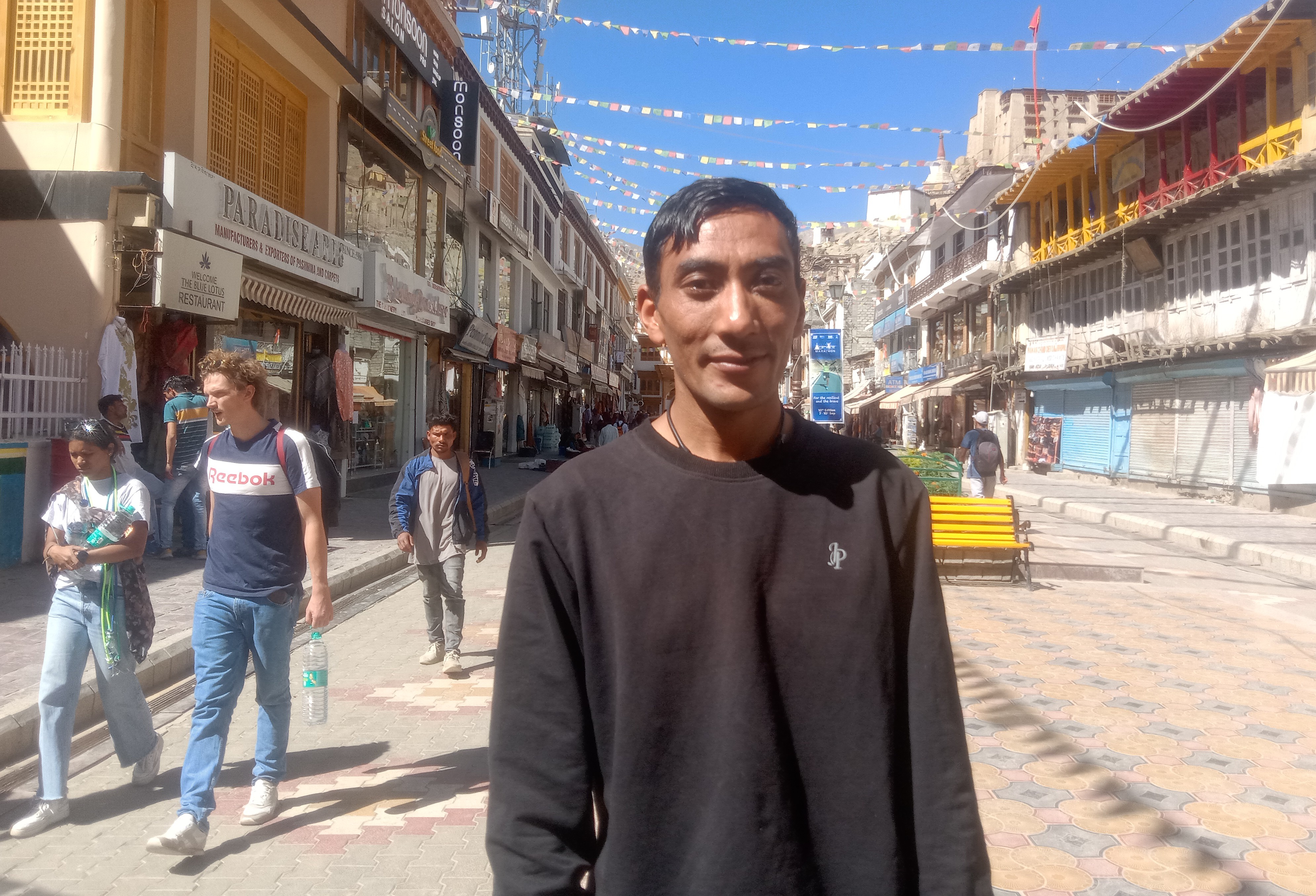
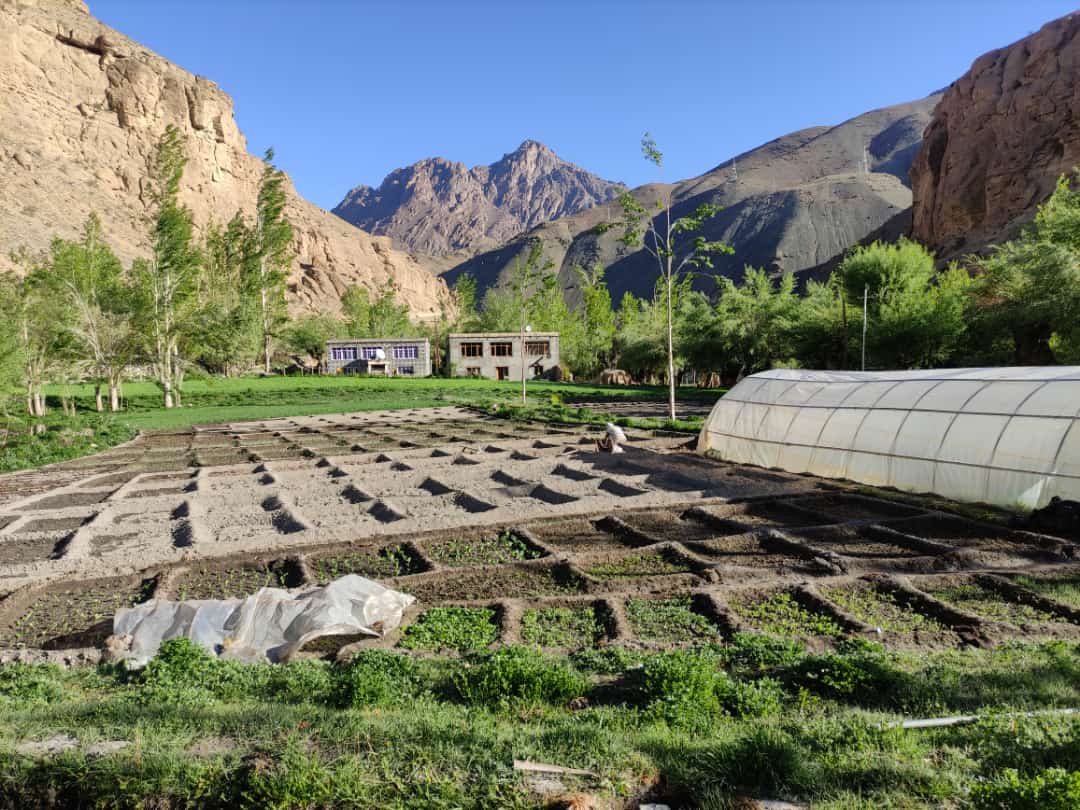
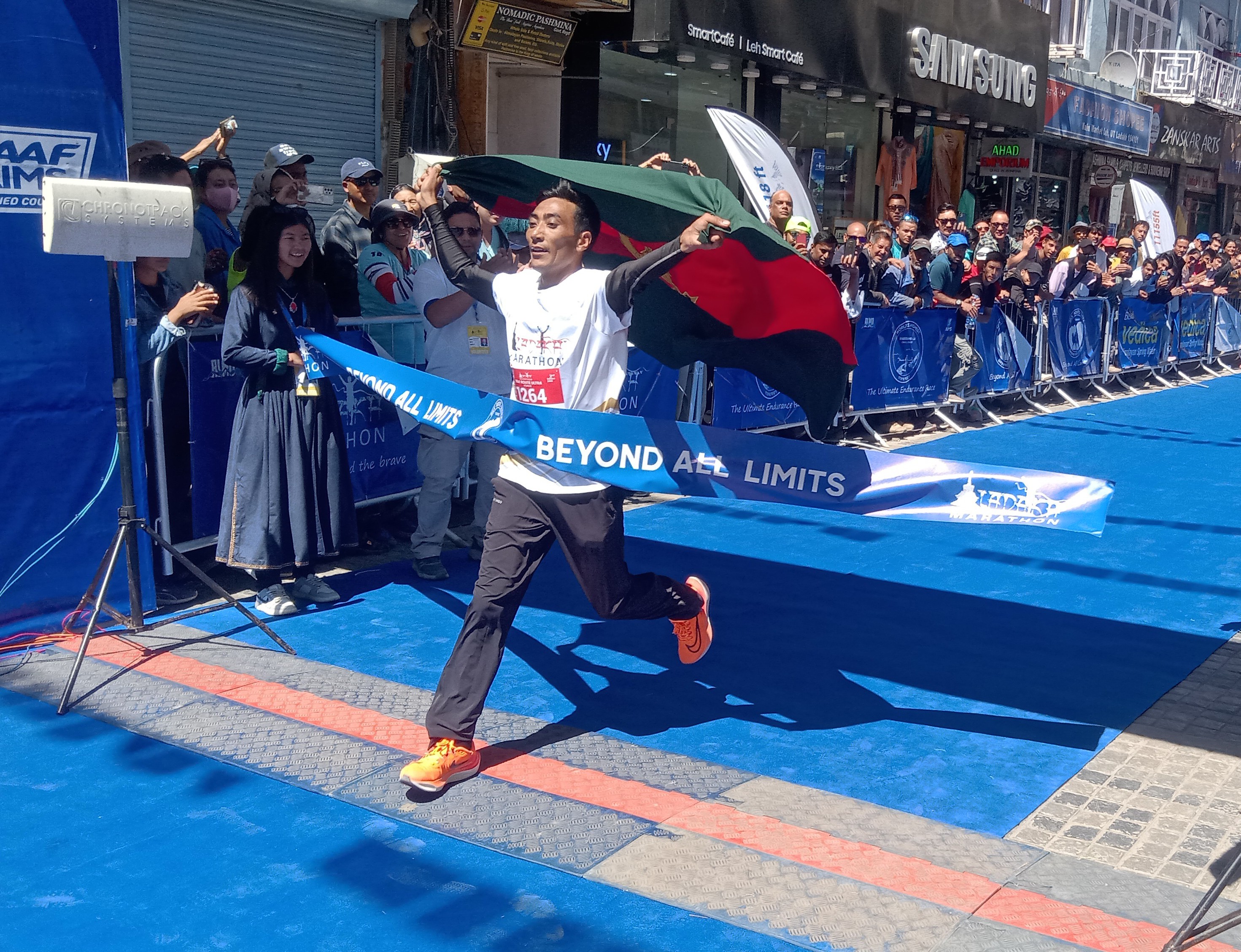
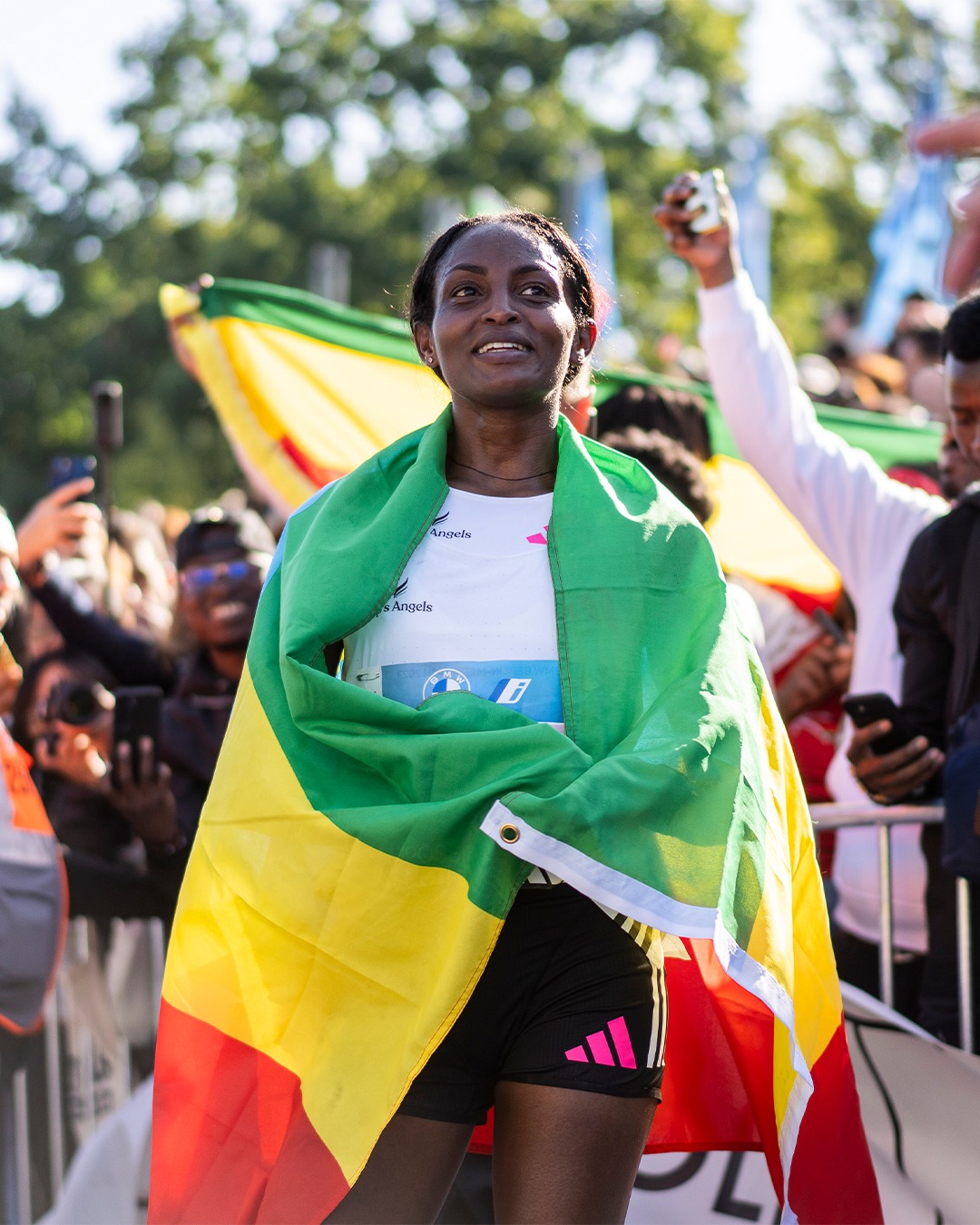
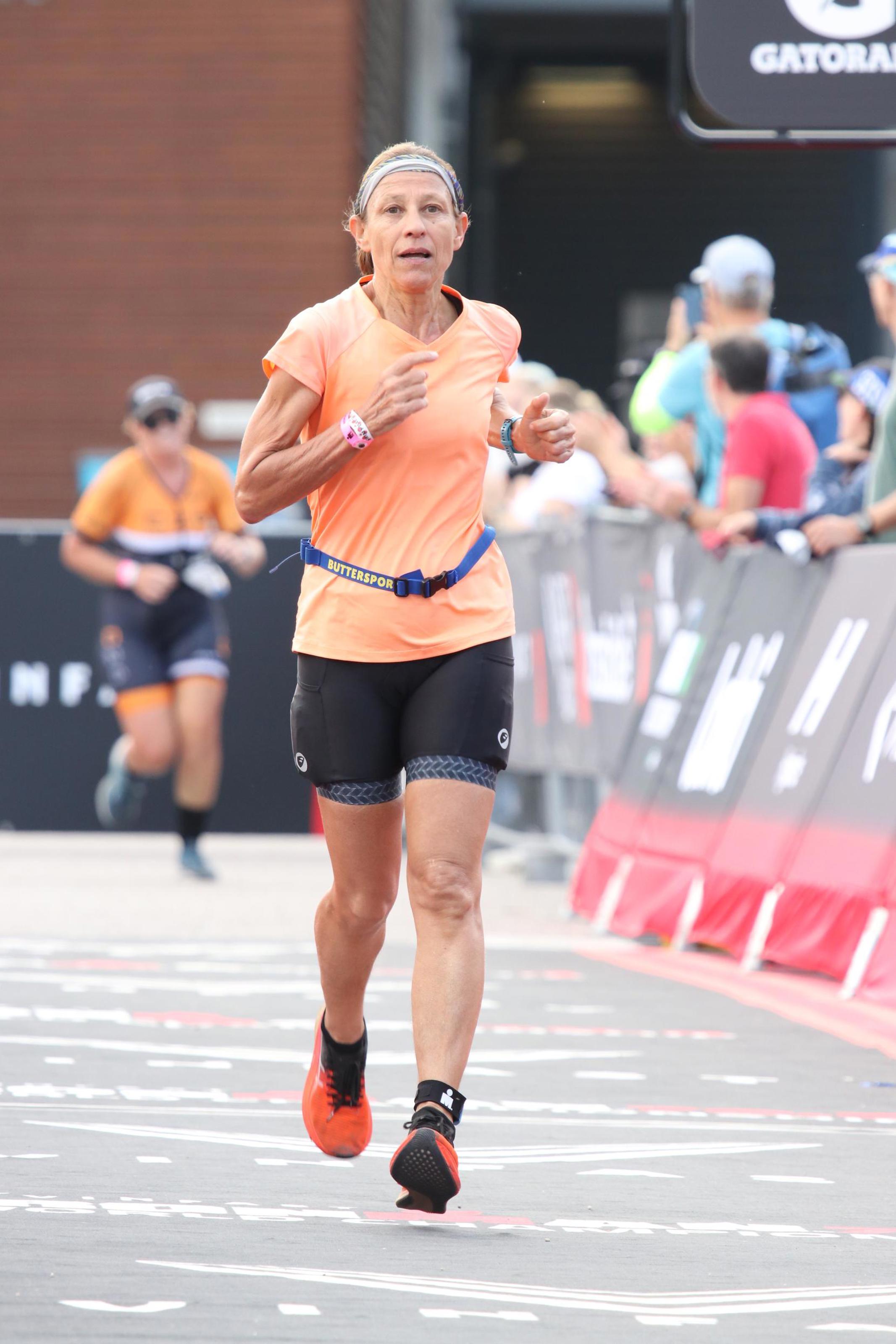
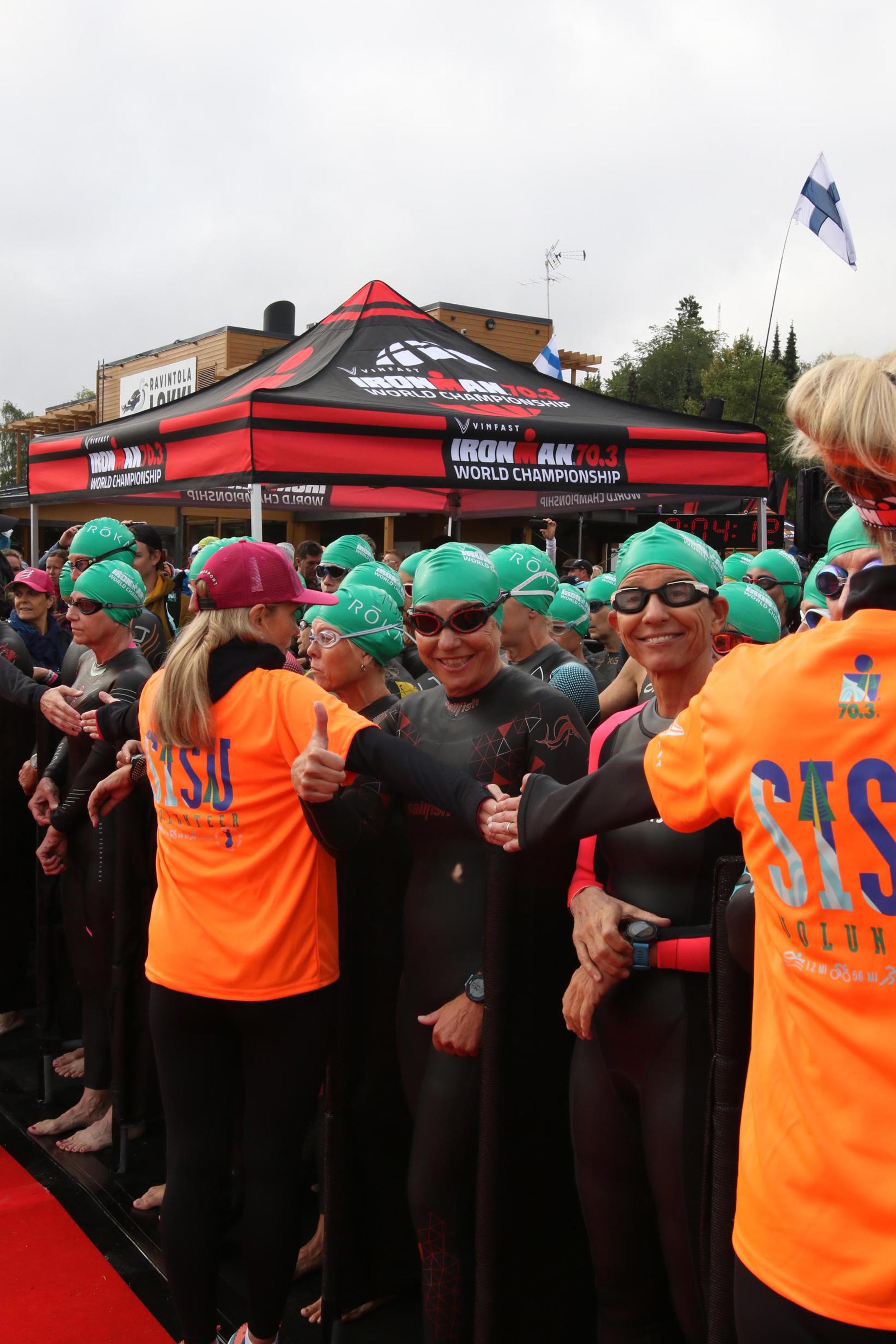

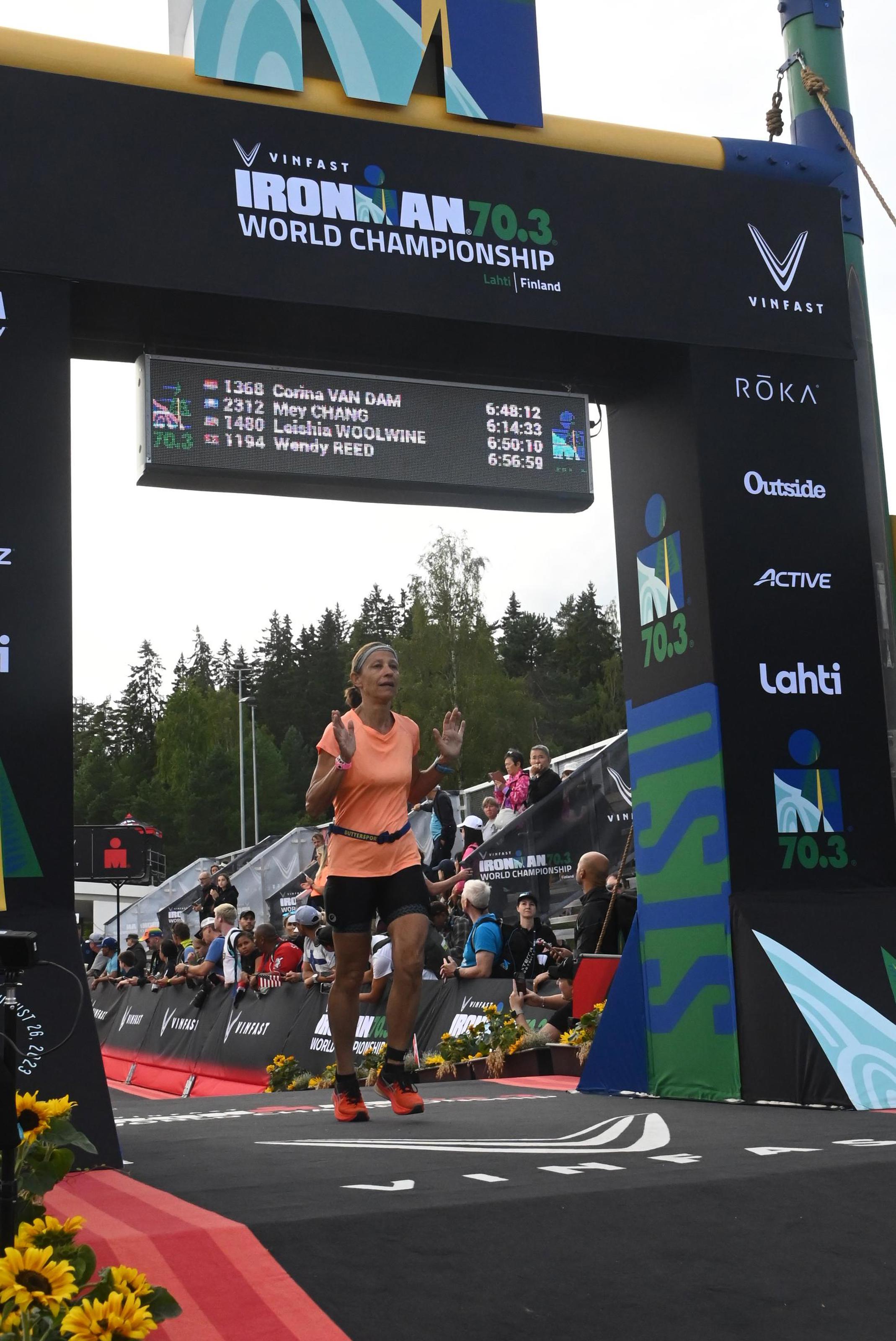
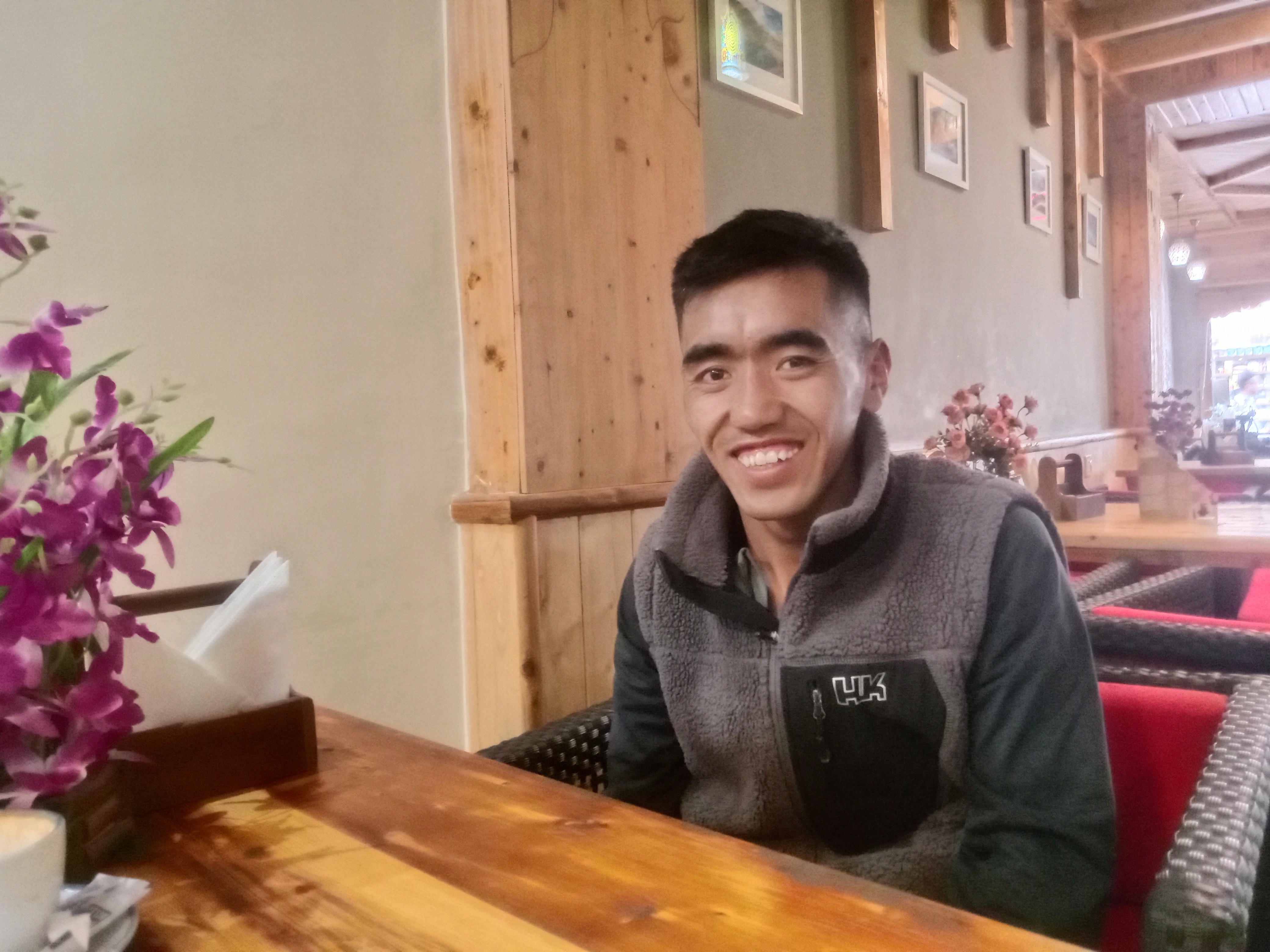
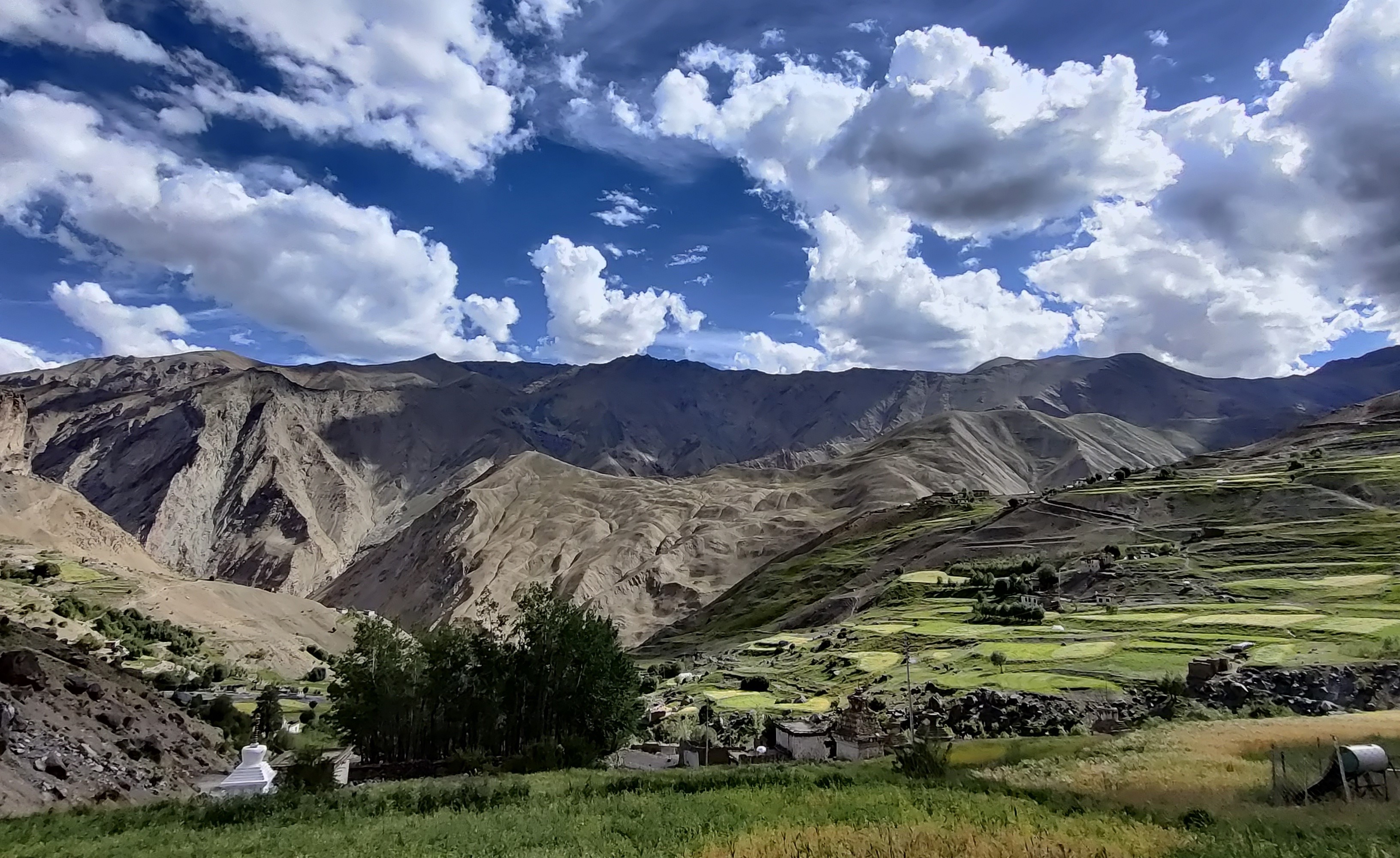
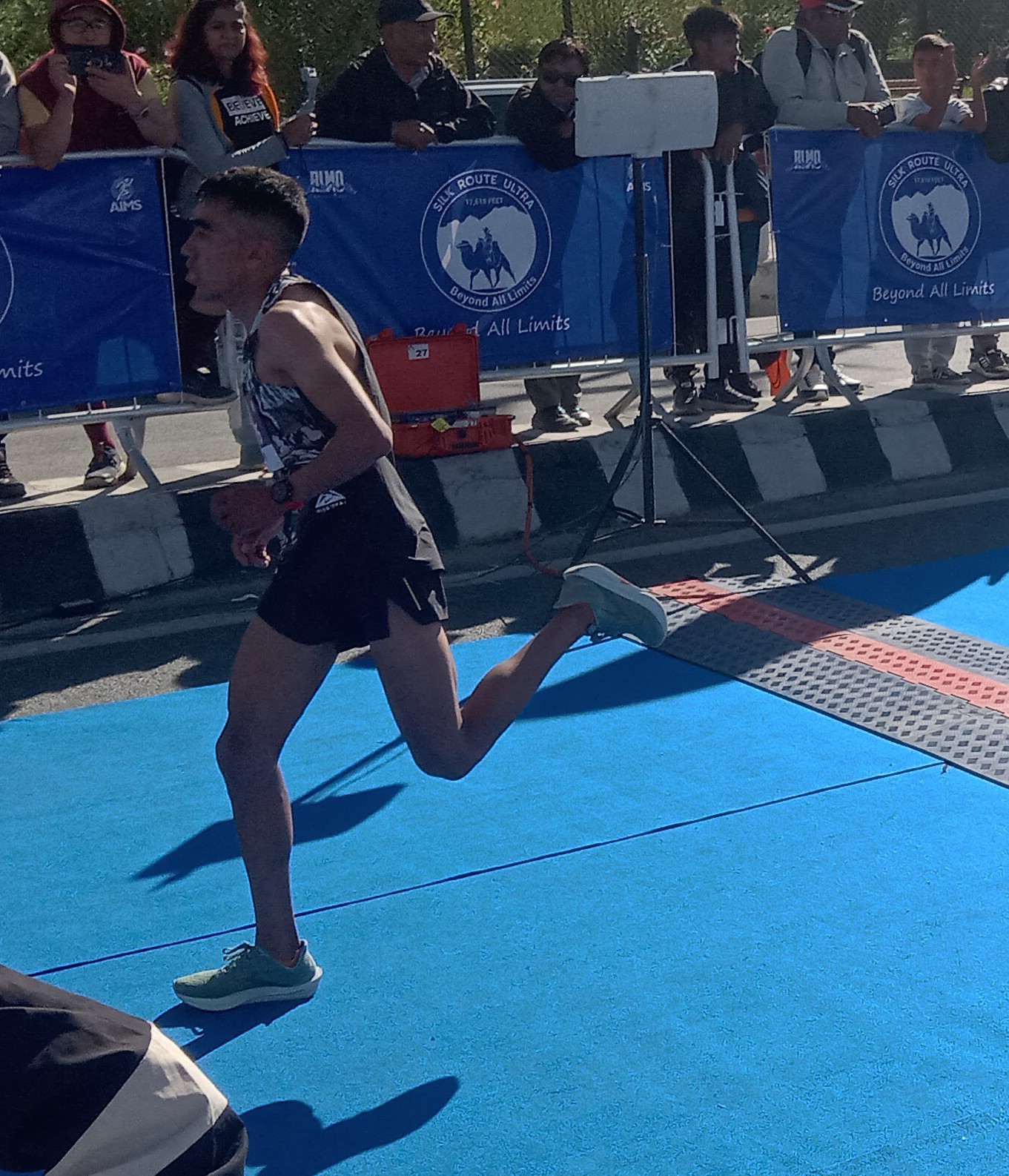

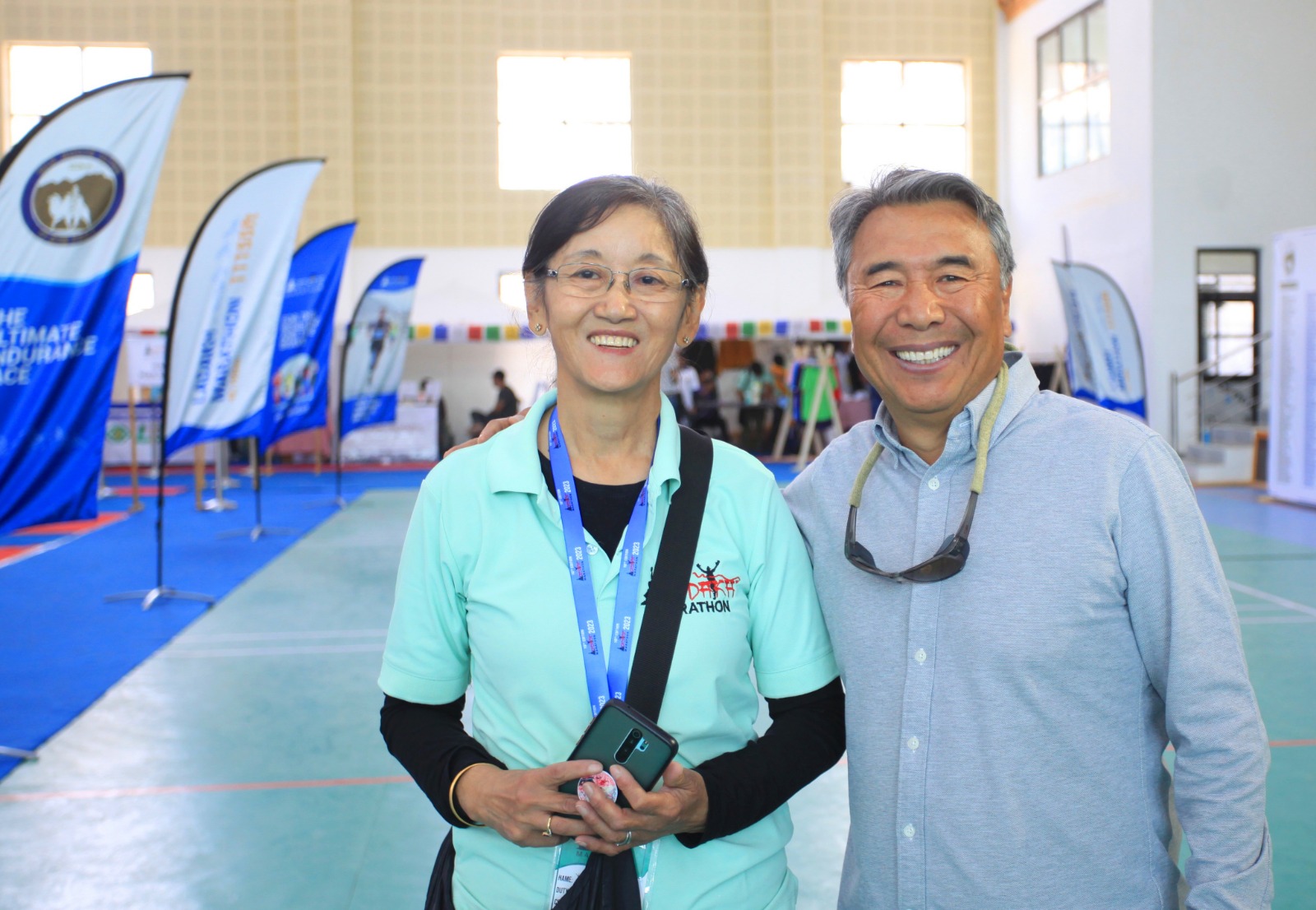
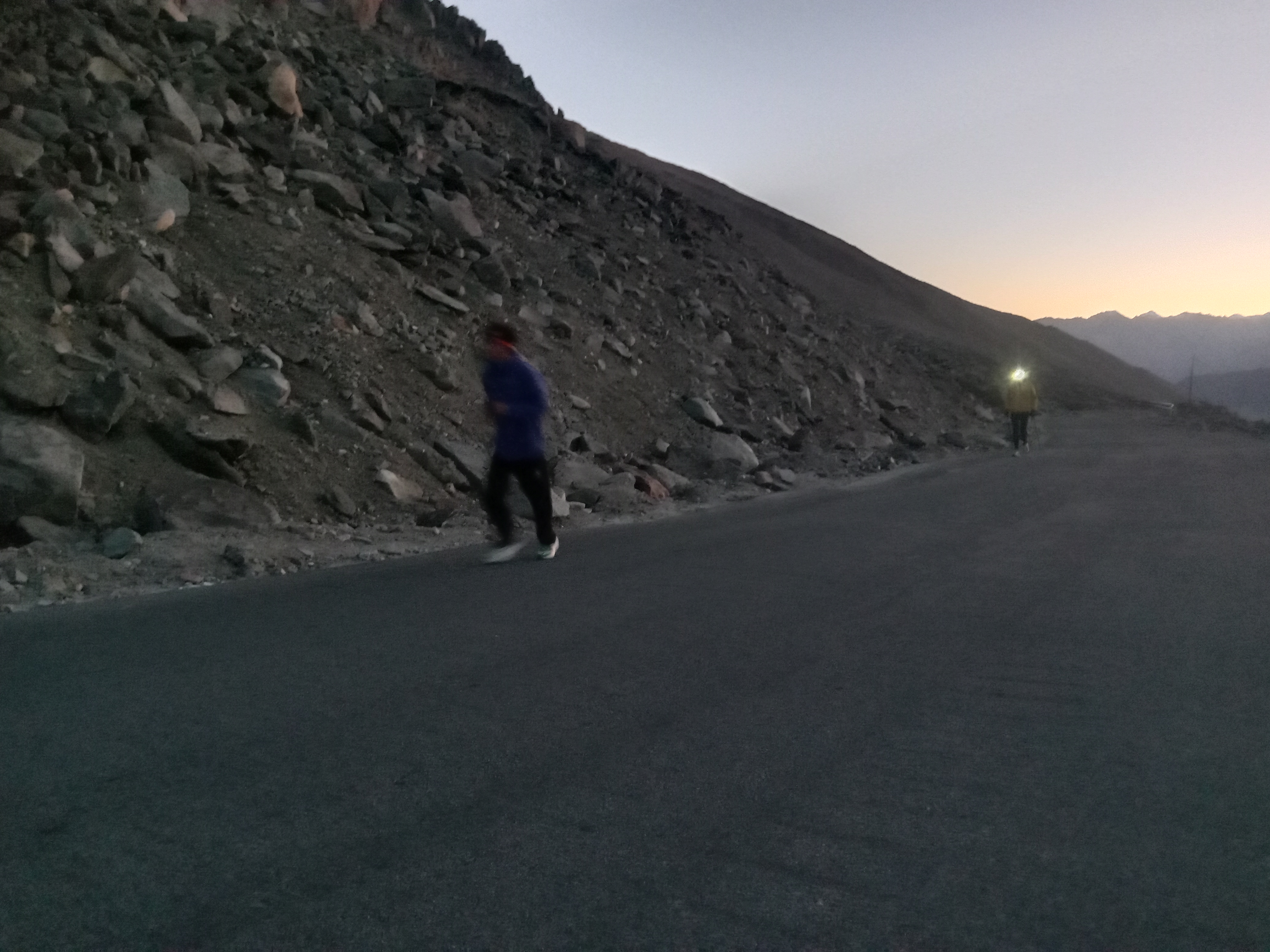
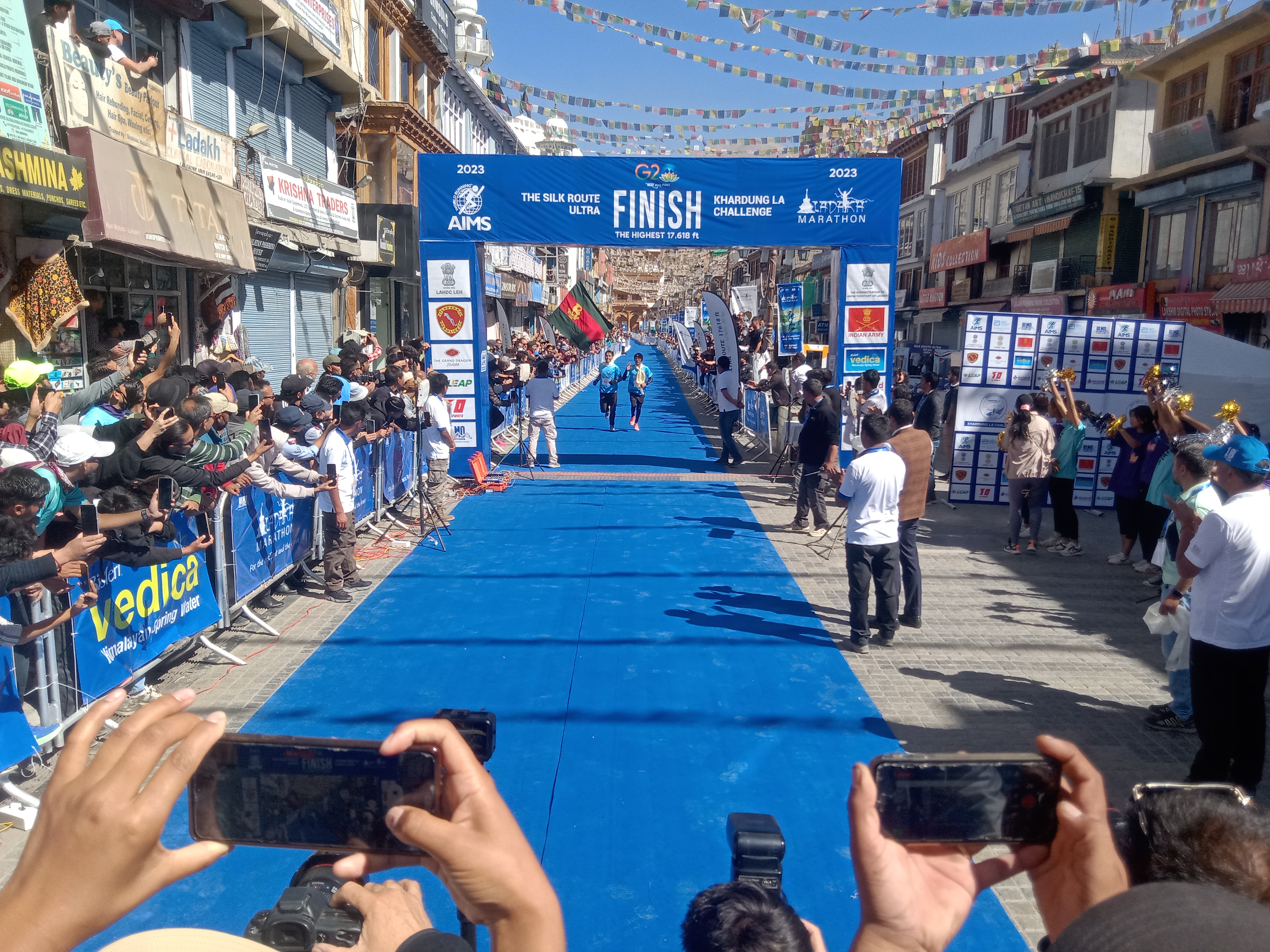
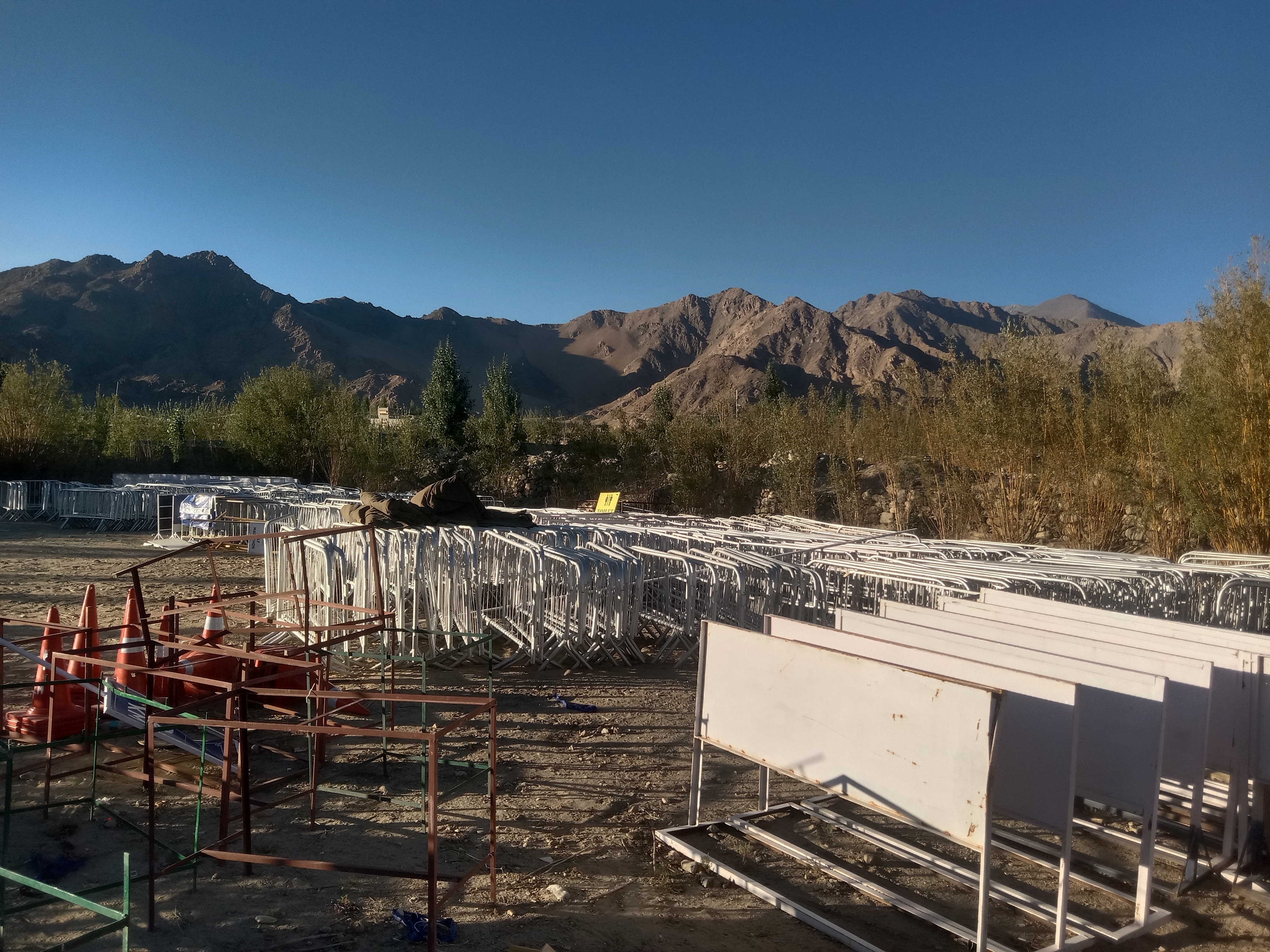
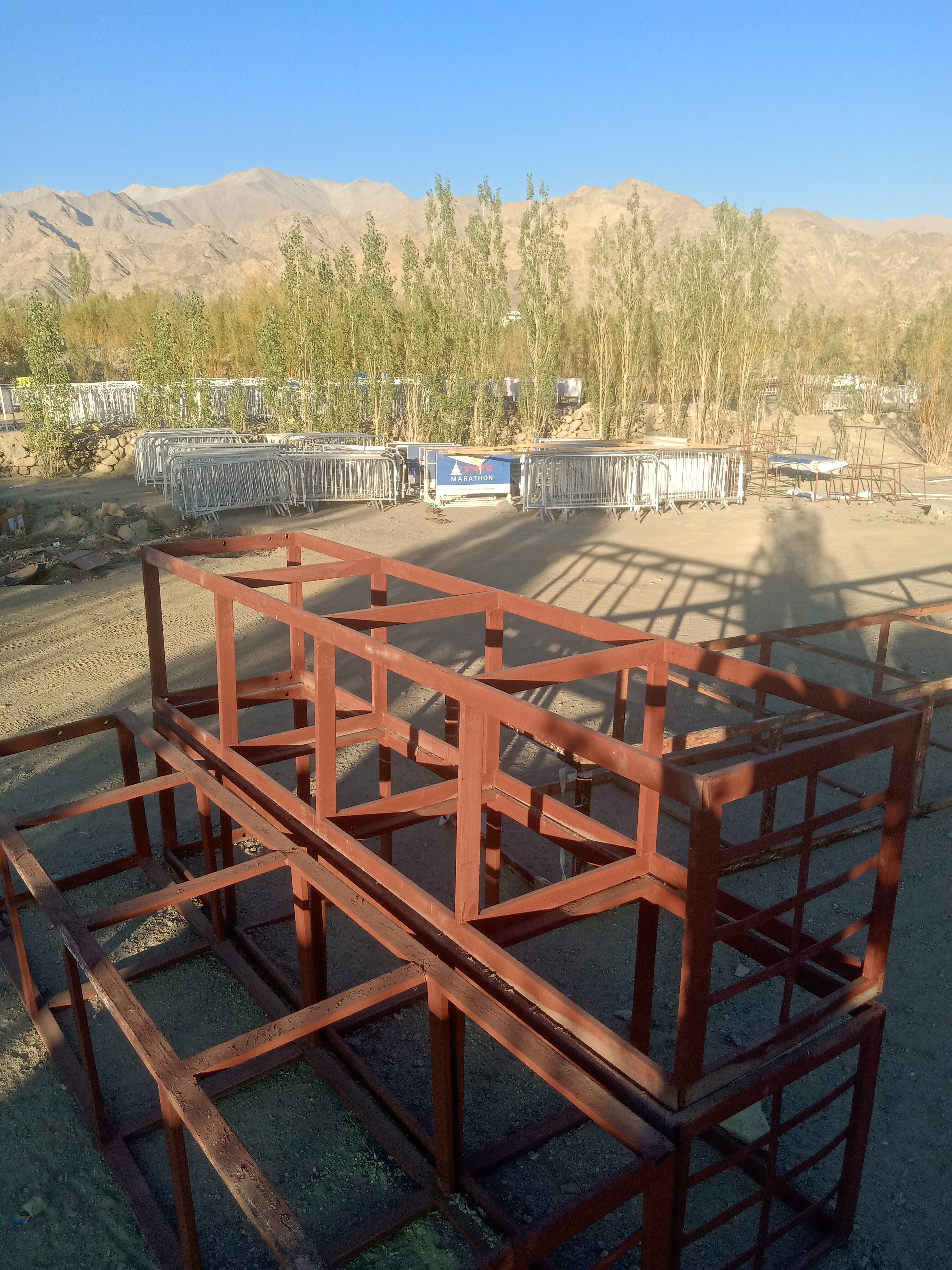
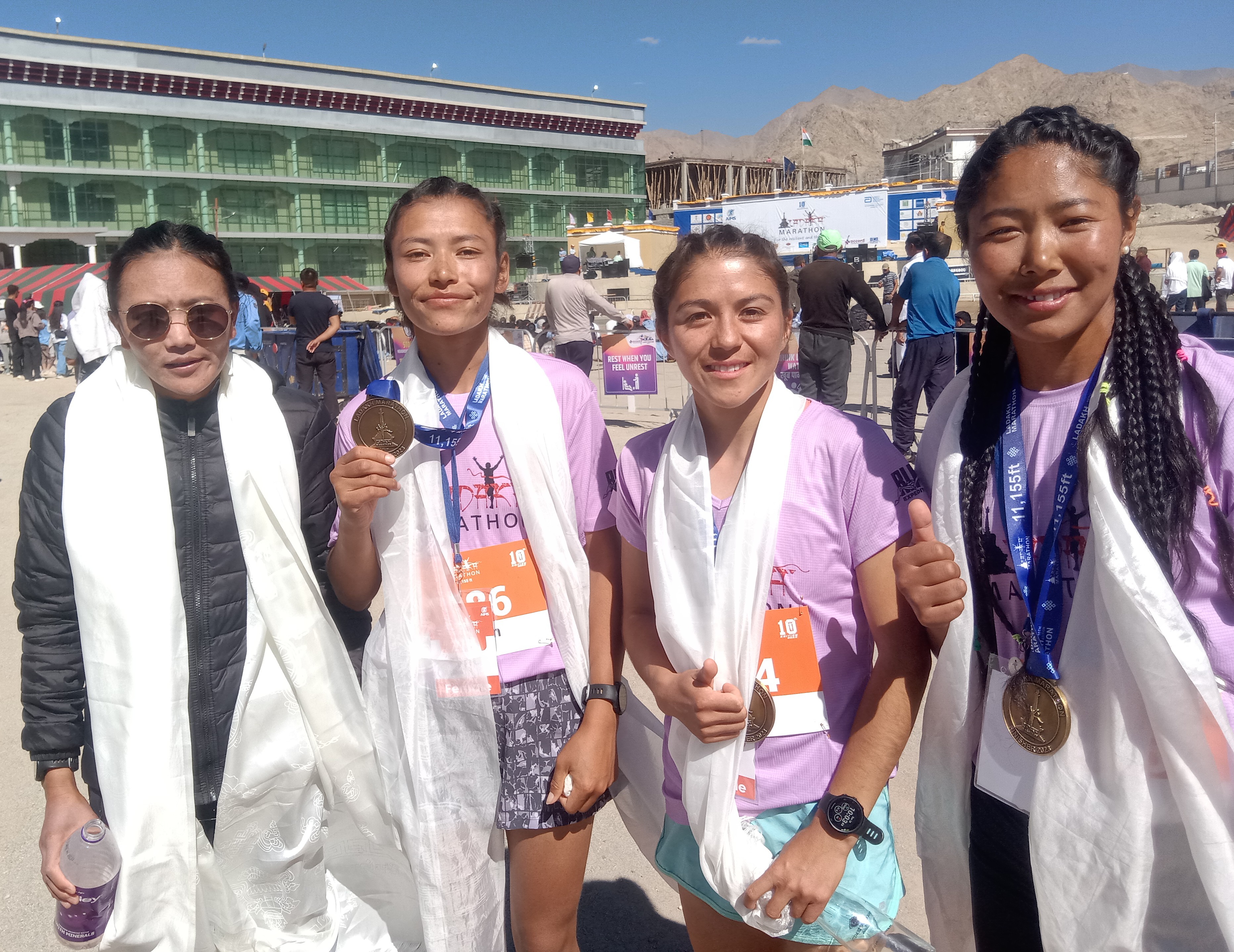
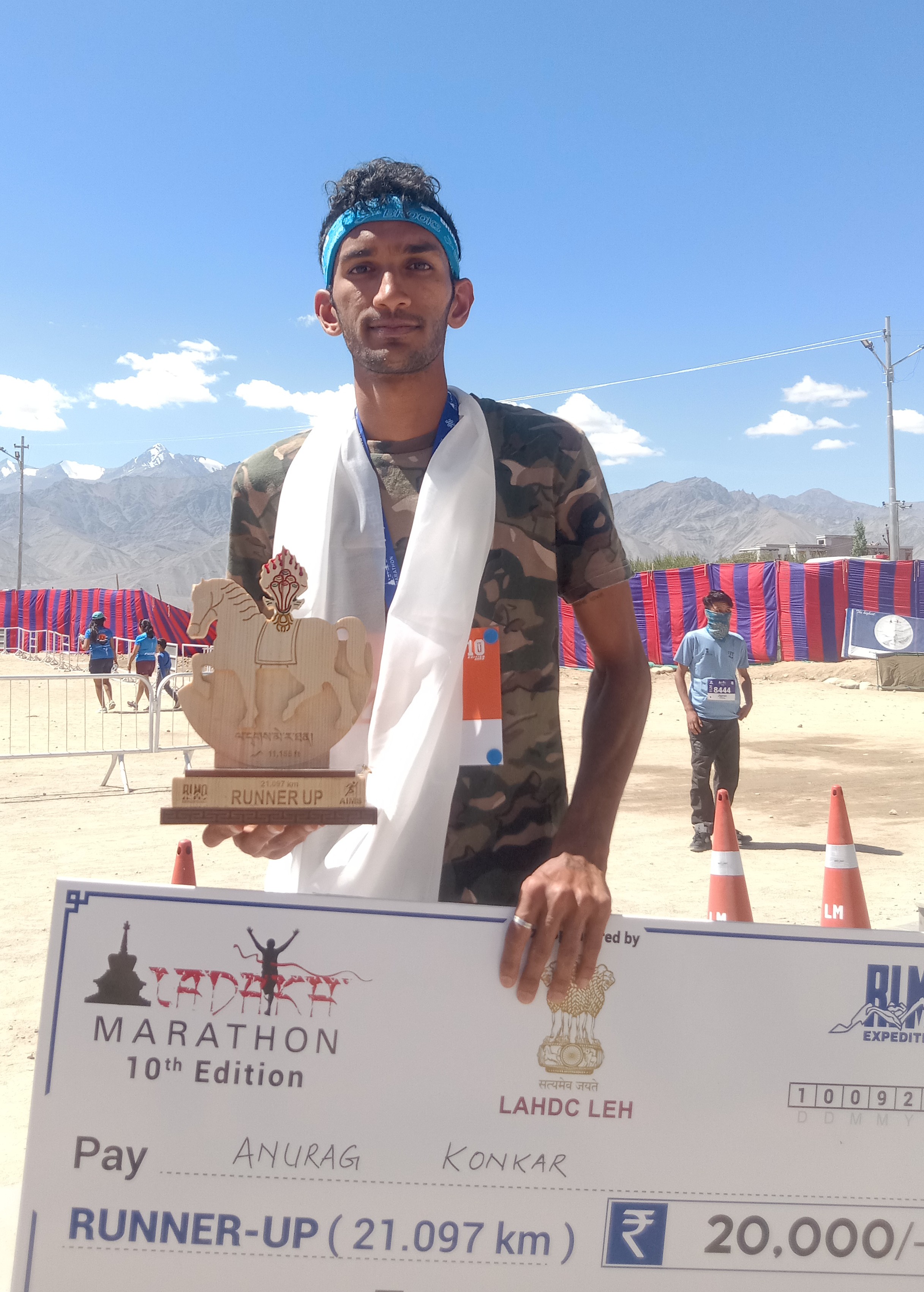
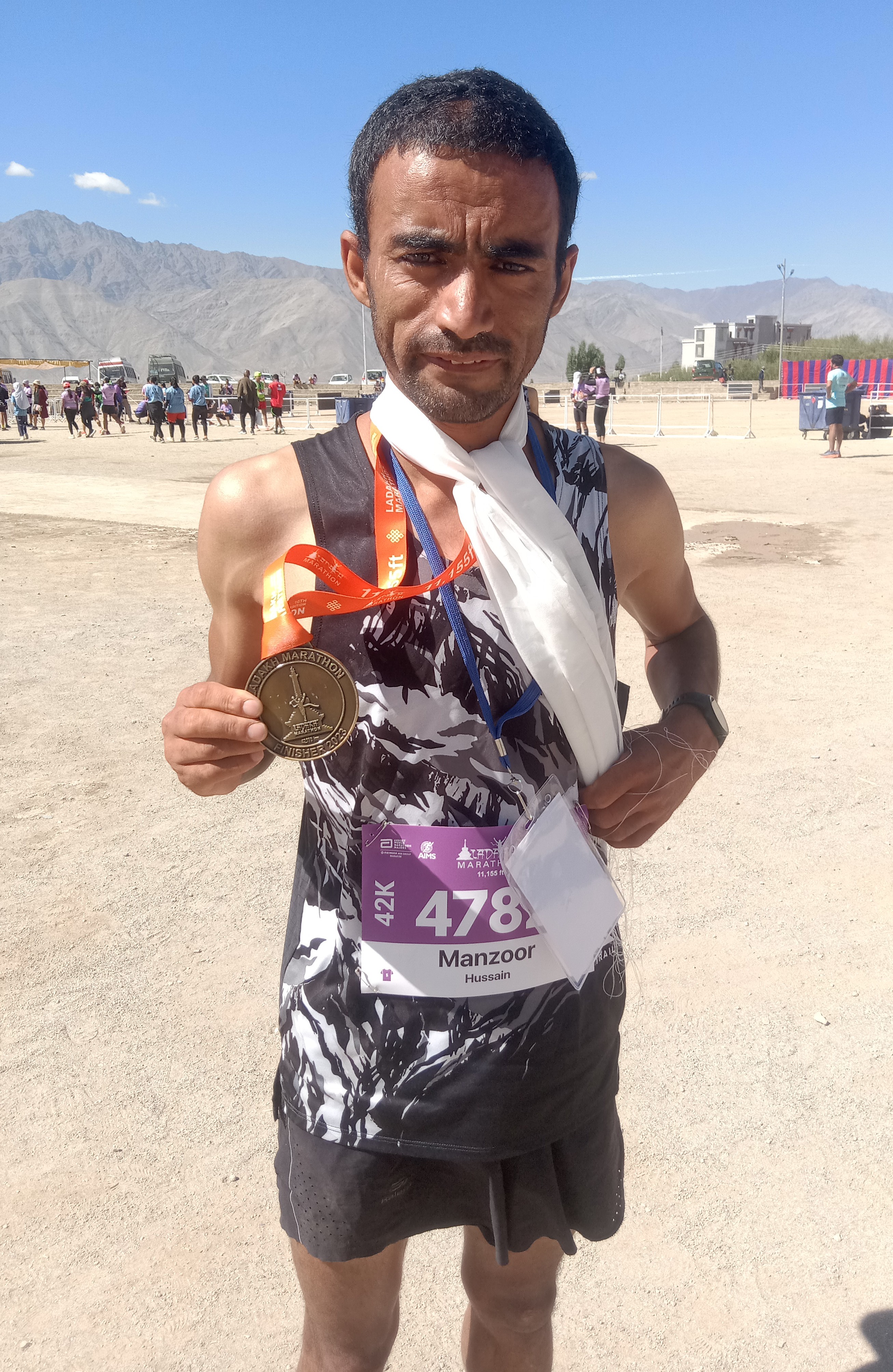
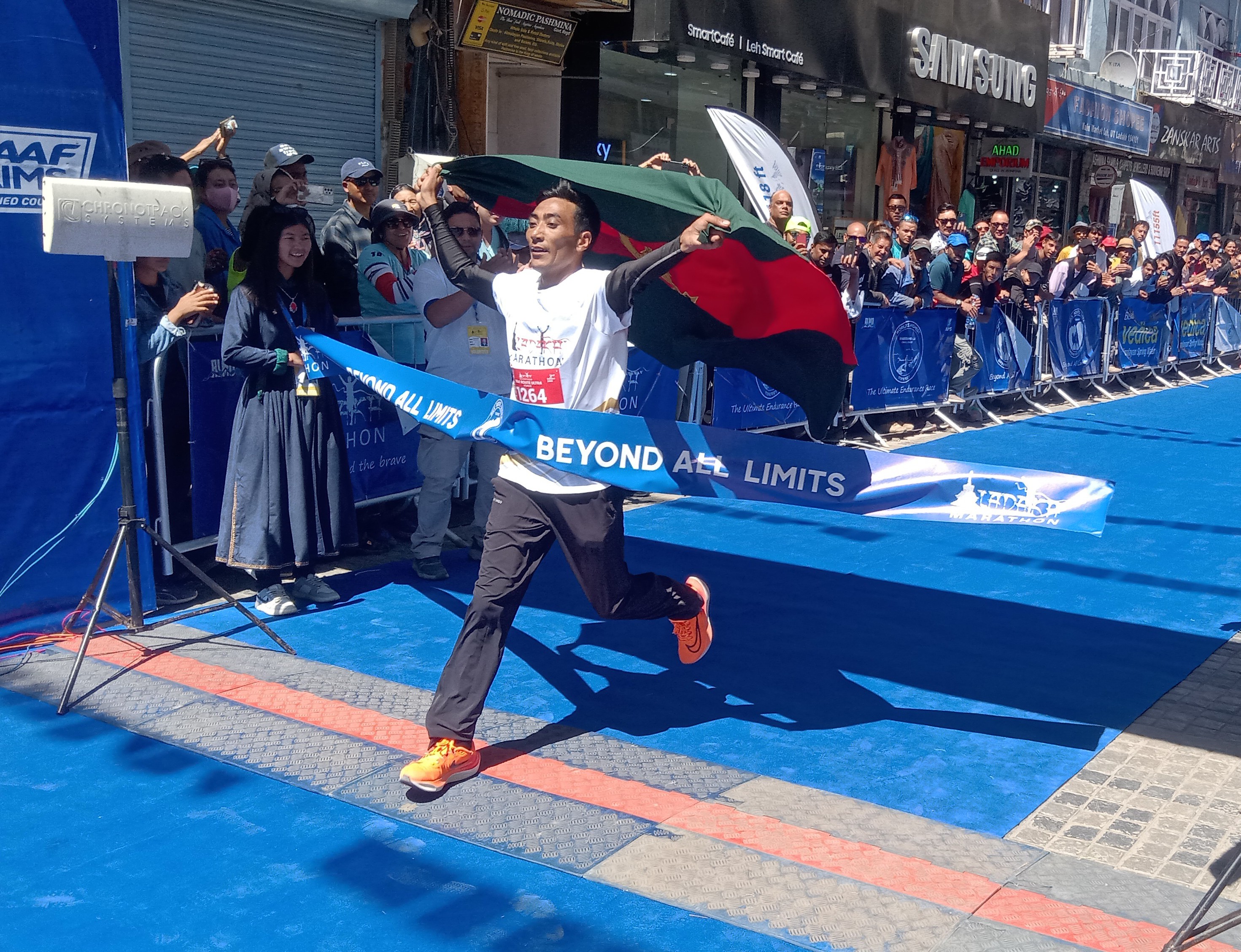
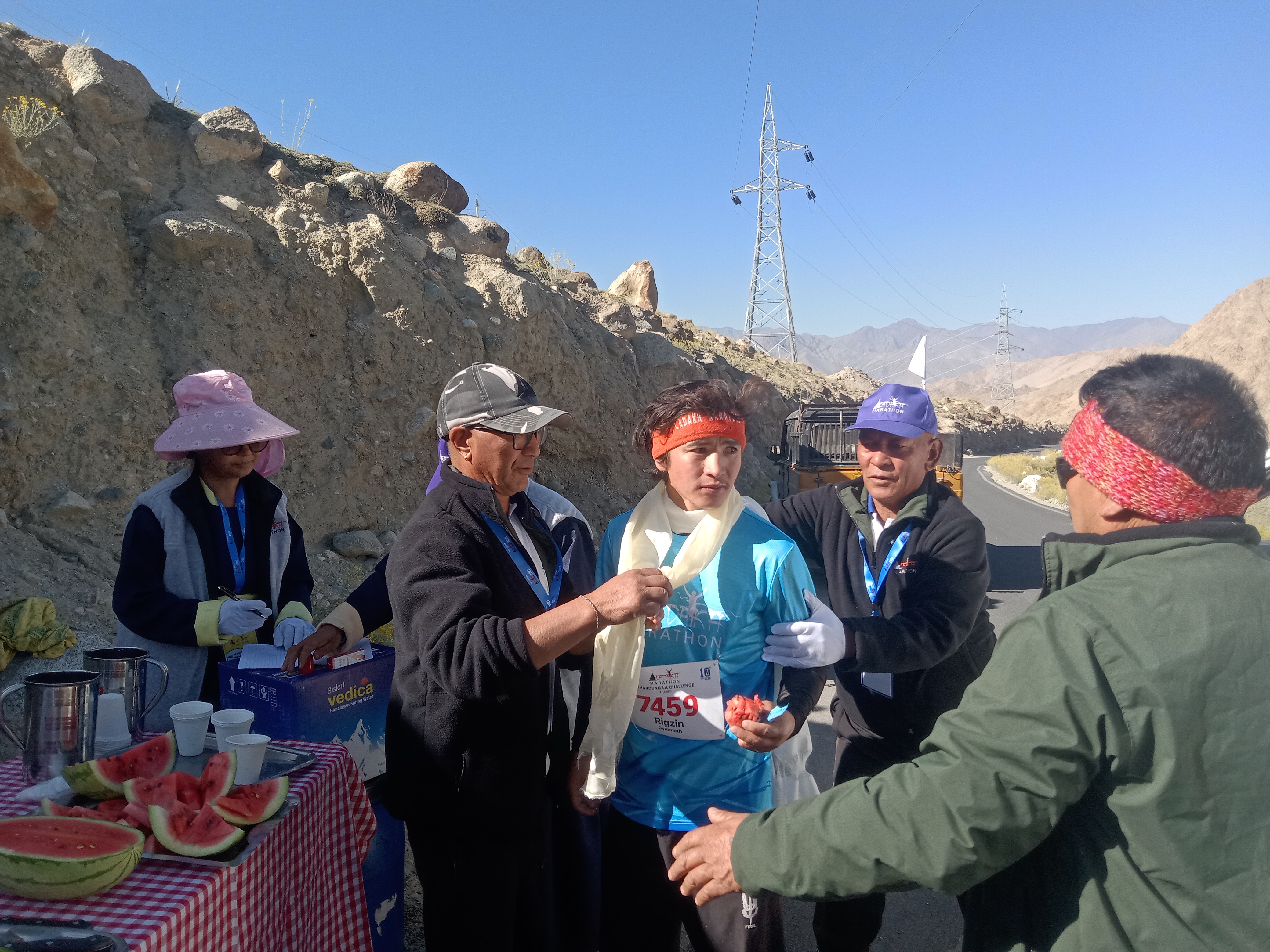
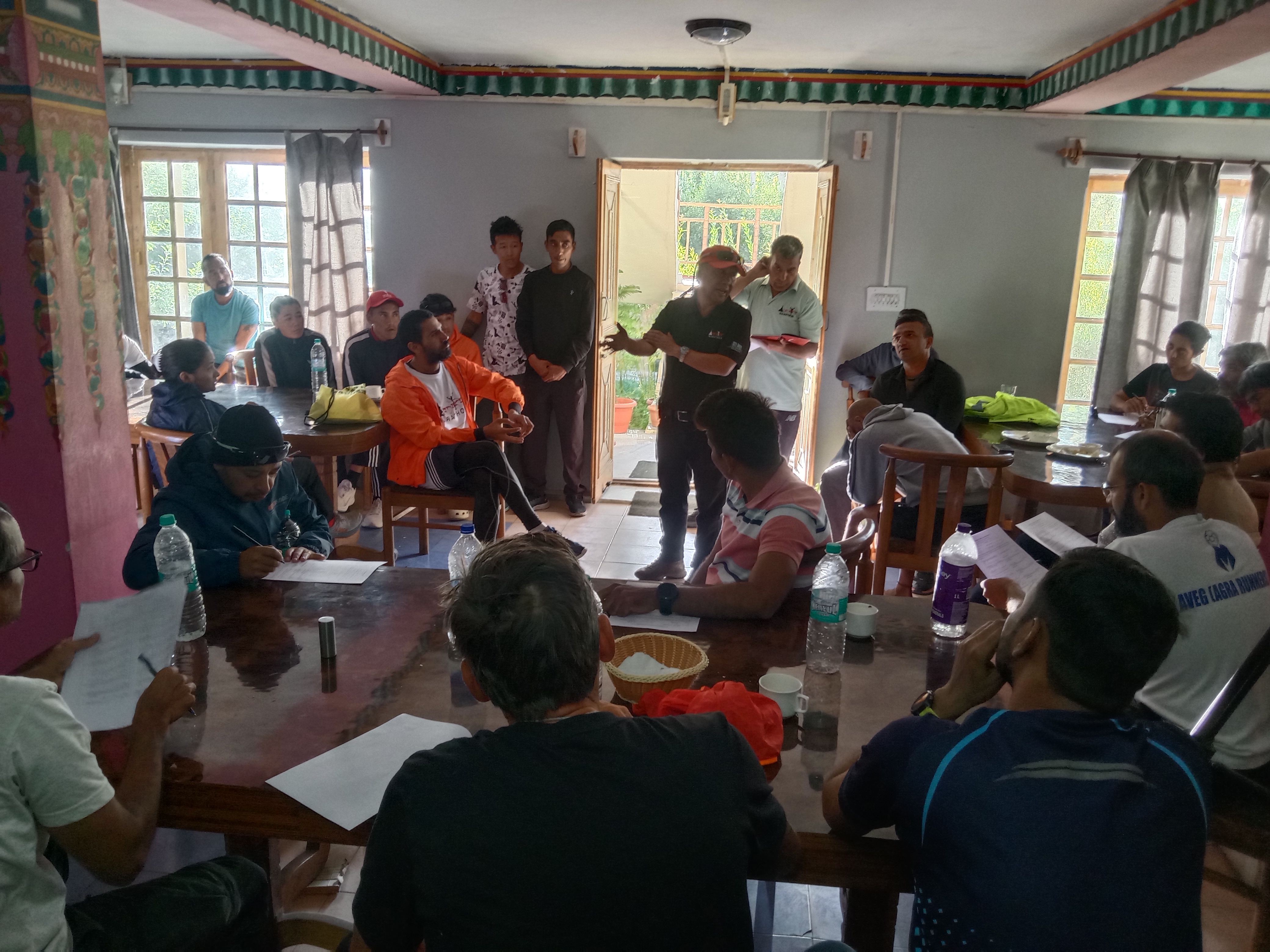
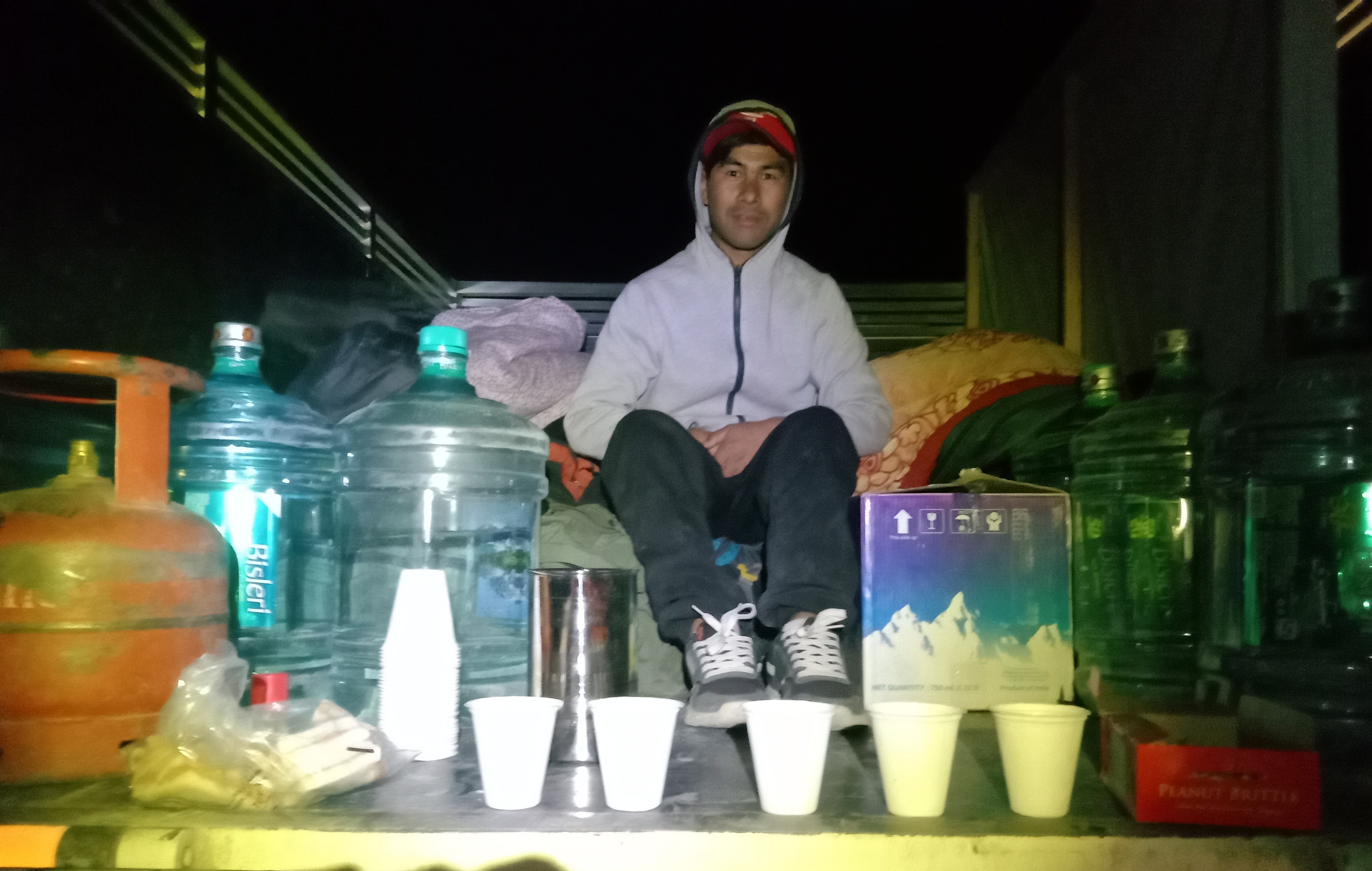
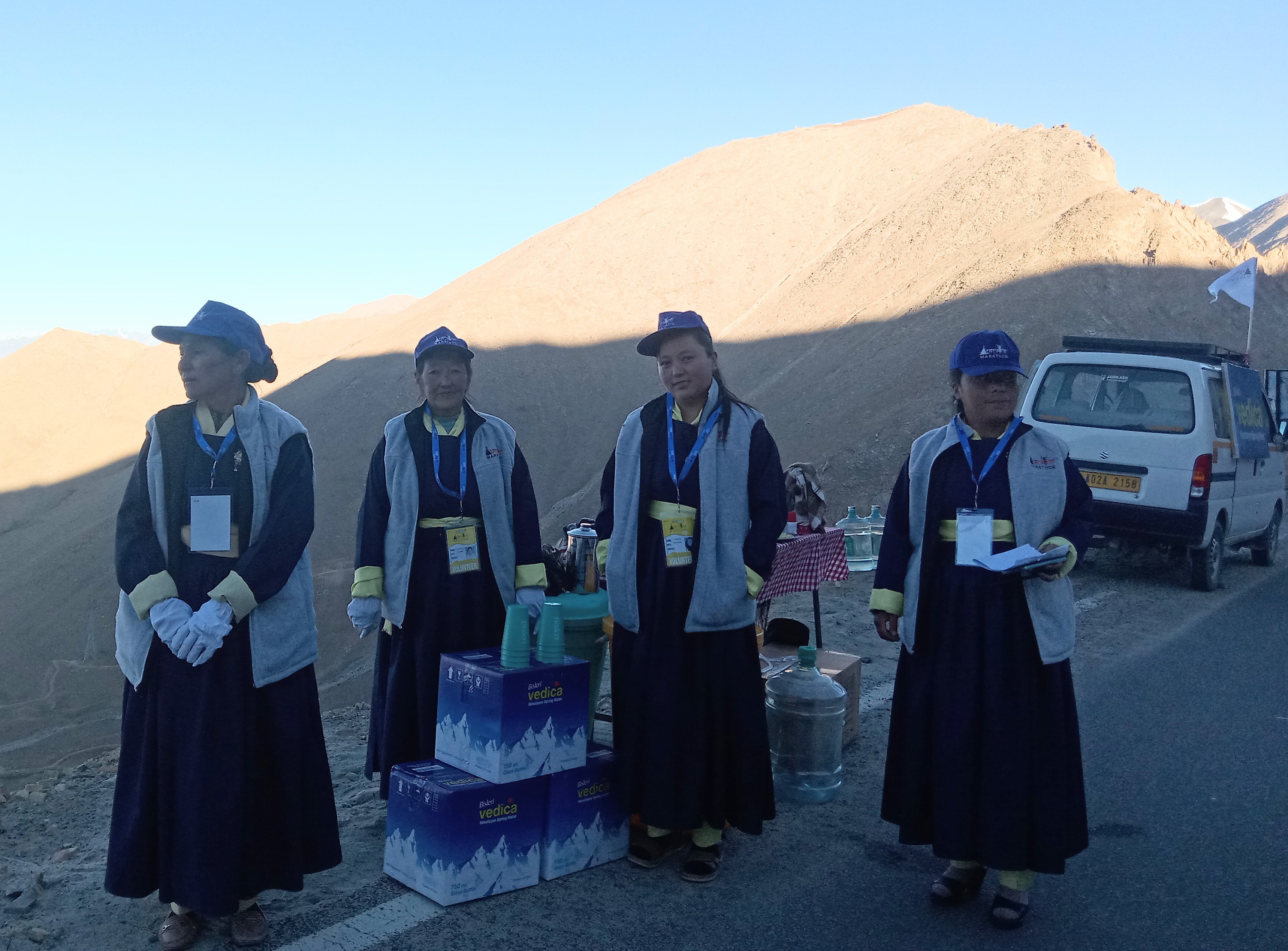
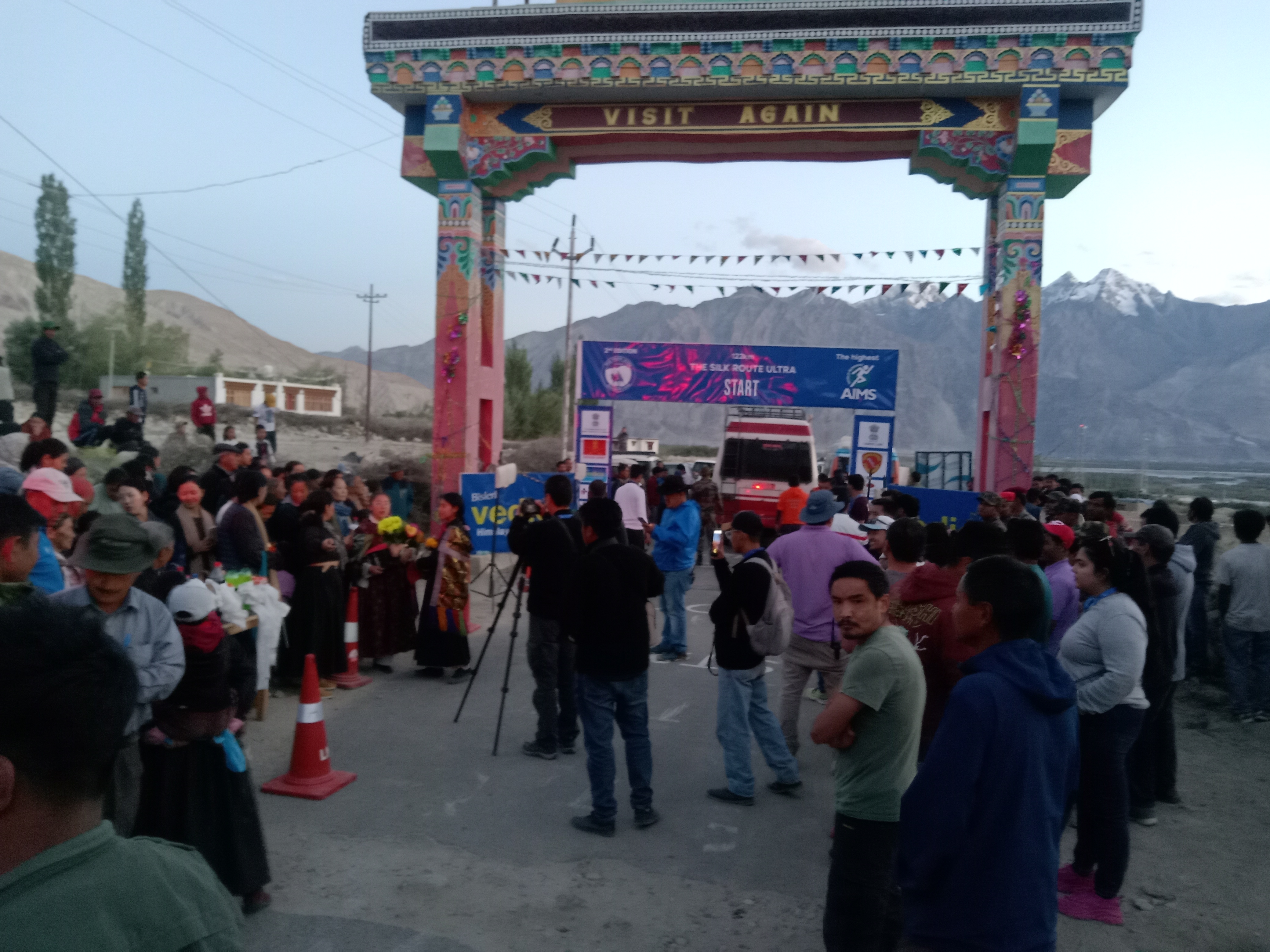
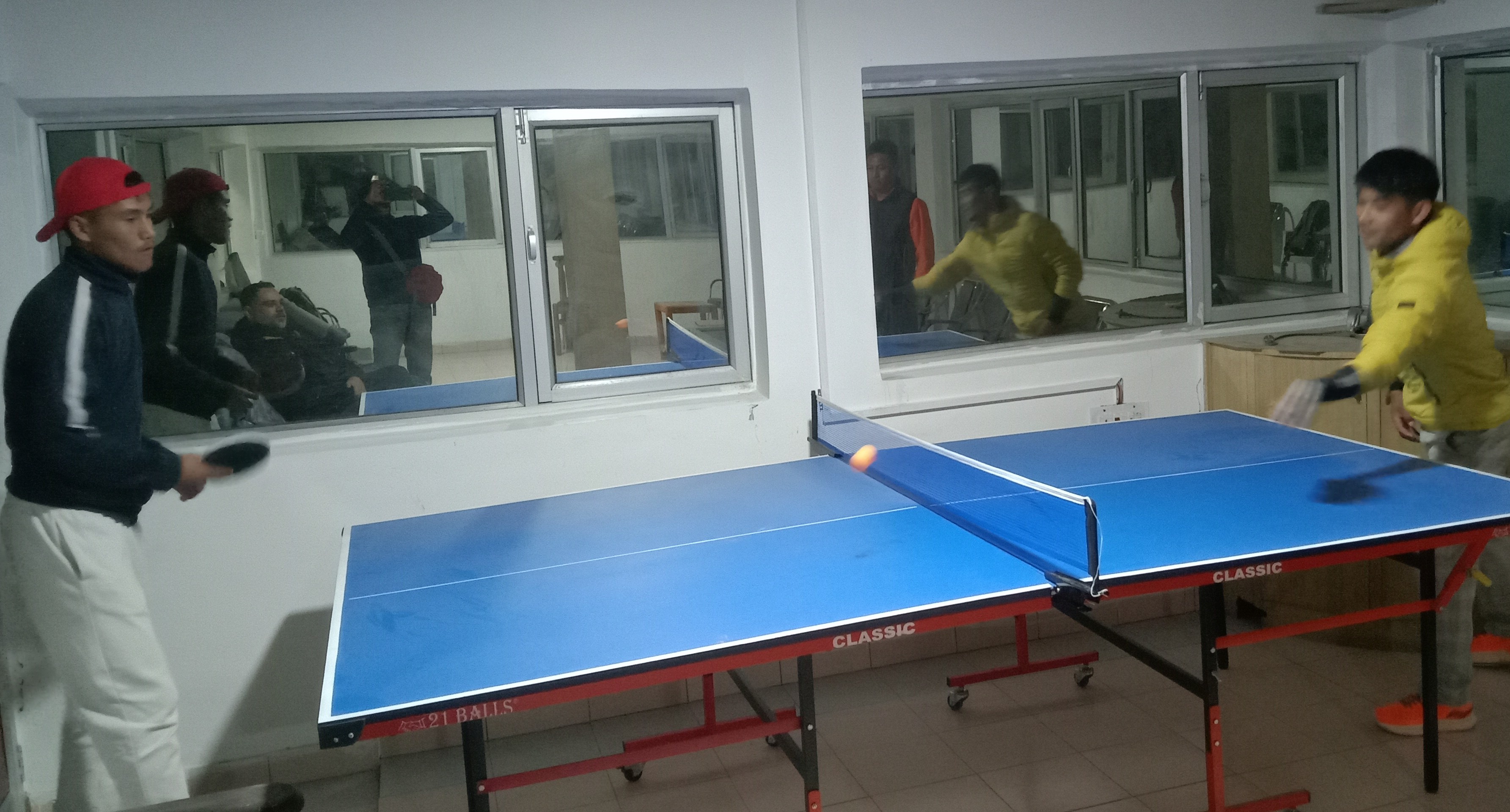
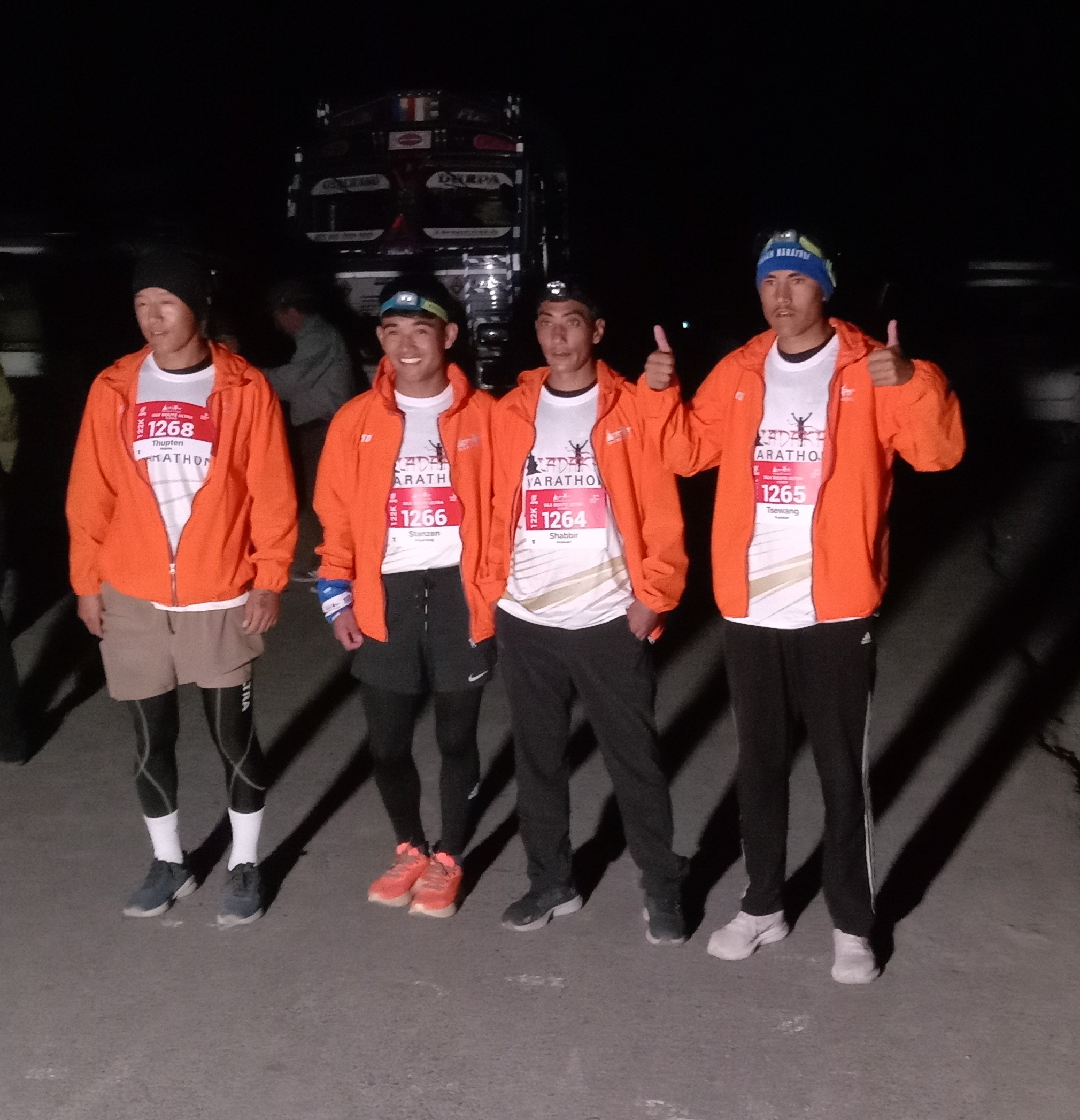
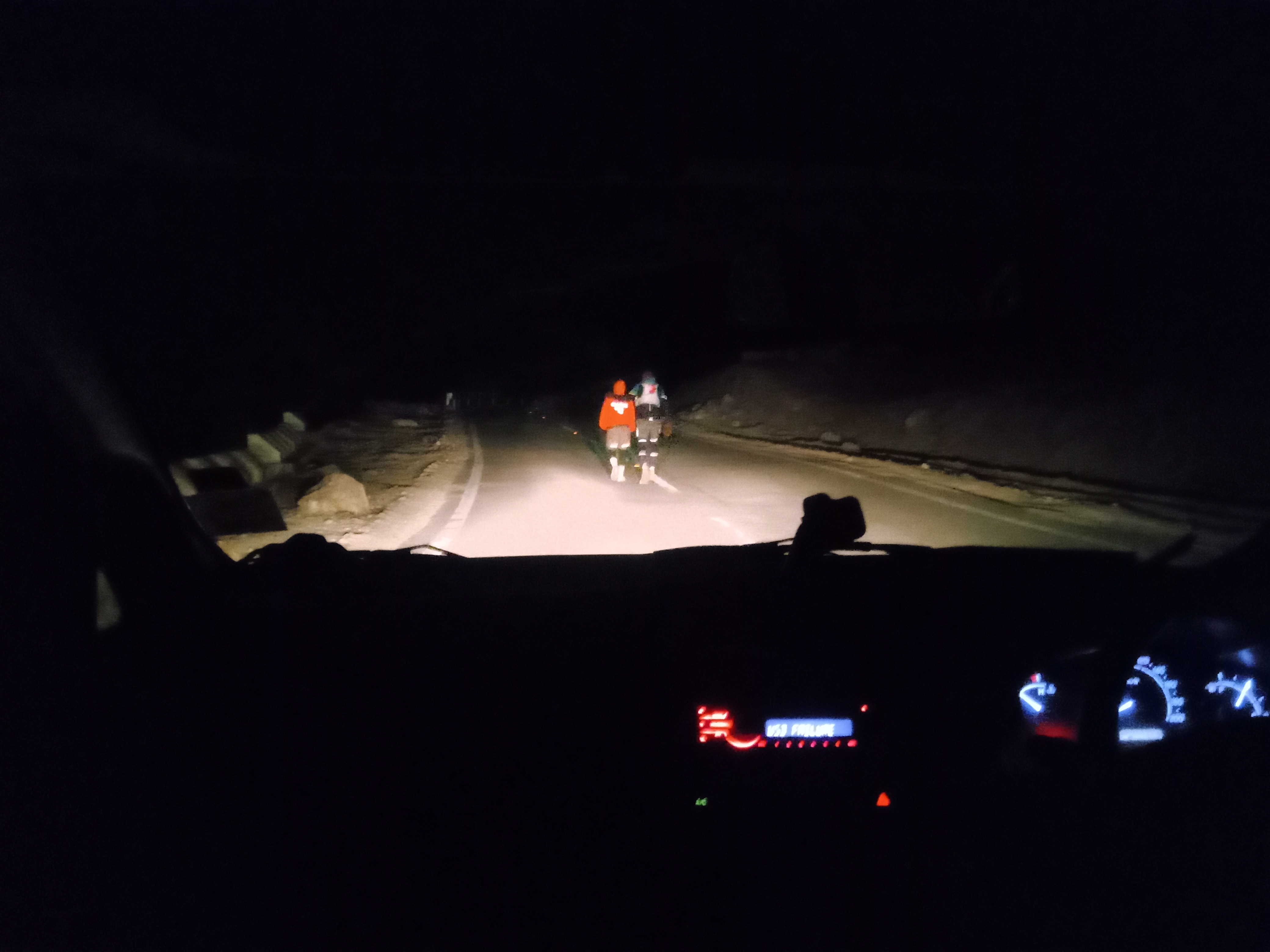
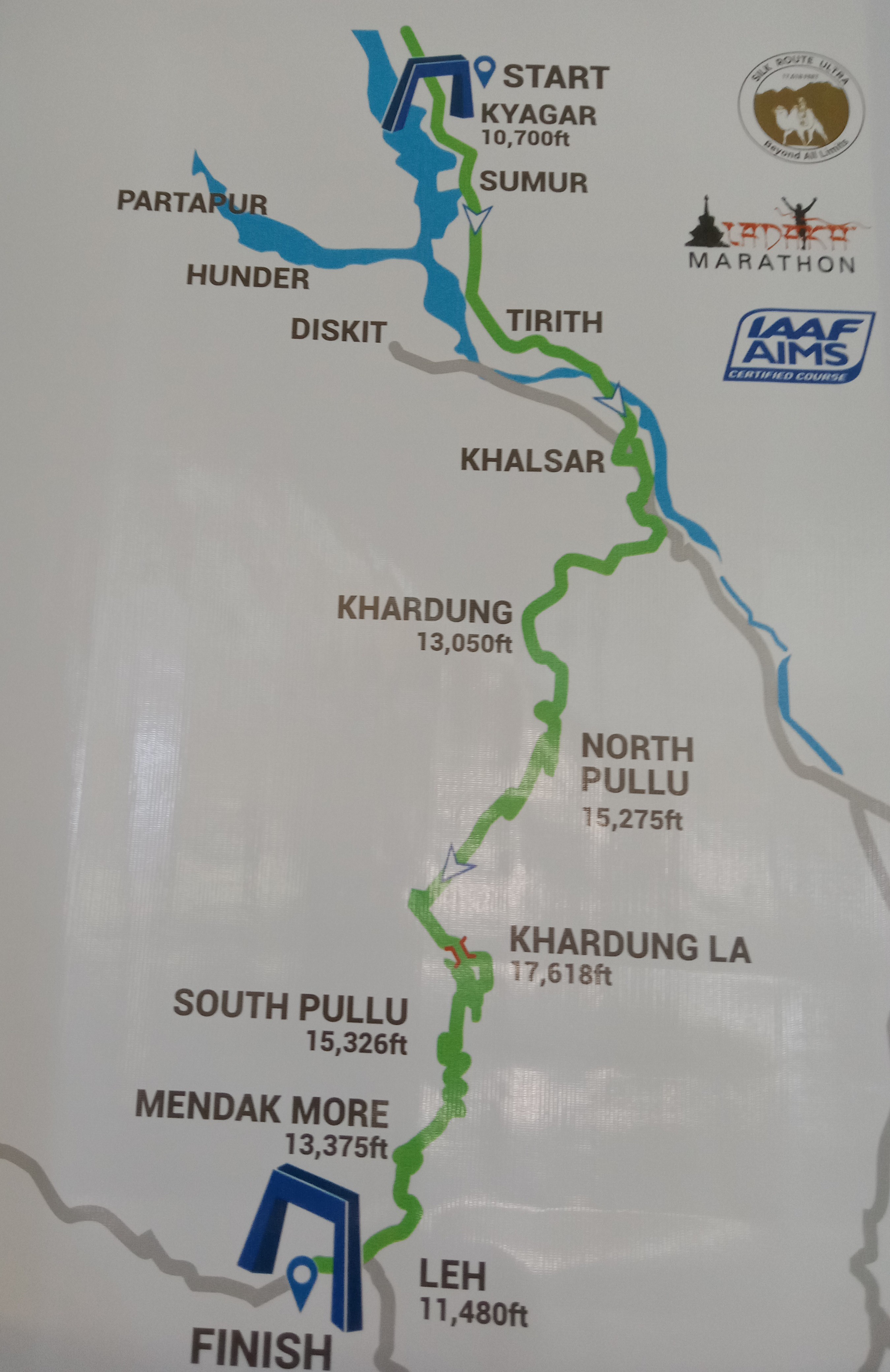
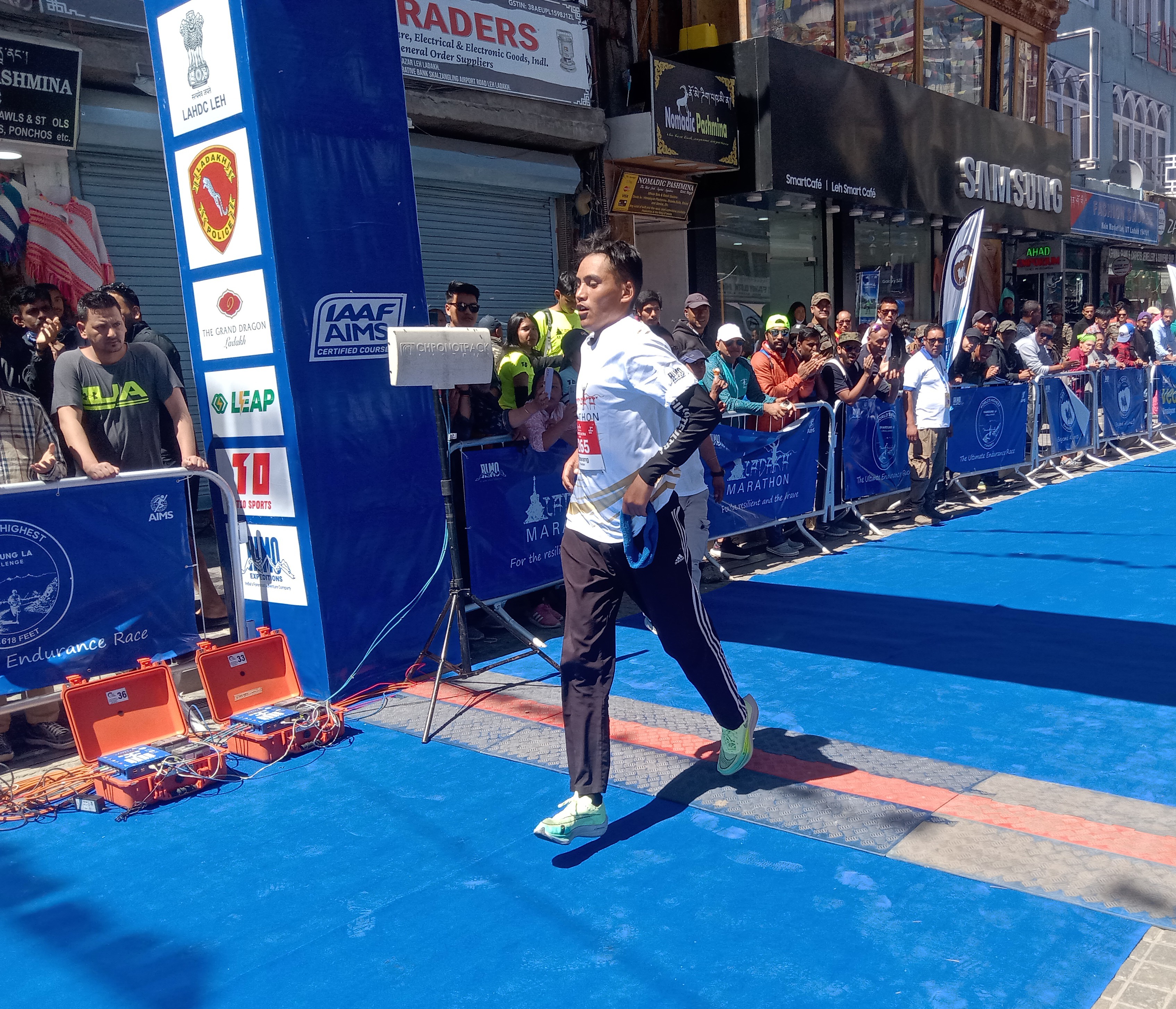
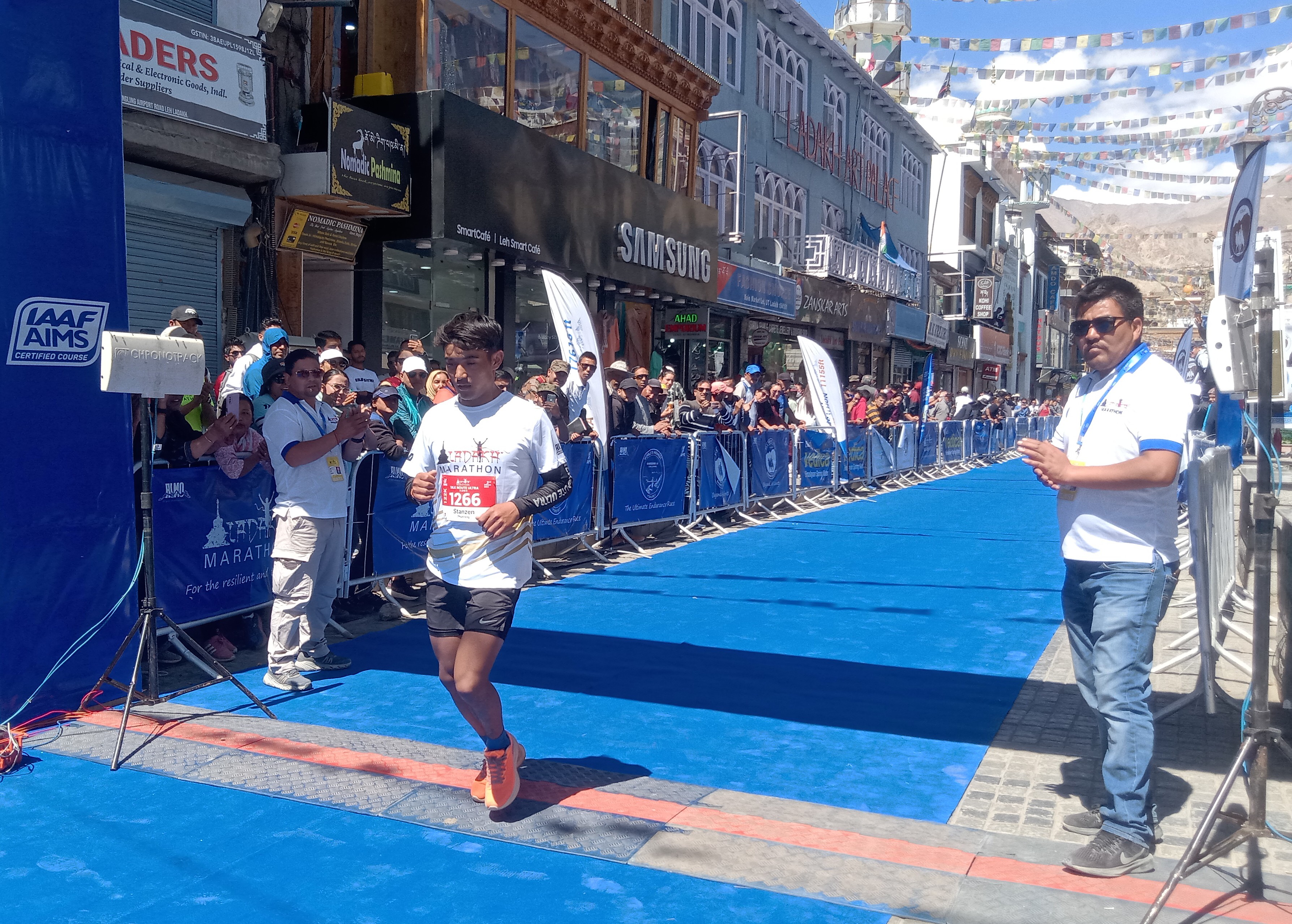
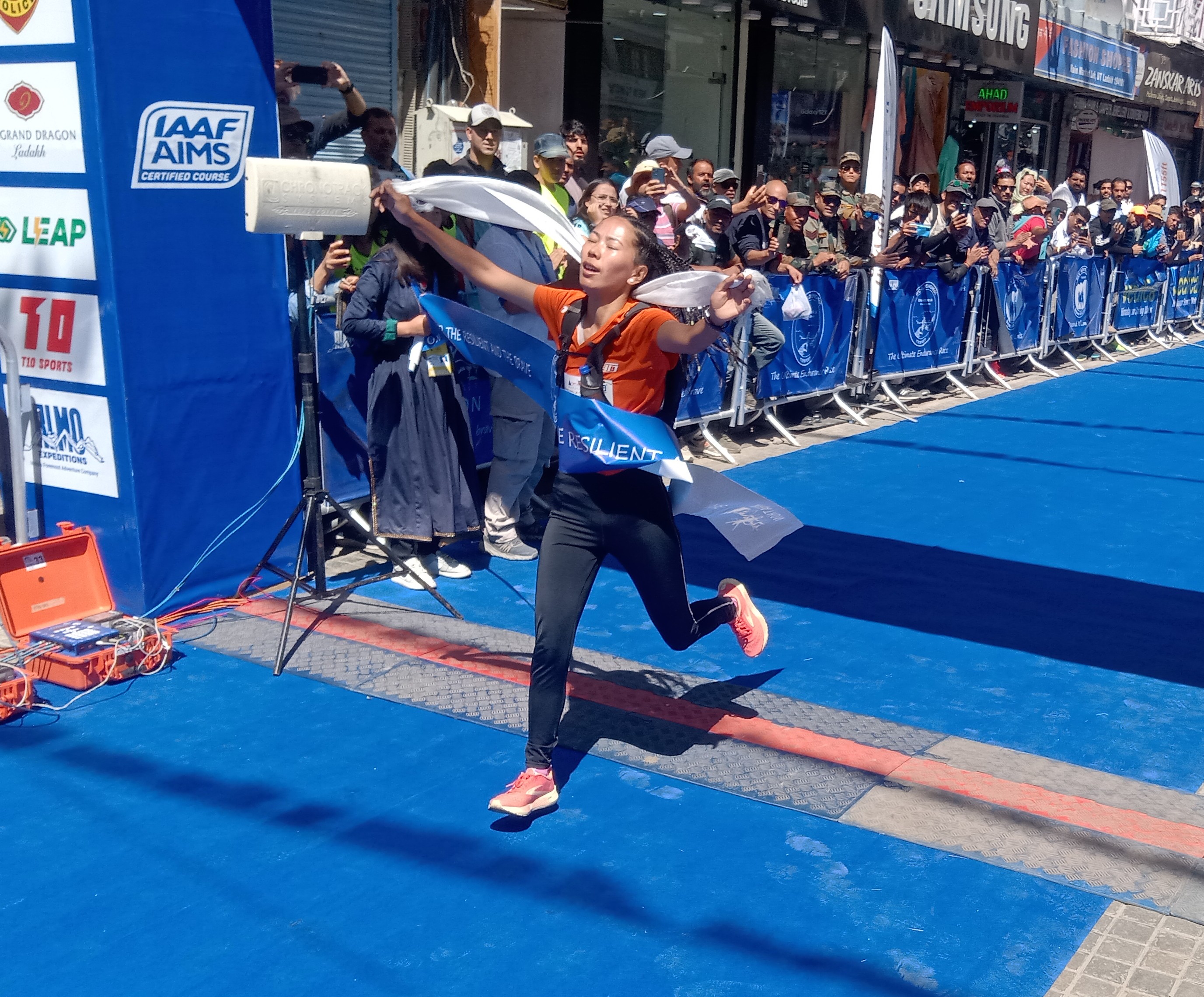
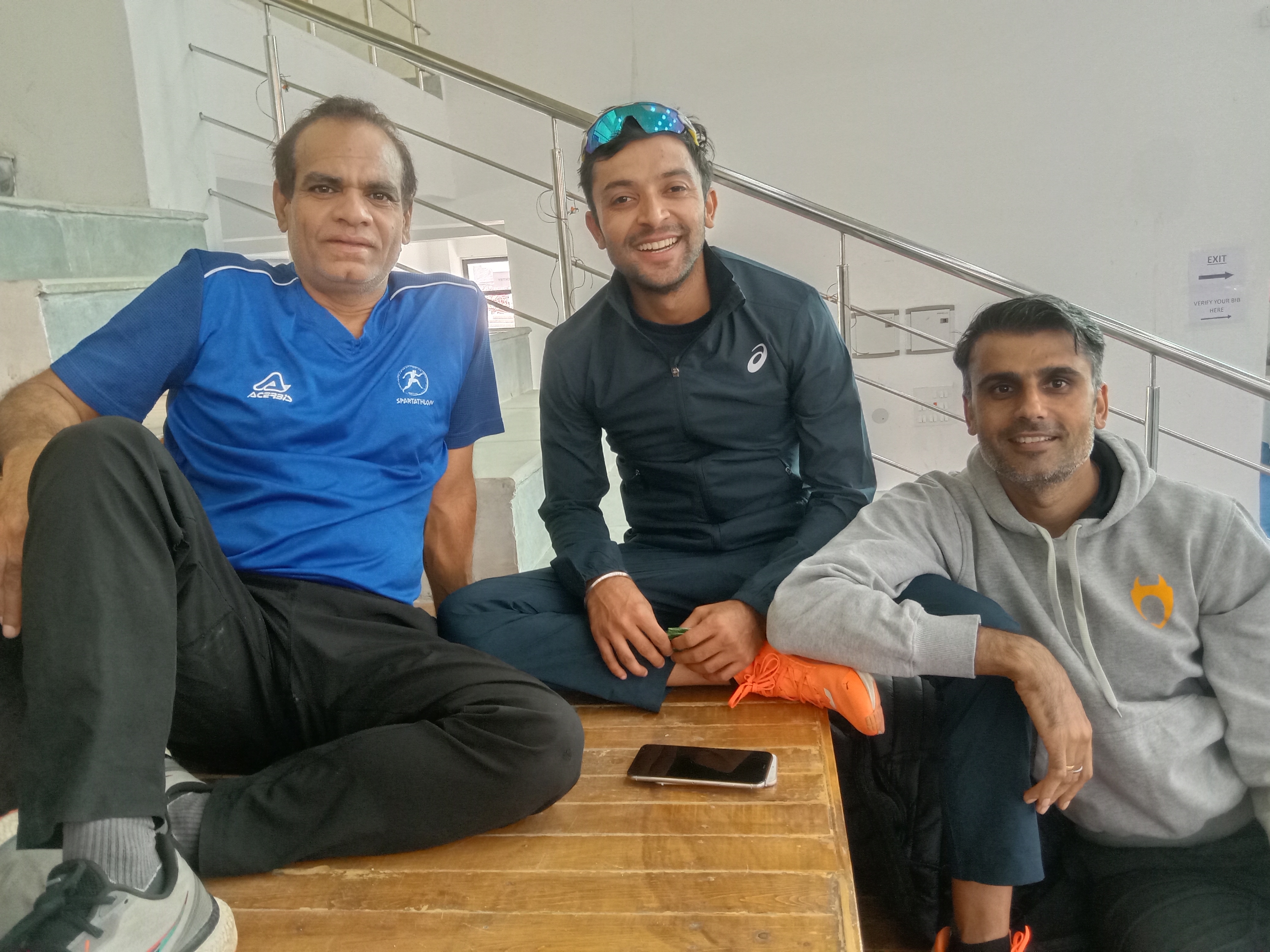
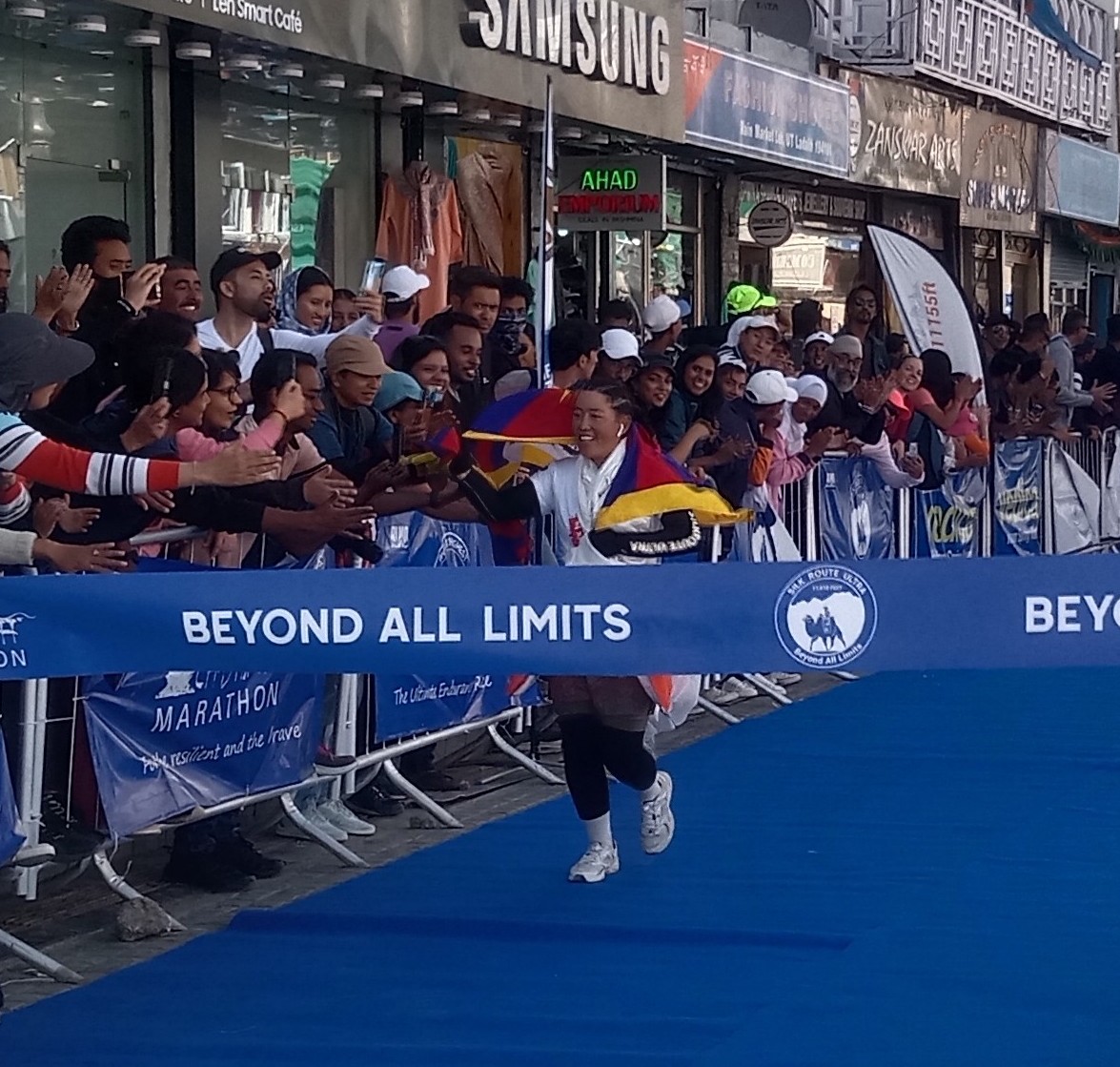
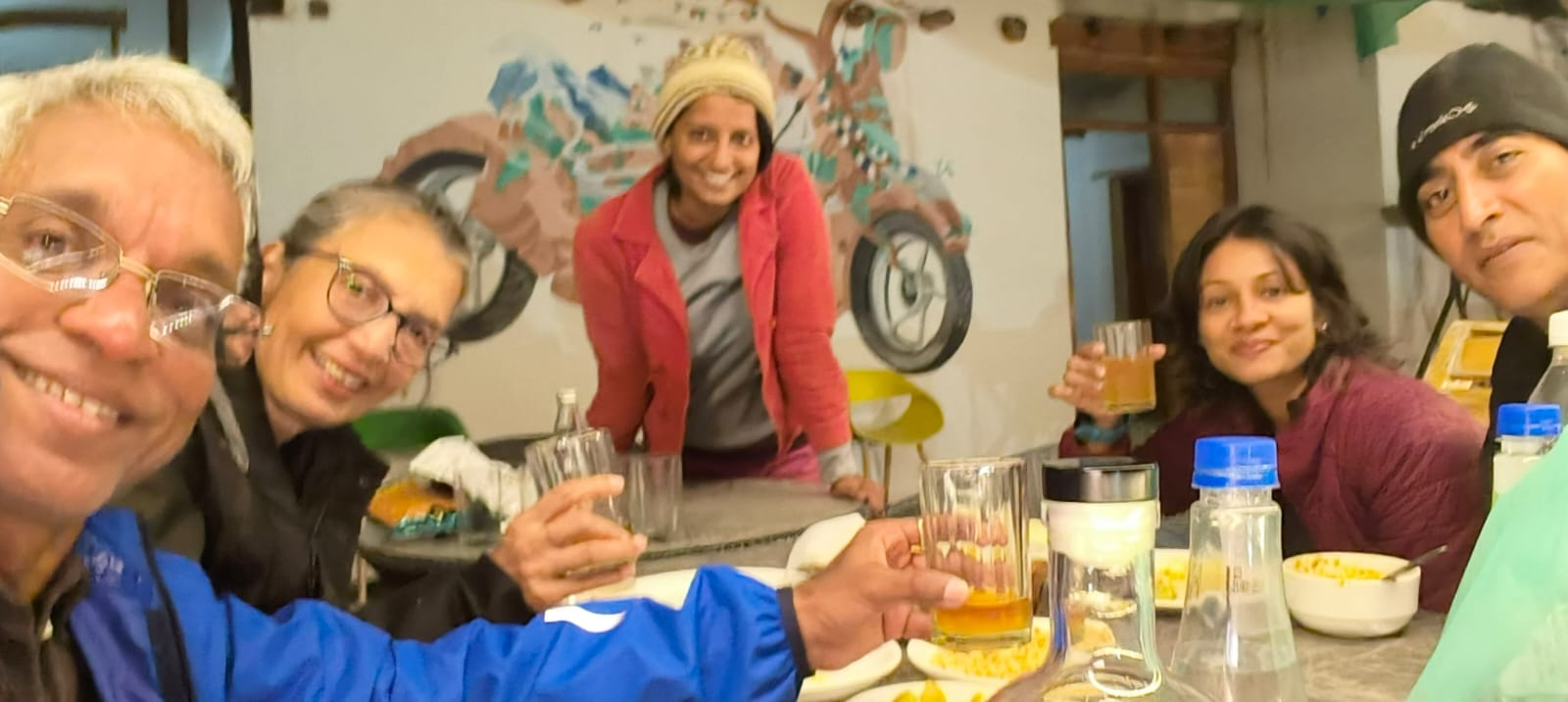
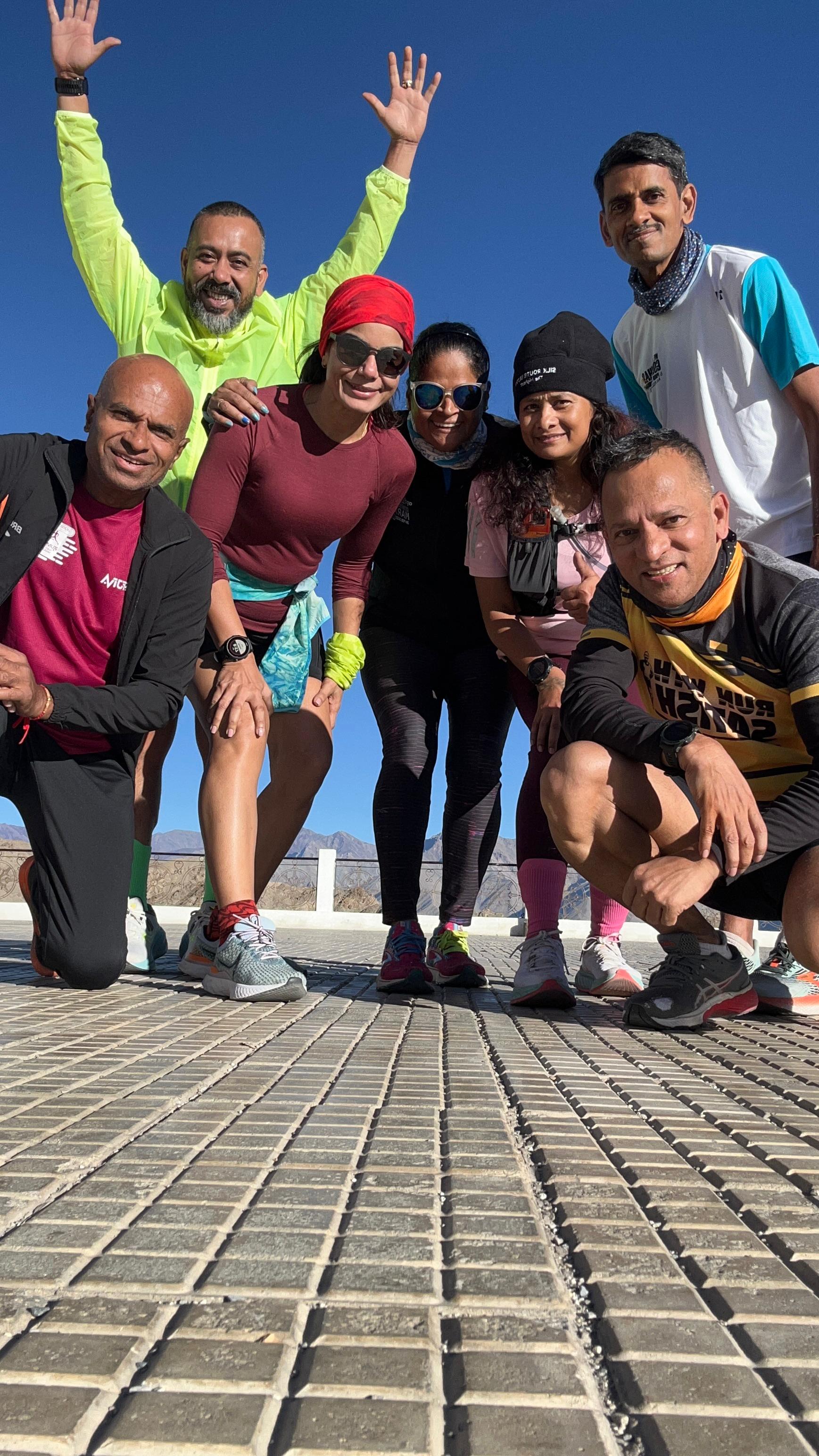
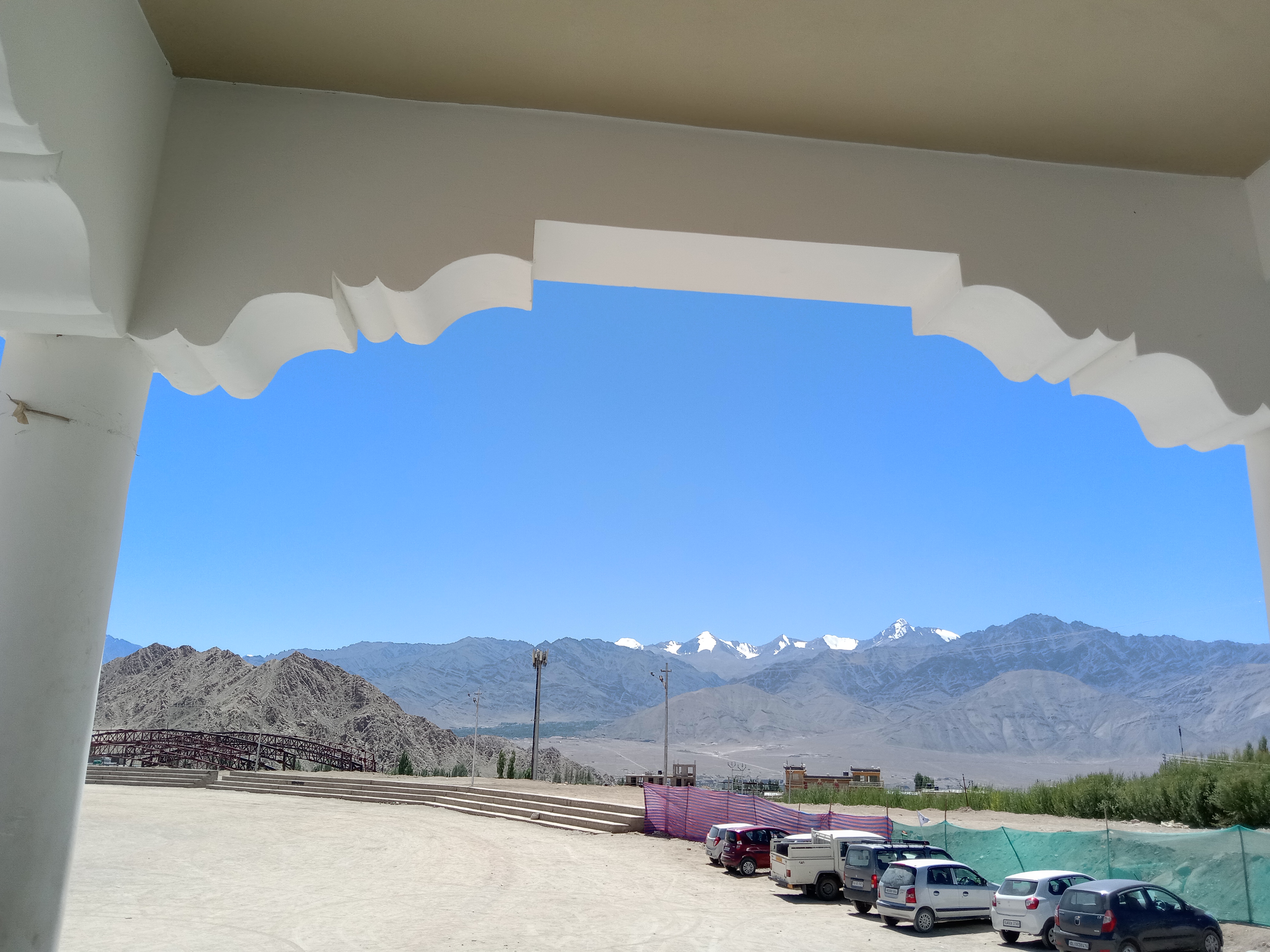
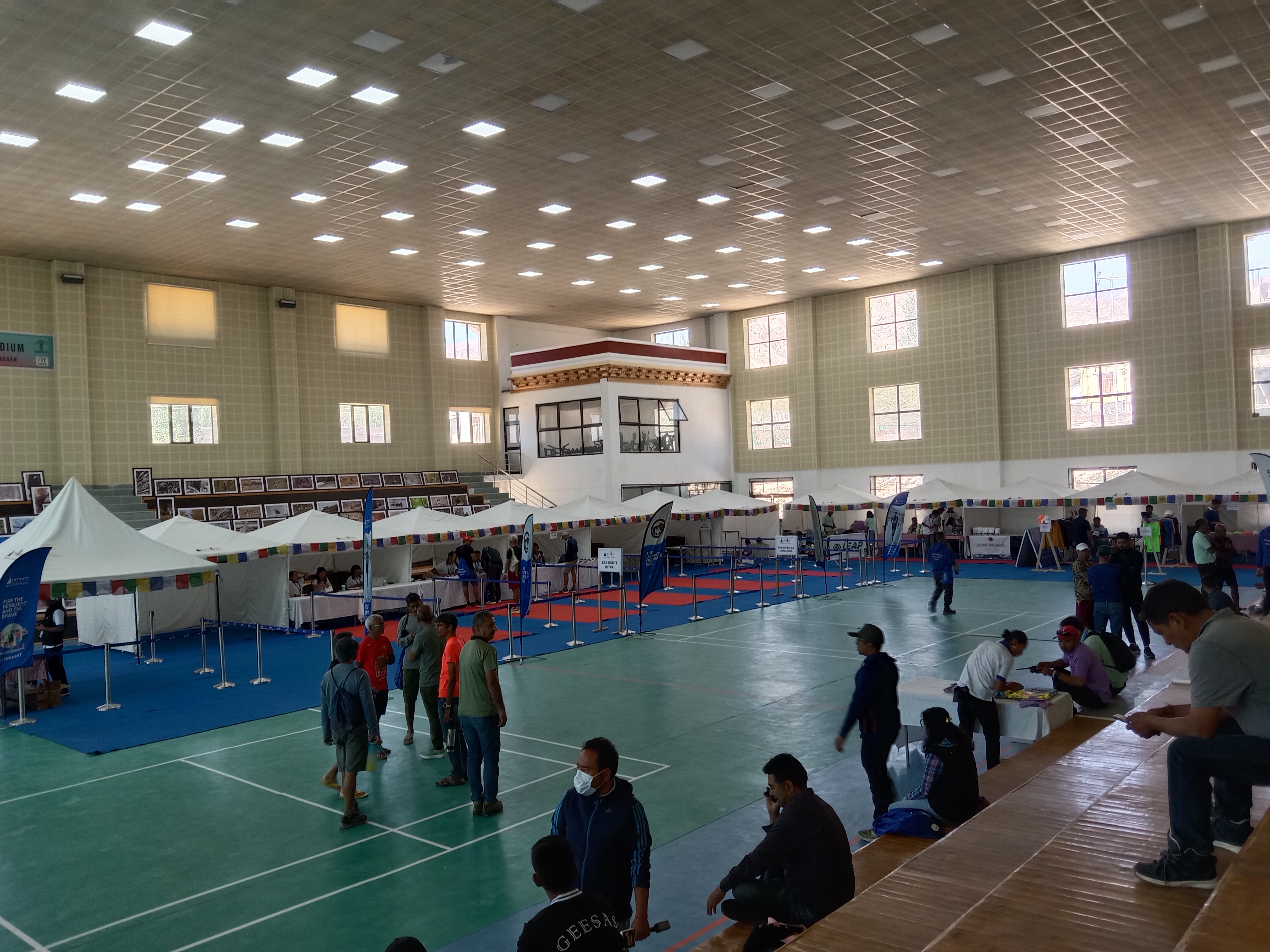
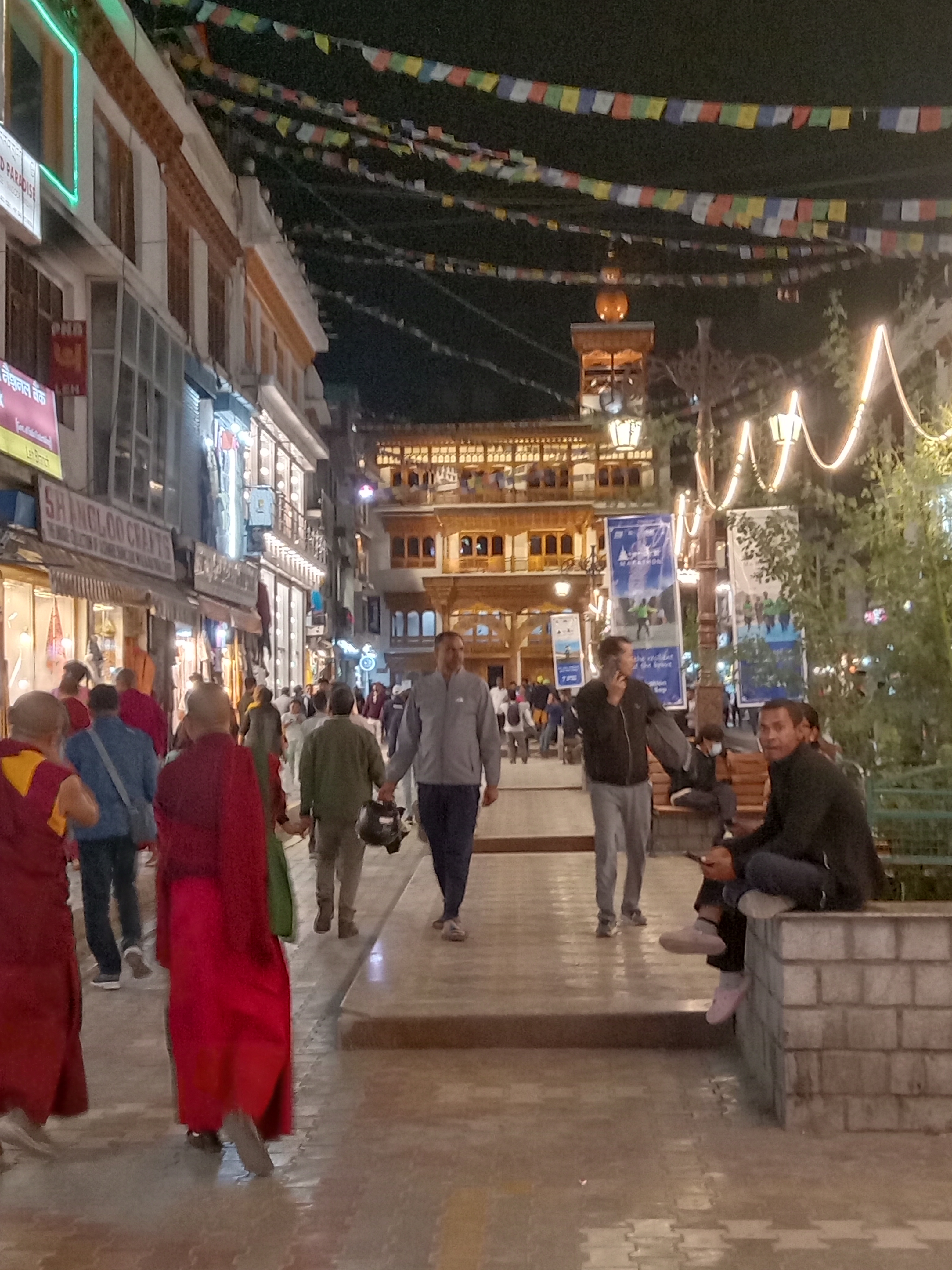
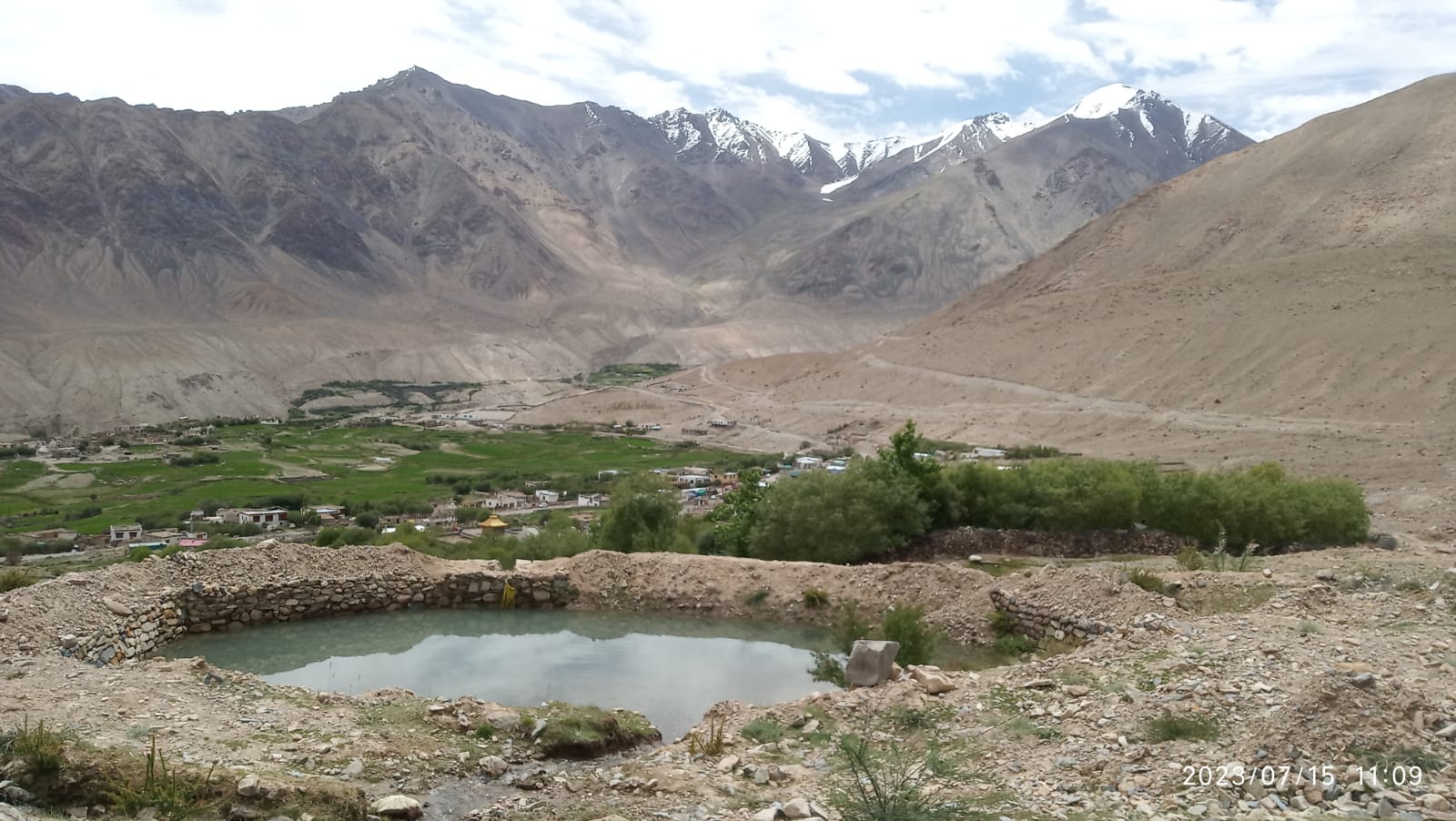
 Outrigger