
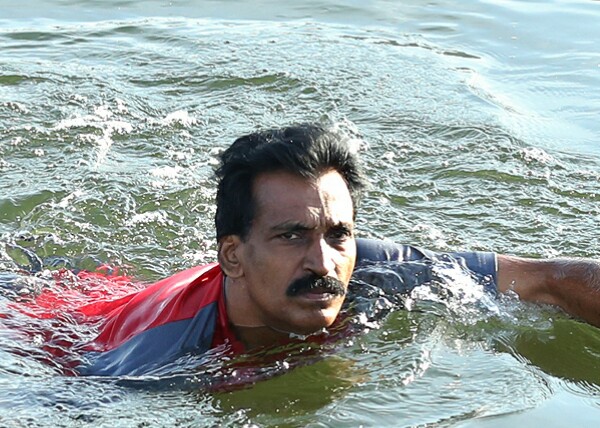
The owner of a small furniture shop in Aluva has been making a unique contribution to life in Kerala.
A land of backwaters, rivers and seacoast, accidents involving boats have been several in the state. In May 2023, 27 people died when their boat capsized in Tanur. That was merely the latest at the time of writing. What set Saji Valasseril thinking was an incident 21 years ago, when 29 people lost their lives after their boat traveling from Muhamma to Kumarakom, capsized in the Vembanad Lake. “ There were other mishaps too that made me want to do something,’’ Saji, a resident of Aluva, said. In 2007, 15 students, two teachers and an employee were killed when their boat sank in Thattekkad. In 2009, there was the Thekkady boat tragedy when 45 people died after their boat sank in the Periyar National Park. For Saji, it just didn’t make sense that people should die so. He felt that if people knew how to swim; at the very least if they could stay calm and afloat till rescuers arrived, lives could be saved. Saji had a background relevant to imagine so. His late father, V. Thomas Mani, had been a champion swimmer during his days in the army’s Madras Regiment. He taught Saji to swim in the river Periyar.
In March 2010, Saji decided to address the subject of drownings in Kerala, starting with his own family. His two children – Merin and Jerin – and the children of a friend, commenced learning to swim under his tutelage in the Periyar. On the map, Aluva, located on the banks of the Periyar, is a little before the river splinters into a complex estuarine geography ahead of its rendezvous with the backwaters and the Arabian Sea. The Periyar is Kerala’s biggest river in terms of volume of water carried. Because he was imagining back from all those boat accidents and survival in such contexts, Saji oriented his swimming lessons towards an eventual river-crossing. Merin did just that on the 39th day of her training; aged 13, she swam across the Periyar. The younger Jerin followed suit; he took two to two and a half months of training.
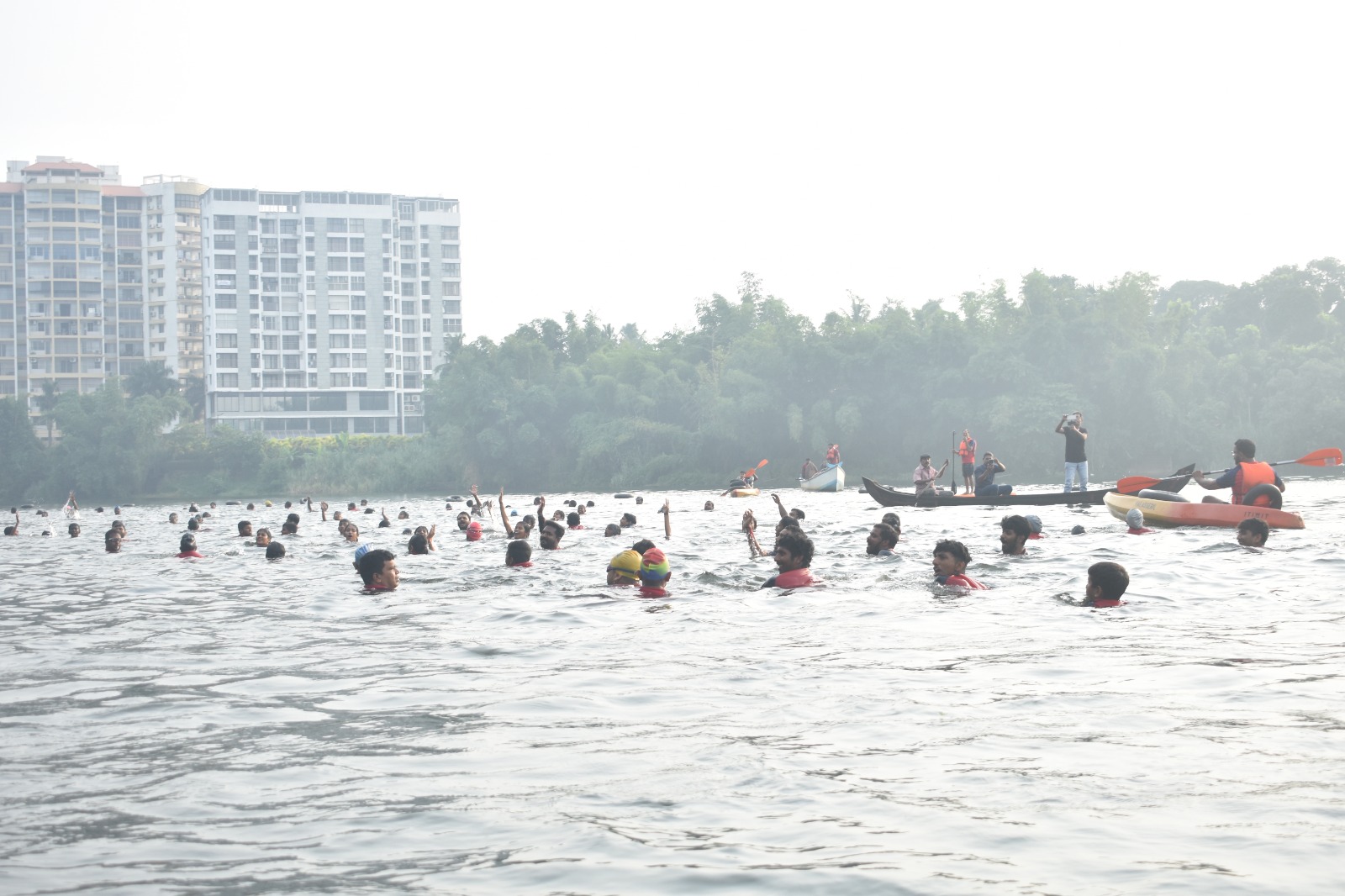
Around 2012, Saji named his endeavour, ` Valasseril River Swimming Club.’ By 2013, the number of people crossing, rose to 38. “ About one third to a quarter of a batch reach the competence level where they become eligible to try a crossing. The rest, learn swimming and go,’’ Saji said, adding against the backdrop of his syllabus that he estimates a trainee to acquire basic skills in 16 days. In 2014, 76 people swam across the Periyar. In 2017 the number touched 87 and in 2019 it rose further to 91. After a spike in response during the COVID phase, when almost 240 people crossed each year in 2020 and in 2021; in 2023, 1620 people trained, of who, 140 crossed. “ In all, I estimate, about 8000 people have by now learnt swimming from us,’’ Saji said leafing through files of entry forms submitted over the years. He has since become a regular subject of interest for the local media. According to Saji, the current length of the club’s crossing is approximately 750 metres as the route is to and fro. Maximum depth should be 30-40 feet.
Saji’s swimming sessions also attracted a clutch of differently abled individuals and senior citizens. Media reports cited a double amputee, a boy born without hands, a girl who underwent neurosurgery and was weak in one leg and a septuagenarian lady – Arifa – who swam with her hands tied, among those who crossed the Periyar. On August 14, 2023, Arifa spoke to this blog. In 2018, Aluva, where she resides, was among places affected by the heavy rain and floods that hit Kerala. She was not in town when calamity struck but her children told her of what happened including the tales of rescue. Arifa didn’t know how to swim. But she quickly realized that to be useful in times of flood and be part of relief work, swimming was an essential skill. That’s how at 68 years of age, she connected with Saji. Having grown up near a river, Arifa wasn’t an utter stranger to water. But that was 55 years earlier in her childhood. The year she attended Saji’s training session and learnt to swim, she couldn’t cross the Periyar because the day for swimming across coincided with her period of fasting. Then the lockdown induced by COVID-19 intervened. Eventually, she swam across the Periyar in 2022. Two months later with a week of training devoted to the new challenge assigned her, she swam across with her hands tied. “ The message I’d like to share from this attempt is that all should learn how to swim,” she was quoted as saying in the New Indian Express. In its early days, Saji’s program was focused on children. In 2016, very unexpectedly, a parent swam along in the crossing. He died of a heart attack. Following this, an ambulance became a constant presence at the program site and on the day of crossing, a safety-boat was engaged. More importantly, Saji began training adults as well. Nowadays, no adult gets to the crossing stage without the trainers being convinced that they are up to it, Saji said. Aside from his commitment to the journey he has embarked on, what engages about Saji’s project is the manner in which he built up scale.
A state, where many houses once sported private ponds, the declining engagement of the average Malayali with swimming, is a product of altered lifestyle. Greater construction has meant the old ponds levelled and built over. Overwhelming emphasis on academics meant the school and college-going became distanced from swimming or they learnt it as a skill paid for and acquired at any of the state’s modern but expensive swimming pools. Simply put, the numbers of those in newer generations who were acquainted with water, shrank. As these shifts happened, the Periyar’s kadavu or bathing ghats grew neglected and with it, familiar places on the river with gradual progression in depth and ideal to teach swimming, dwindled. Compounding the issue has been the problem of sand mining (it plagues many rivers in Kerala), which creates places with sudden variation in depth.
A May 2022 report in Mathrubhumi said, “ As per the records of the Fire and Rescue Department, on an average, three people drown in the state per day. ‘’ According to it, in 2021 alone there were 1102 reported cases of drowning, up from less than 1000 the year before. Many people drowned in rivers and ponds when visiting such places in groups. Even if one knew swimming, being able to tackle natural water bodies with currents in them, was an issue contributing to the fatalities, the news report said. When this writer contacted M Naushad, Director (Technical) of Kerala Fire and Rescue Services, he said that while knowing how to swim is always a good thing, people not heeding instructions to desist from swimming when and where conditions are not ideal, was a worry.
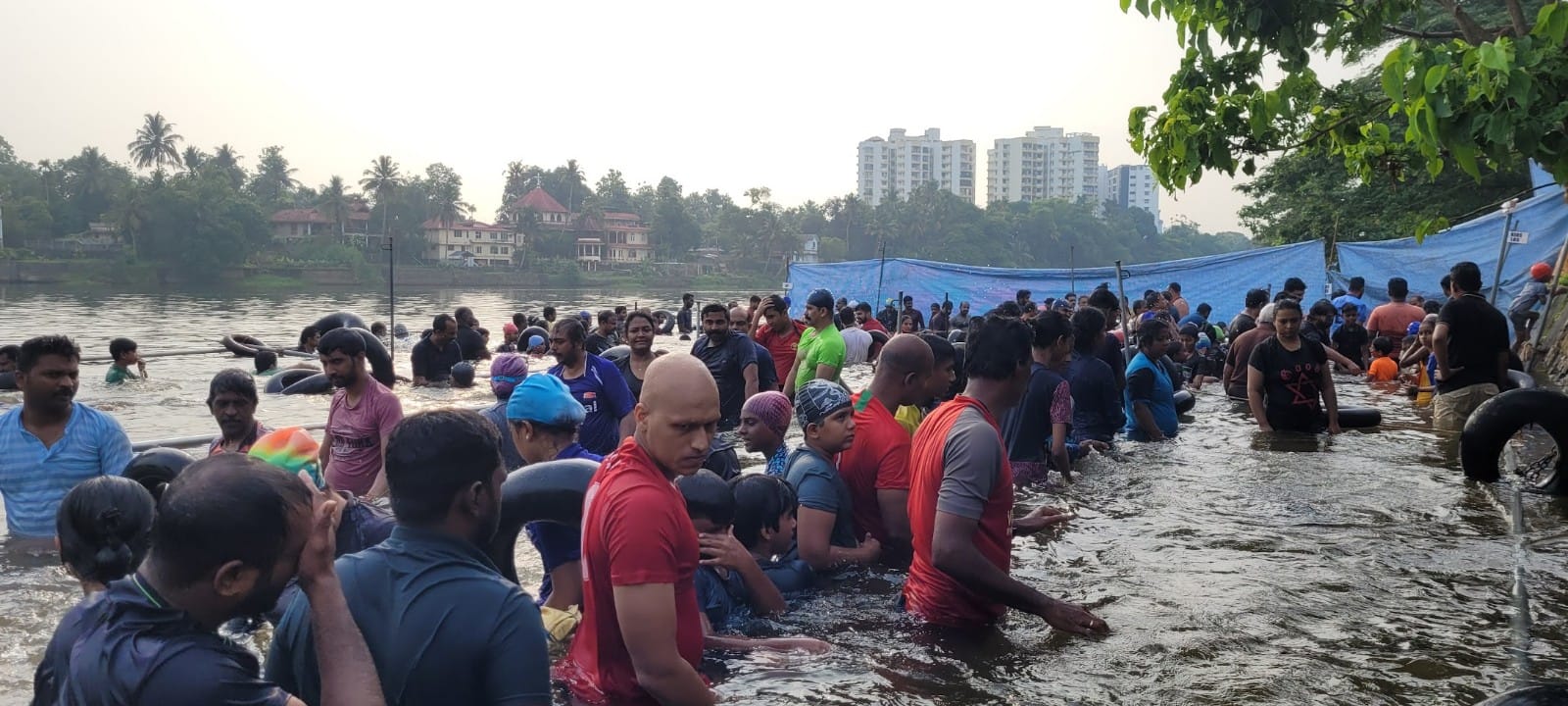
Saji, who is clear that his job is not to create champion swimmers but impart a survival skill, hosts his training at Manappuram in Aluva, a place by the Periyar famed for a Shiva temple and which has a gradually sloping approach into the waters. Here, Saji came up with an ingenious device (his fabrication skills came of use); a removable, collapsible structure of GI pipes, 70 feet by 40 feet in dimension. He currently uses four such structures. Each of them, anchored and kept afloat by an array of inflatable rubber tubes, separates the area within used for training, into seven lanes of varying water-depth. The trainees work their way from the shallows to the deep lane. This graduation takes weeks. It is only after such progression entailing 50 days, that the best of the lot, get a shot at the crossing monitored by expert swimmers with a kayak in tow. For Saji, this method has worked well so far. More importantly, since his mission commenced in the need to teach a state how to save itself in water, he considers the model replicable for use at other locations. “ If you look at where all people are drowning these days, you will be amazed. There is the case of a large temple pond, which was cleaned and beautifully redone only to have people drown in it later. My device can be built to required scale and all it needs is the shallows of these ponds. If people are trained using the device in such ponds and they venture to the deep only after they are properly skilled, fatalities can be minimised,’’ Saji said.
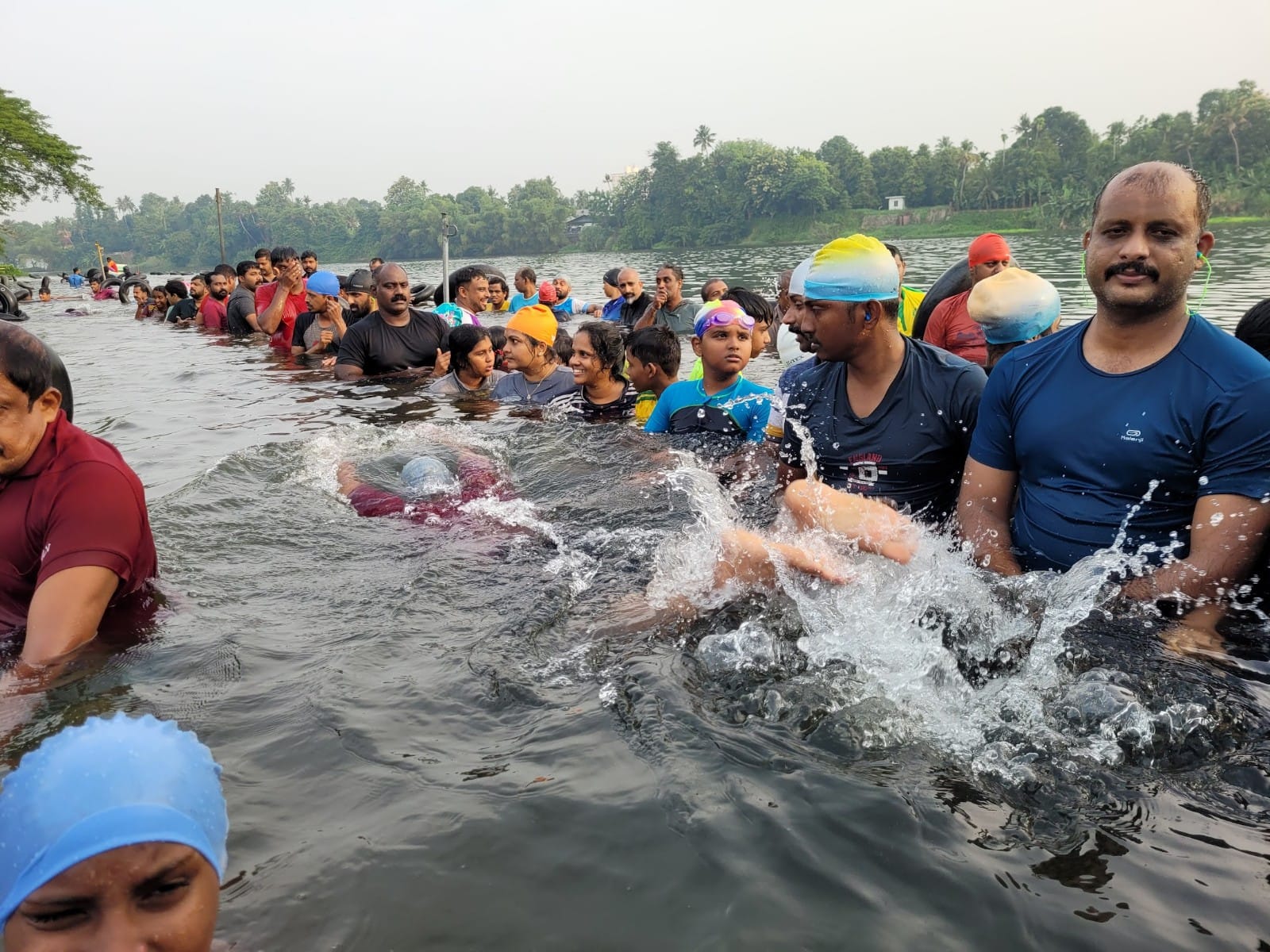
Thanks to the four structures in the water, Saji said, the club can train close to 1000 people at a time. As a concept, scaling up won’t be appreciated by discerning trainers because of the inbuilt danger in something going wrong. For instance, trainers’ attention risks being spread thin as the number of trainees rise. Health issues is another. But against the backdrop of Kerala’s emergent equation with water (there is the newfound reality of floods to cope with during rains plus those recurrent boat tragedies) Saji merits a hearing. According to him, municipal authorities and elected representatives have supported him in the ongoing project in Aluva. To aid scale and reduce risk related to the natural variabilities of a river, he wishes for a large tank with powerful pumps, built at Manappuram, which mimics the water depth of the Periyar’s banks and its flow. It will cost money; sponsors will be needed. But if by now, you are thinking that training plus scale should be fetching this man good money; hang on. According to Saji, he charges nothing except for expenses around safety. His main income remains the small shop: Valasseril Furniture.
(The author, Shyam G Menon, is a freelance journalist based in Mumbai. This is the slightly extended version of an article written by the author and published in The Telegraph on July 10, 2023.)
 Outrigger