SPORTS GETS A MENTION

Illustration: Shyam G Menon

After raising hopes in June ahead of its release, the National Educational Policy 2020 as currently available on the website of the Ministry for Human Resource Development, restricts mention of sports to little over a paragraph.

On Pages 12 and 13, under the sub-section titled Experiential Learning, the policy says, “ sports-integration is another cross-curricular pedagogical approach that utilizes physical activities including indigenous sports in pedagogical practices to help in developing skills such as collaboration, self-initiative, self-direction, self-discipline, teamwork, responsibility, citizenship etc. Sports-integrated learning will be undertaken in classroom transactions to help students adopt fitness as a lifelong attitude and to achieve the related life skills along with the levels of fitness as envisaged in the Fit India Movement. The need to integrate sports in education is well recognized as it serves to foster holistic development by promoting physical and psychological well-being while also enhancing cognitive abilities.’’

A quick perusal of the document did not reveal any reference to sports more prominent than this, elsewhere in the text. The Fit India Movement referred to in the policy was launched on August 29, 2019 by Prime Minister Narendra Modi. It is a nation-wide campaign aimed at encouraging people to include physical activities and sports in their everyday lives. The educational policy document (as available on the Internet) is divided into four parts – school education, higher education, other key areas of focus and making it happen. The reference to experiential learning including the paragraph on sports-integration is under school education. The part titled other key areas of focus, has sub sections devoted to professional education, adult education and lifelong learning, promotion of Indian language, arts and culture, technology use and integration and online and digital education: ensuring equitable use of technology. It had no sub-section on sports.

The National Education Policy 2020 received cabinet approval on July 29. On June 11, 2020 media reports had quoted the Union Minister for Sports, Kiren Rijiju, saying that sports is set to become part of educational curriculum.

(The author, Shyam G Menon, is a freelance journalist based in Mumbai.)

TEAM FOR IAU VIRTUAL RUN ANNOUNCED

Illustration: Shyam G Menon

A second team representing AFI has also been announced

Nine men and nine women will run for India in the IAU 6 Hour Virtual Global Solidarity Run scheduled to take place from 6AM to 12PM on August 29, 2020.

The event put forth by the International Association of Ultrarunners (IAU), features member federations worldwide nominating teams to participate. In its outline for the event, available on the IAU website, IAU has said that athletes may run indoors or outdoors but would need to record their performances on one of the many sports platforms like Strava or Garmin. Federations or their nominated team manager would need to verify and check their athletes’ performances and then submit the tabulated results to the IAU. “ There will not be a ranking list as this is a run signifying global solidarity among the ultrarunning family,’’ the IAU write-up said.

Among other details it informed member federations, “ athletes must run at any time in one continuous six-hour block over the weekend August 29th / 30th in your own time zone. Results will not count for publication if they are done outside of these designated dates. If your country allows athletes to compete together, you may have your own race and / or virtual race with a specific start time. Otherwise athletes can compete either indoors or out in their own space but must record the activity and give your nominated team manager those results.  The results should be submitted to the IAU no later than September 1st.’’

According to a press release from the Athletics Federation of India (AFI), the Indian runners selected to participate are: women – Anju Saini, Aparna Choudhary, Ashwini Ganapathi, Bindu Juneja, Darishisha Iangjuh, Deepti Chaudhary, Hemlata, Nupur Singh and Shyamala S; the men’s team includes Abhinav Jha, Amit Kumar, Binay Sah, Geeno Antony, Hemant Singh, Pranaya Mohanty, Sunil Sharma, Suraj Chadha and Tlanding Wahlang.

While IAU had offered each member federation the possibility of their run taking place in one location if required, Sunil Chainani, member of the committee appointed by AFI to oversee the selection of Indian ultra teams, said that given the ongoing pandemic, Indian runners will be running at their respective locations.  “ We decided to give priority to safety,’’ he said of the decision not to assemble in one place. COVID-19 cast its shadow in other ways too. Some runners who wished to apply and participate couldn’t do so because their locality had containment zones limiting the space available for them to run. Others were concerned about running for six hours in their respective locations because running outdoors – in the form of daily exercise – is allowed only for lesser duration during the pandemic. The selectors also did not want anyone pushing themselves unnecessarily. “ The lockdown has affected everyone’s training and we don’t want runners straining themselves. We wish to keep our athletes safe,” Sunil said.

According to the IAU website, there will be a category within the run called President’s Club. It encompasses the leadership of member federations and select personalities who have contributed to the sport.  “ The Presidents Club team signals to the global ultrarunning family that we are all in this together. It also serves as a motivation to all our athletes to see their federation leadership participating with them in this endeavor. The team also includes selected personalities who have done an outstanding job promoting the sport globally,’’ Nadeem Khan, president, IAU has been quoted as saying on the association’s website. Adille Sumariwalla, president, AFI, features in the President’s Club list.

Also running on August 29 will be a second team of ultrarunners, this one representing the AFI. The corresponding virtual event’s name is AFI 6-Hour Solidarity Run. The revised criteria for applying to the team (as available on the AFI website), was: for women – 155 kilometers covered in 24 hours, 100 kilometers done in 10:45 or 500 trail-ITRA points accumulated as of date; for men – 195 kilometers covered in 24 hours, 100 kilometers done in 9:45 or 600 trail-ITRA points (any one of these norms had to be satisfied to apply). The idea of a second team was to increase participation in the event and generate greater interest in the sport, Sunil said. As per a recent AFI press release (essentially an update to the earlier one), the members of the team for the AFI 6-Hour Solidarity Run are Ajit Singh Narwal, Badal Teotia, Manoj Kuthupady Bhat, Nishu Kumar, Sandeep Kumar, Santosh Gowda, Sikander Lamba and Velu Perumal.

 (The author, Shyam G Menon, is a freelance journalist based in Mumbai.)

AT A GLANCE / AUGUST 2020

Illustration: Shyam G Menon

Sports functions of up to 100 persons allowed from September 21

Under guidelines for further relaxation of lockdown in areas outside containment zones, the central government in its order dated August 29, 2020 has allowed sports functions involving up to 100 persons, from September 21, 2020 onward.

“ Social / academic / sports / entertainment / cultural / religious / political functions and other congregations with a ceiling of 100 persons, will be permitted with effect from 21st September, 2020 with mandatory wearing of face masks, social distancing, provision for thermal scanning and hand wash or sanitizer,’’  one of the sub sections of the order said.

Swimming pools will however continue to remain closed.

AFI defers start of national competitions

The competition committee of Athletics Federation of India (AFI), at its meeting of August 28, 2020, decided to defer the start of national competitions.

According to a related press release, AFI had been hoping to resume competitions on September 12, 2020 with an AFI Grand Prix in Patiala. “ It would be advisable if the coaches redraw the training schedules of athletes. We are now looking at October end or early November for some competitions for seniors and late November for juniors,” AFI president, Adille J. Sumariwalla was quoted as saying. The National Open Athletics Championships, slated for September 20 to 24 and the Federation Cup, due from October 5 to 9, have also been postponed, the statement said.

Illustration: Shyam G Menon

Mumbai Ultra takes a break, organizes blood donation drive for Independence Day

Under normal circumstances, Independence Day would be the time for Mumbai’s annual rendezvous with the Mumbai Ultra. This year, the 12-hour run is taking a break due to the ongoing COVID-19 pandemic and has organized instead a blood donation camp.

The camp will be held on August 15, 2020 at Veer Savarkar Smarak Bhavan, Shivaji Park, Mumbai, for a period of 12 hours from 8AM to 8PM.

“ We had to cancel this year’s ultra-running event because of the pandemic. As we have been associated with Tata Memorial Hospital for the past few years, I decided to call them and inform them about the cancellation. The director of the hospital spoke about the shortage of blood and asked us if we can organize a blood donation camp,” Naveen Hegde, one of the organizers of Mumbai Ultra, said.

The event’s organizing team then set about working on the logistics for the blood donation drive. Naveen expects around 500 people to come forward for donating blood. At the time of writing, over 450 people had registered to donate blood. Those seeking to register can get the relevant details on the event’s Facebook page.

If held, the 2020 edition of Mumbai Ultra would have been the seventh edition of the event.

Cancellation of the 2020 Ladakh Marathon now spans all race categories

The organizers of the Ladakh Marathon have confirmed that the cancellation of the 2020 edition of the event now spans all race categories.  On July 2, they had informed that the main Ladakh Marathon had been cancelled owing to COVID-19 but the two elite races in its fold – Khardung La Challenge and Silk Route Ultra – were under “ review” with a final decision expected by end-July.

A statement dated August 10, 2020, now available on the event’s website says that the cancellation includes Khardung La Challenge and Silk Route Ultra. “ The 9th edition of the Ladakh Marathon scheduled for 10 – 13 September has been cancelled because of the COVID-19. All six races – Marathon, Half Marathon, 10 km, 5 km, 72 km ultra Khardungla Challenge and 122 km Silk Route Ultra stand cancelled for the year 2020.’’

It attributed the cancellation to the situation around COVID-19 and the India-China border tensions of the past few months. Ladakh is close to the international border. “ After undertaking a risk-assessment exercise a collective decision was taken to cancel the 9th edition of the Ladakh Marathon as the well-being of our runners, the residents of Ladakh, our volunteers and staff remains our top priority,’’ the statement said, adding, “ all confirmed registrations for the 9th edition of the Ladakh Marathon have been automatically transferred for a period of two years to 2021-2022.’’

Illustration: Shyam G Menon

2020 Paris Marathon cancelled

The 2020 Schneider Electric Marathon de Paris has been cancelled.

“ After having tried everything to maintain the event, we, alongside the Ville de Paris, feel obliged to cancel the 2020 edition of the Schneider Electric Marathon de Paris and the Paris Breakfast Run. Faced with the difficulty that many runners, especially those coming from abroad, had in making themselves available for the 14th / 15th November, it was decided that it would be better and simpler for those concerned if we organised the Schneider Electric Marathon de Paris in 2021,’’ an official statement dated August 12, 2020, available on the event website, said.

“ Those who were signed up for this year’s edition are, if they wish, already signed up for the 2021 edition. If not, they will benefit from a voucher, the value of which being equal to however much was spent on the bib and extra options or a reimbursement after a period of 18 months,’’ the statement said adding, “ we will be working side-by-side with the Ville de Paris to put on a 2021 edition that brings together the most passionate runners on the most beautiful streets in the world.’’

Reminder from World Athletics on the need to stick to shoe regulations

World Athletics has reminded that the recently introduced Rule 5 pertaining to the sole height of shoes will need to be adhered to if the results at national championships and domestic competitions are to be recognized by it.

“ As more athletes around the world return to the track for national championships, one-day meetings and other record-breaking attempts, World Athletics has issued a reminder to Area Associations and Member Federations today about the recently introduced Rule 5, governing competition shoes. The amended rule, which puts a sole height limit of 25mm on all shoes worn in track events of 800m and above in distance (including Steeplechase), came into force on 28 July 2020, when it was published. The rule does not prevent a road running shoe from being worn on the track but a 30mm or 40mm road running shoe cannot be worn for track events because of the 25mm limit. As this is a transition period, all results currently in the World Athletics database will be processed, but any result of an individual athlete who has worn non-compliant shoes for the race will be marked “Uncertified” (“TR5.5”). In the case of National Championships and other domestic competitions, for results to be validated and recognised by World Athletics for statistics purposes, such competitions must be held under World Athletics Technical Rules and Competition Rules. This means that Rule 5 of the Technical Rules must be applied in full for the competition results to be recognised by World Athletics as valid. To preserve the integrity of national records and statistics, the responsibility lies with the Member Federation to ensure that all athletes, officials and competition organisers are fully aware that Rule 5 of the Technical Rules will be applied in full. If a Member Federation or competition organiser permits an athlete to compete in non-compliant shoes, then the athlete’s individual results from the competition will be marked in World Athletics’ records and statistics as ‘Uncertified (‘TR5.5’) i.e. invalid. In some cases, this may apply to the entire race. Results achieved before 28 July, where an athlete has worn a shoe above the current track limits, are valid provided the results were achieved in shoes that complied with the sole thicknesses in the previous rule. For example, if an athlete wore 40mm non-spike shoe on the track or 30mm spike between 31 January 2020 and the notification and publication of change of rules on 28 July 2020, then the competition result is valid. The list of shoes that were submitted to World Athletics by manufacturers for assessment, and have been approved, will be published on World Athletics’ website shortly to assist Athletes, Member Federations, Technical Officials and meeting organisers,’’ a statement dated August 10, 2020, available on the website of World Athletics said.

World Athletics publishes list of approved competition shoes

World Athletics has published the list of approved competition shoes, following the amendments to Rule 5 of the Technical Rules announced on 28 July 2020.

The list has been compiled following introduction of the requirement on 31 January 2020 that any new shoe an athlete proposes to wear in international competitions needs to be assessed by World Athletics.

According to a press release dated August 13, 2020, available on the website of World Athletics, “ the list does not contain every shoe ever worn by an athlete but it does include some older models of shoes that manufacturers sent to World Athletics for assessment by its independent expert. The position with older shoes that are not on the list is that they still need to comply with the rule going forward. The athlete, or their representative, will need to ensure their older shoe complies with Rule 5.13 in terms of the maximum sole thicknesses for their specified event and any inserted plate or blade, including spike plates if relevant.

“ Under Rule 5 of the Technical Rules, athletes (or their representative) have the responsibility to provide World Athletics with specifications of the new shoes the athlete proposes to wear in competition. World Athletics accepts shoe specification and samples submitted by manufacturers for further examination. If there is doubt about a shoe (particularly shoes that no other athlete has) then athletes, officials and meeting organisers should first refer to the approved list.

“ If the competition referee has a reasonable suspicion that a shoe worn by an athlete might not comply with the rules then at the conclusion of the competition the referee may request the shoe be handed over for further investigation by World Athletics.

“The list of approved shoes will be updated regularly to reflect any new information received.’’

The list of approved shoes (as of August 13, 2020) is available as a link on the above cited press release, on the website of World Athletics.

(The authors, Latha Venkatraman and Shyam G Menon, are independent journalists based in Mumbai.)

CITIZEN K

This image was downloaded from the film’s Facebook page and is being used here for representation purpose. No copyright infringement intended.

For many of us, lockdown has been an opportunity to reflect.

Among other things, you think of the meaning of life. Lockdown has been a bit like the prisoner’s existence except there was neither crime committed nor sentence decreed. But the effect was similar – the limits of our wanderings shrank and a prison cell took shape. Luxuries waned. For the first time, many of us understood what incarceration is. We started to value freedom. In literature, denial of freedom on scale is usually associated with totalitarian regimes. The dissidents imprisoned for their protest and later released or rendered martyrs for the cause, inspire governments promoting freedom and liberal views. This has been the cycle of events regularly portrayed in political literature.

It was curiosity of this sort that attracted me to the documentary film Citizen K. Plus the fact that as of 2020, democracy is in one of its most imperiled phases with growing sections of humanity only too willing to waive individual rights and instead regiment to preen as human shoal. Why do we do so? Why do we turn our backs on the lessons of history and play into the hands of potentially losing liberal government and personal freedom, both of which we know, are hard to restore once lost? For those like me, valuing freedom and appreciating it for exactly what it is, 2020 has been a bleak but thought provoking landscape.

So what is Citizen K all about? This 2019 documentary film deals with Russia; to be precise, the period following the collapse of the Soviet Union. It tracks the story of Mikhail Khodorkovsky, erstwhile billionaire and among the richest men in Russia who belongs to the first generation of business oligarchs that arose from the ashes of Communism. Doing so, it gives us an inside view of how the phenomenon of Russian oligarchs came about; how that crony capitalism spread roots. Today we accept this well entrenched symbiosis between business oligarchs and politics in Russia as how the country is. The film shows you why and how it came about. It then leads you to the unsaid fault lines that shouldn’t be crossed in this arrangement. Khodorkovsky – a top oligarch – commits the error of voicing political opinion. This makes him appear a threat to Vladimir Putin, president of the country, whose rise was engineered by the oligarchs but who has since become his own master. In due course, Khodorkovsky is arrested and sent to jail. His giant oil company is merged with state owned enterprise. The billionaire’s wealth shrinks. A long drawn out legal battle to free him follows, much of it trashed by the state’s counsels. Eventually as part of his image building exercise, Putin embarks on a series of amnesties and freeing Khodorkovsky is one of the things he does. With life in Russia too dangerous for him, the businessman shifts overseas. He recasts himself as a political campaigner and emerges over time, a major critic of Putin’s administration.

Neither of the two main protagonists in this drama are angels. Khodorkovsky is a former oligarch, whose rise to riches will remain questionable. Such questions haunt Russian fortunes built up in the period around the Soviet Union’s fall. It was a case of a country that knew little of modern capitalism having lived behind the Iron Curtain for decades, suddenly required to put in place a new economic system using whatever it had at its disposal. The period following the disintegration of the Soviet Union was one of desperation and inequality, during which, the oligarchs exploited common people to corner shares of public enterprise. Through such beginnings in capitalism, Khodorkovsky created the bank that would later become his vehicle for building the oil company – Yukos. Putin on the other hand, was a candidate supported by the oligarchs in the wake of Communist echoes reviving in the declining years of the Boris Yeltsin era. He becomes president, does good work but also goes on to become an institutional entity that stalks the land like an unshakable, permanent political presence. Elections are held but it is a trumped up ecosystem in which the opposition is lame and you can’t be sure whether it is independent or propped up by the ruling formation for illusion of democracy. This predicament is Citizen K’s story.

It is an interesting documentary for multiple reasons, the most prominent of which, is a product of our times. There are shades of Russia – its penchant for personality cult, rule by strongman and appetite for business oligarchies – surfacing in other countries. The larger trend is what attracted me to Citizen K as a viewer; this issue of similarity in political aspiration across countries (it is a model going around), none of it healthy for freedom, economic equality and democracy. This is a film that makes you reflect on our age of undemocratic politics, the cult of political personalities and billionaire businessmen and ordinary people split between support for this formation and opposition to it, split between support for rule with an iron fist and rule by liberal government. Good documentaries hold a mirror to existence. Citizen K does just that. The film is available on Amazon Prime.

(The author, Shyam G Menon, is a freelance journalist based in Mumbai.)   

AT THE HEART OF GOLD

This image was downloaded from the Internet and is being used here for representation purpose. No copyright infringement intended.

Gymnastics was among sports included in the very first edition of the modern Olympic Games in 1896. Since then it has become a major fixture with plenty of medals to be won. All sports, in their pursuit of excellence, have evolved talent search and training suited to their needs. A hallmark of gymnastics in this regard, has been the practice of grooming talent from a very young age.

As we increasingly surrender our life to competition, the greater is our tendency to create institutions and approaches so comprehensively dedicated to the theme that they offer scope for violations of other sorts, to be overlooked; even hidden. Worse in tune with such adages as “ no pain, no gain,’’ the violated believe that what they suffered was part of the process of learning to excel. Until somebody – a whistle-blower – declines to see the goings on in that paradigm, calls a spade a spade and opens up.

That’s how the sex abuse scandal linked to USA Gymnastics was first reported in the media in 2016 and investigations commenced into the conduct of their national team doctor Larry Nassar resulting in his eventual imprisonment and sentencing. Others, who were part of the institutional structure and whose actions delayed inquiry and justice, have also not been spared. Wikipedia’s page on Larry Nassar says that more than 150 federal and state lawsuits were filed against him, Michigan State University (MSU), USA Gymnastics, the US Olympic Committee and the Twistars Gymnastics Club. The entire board of USA Gymnastics resigned; the president of MSU and its director for athletics also resigned.

The aforementioned incident is the subject of the 2019 documentary film At the Heart of Gold: Inside the USA Gymnastics Scandal. It is a comprehensive, sensitive account of the scandal. It focuses mostly on the cases surrounding Larry Nassar as that was the epicenter. The said offender and others like him could operate within a system where sport’s relentless pursuit of high performance and consequent traits like catch-them-young, meant the trainees were of an age when they lack the maturity to make informed judgements. That latter attribute – a social situation denying the young a say on what they feel – becomes in turn a shield in service of continuing the offence. Young gymnasts, who complained to officials concerned, saw their complaints ignored or treated cavalierly. As later depositions in court show, in some cases, even parents disbelieved their children. The mistrust caused strained relations between child and parent.

The film’s canvas includes the responsibility of major institutions and influential individuals within them, in prolonging the paradigm of abuse. It makes us think of the problem of institutional sensitivity tripped by focus on success and the perceived infallibility of those familiar for long to the system. The goal being chased and the experience (plus perhaps, the success) of those who went before, serve as prism trivializing the abuse that occurred. The all too often sold narrative is that success doesn’t come easy. What athlete experienced, suspected violation included, finds it tough getting past these walls and qualifying as complaint meriting serious attention. Slowly, what you overlooked gathers mass till one day you have a monster running amok and scars of damage all around. The cases that eventually tumbled out in the USA Gymnastics scandal spanned a couple of decades.

This is a relevant, insightful documentary. It is available on Disney-Hotstar.

(The author, Shyam G Menon, is a freelance journalist based in Mumbai.)

“ PERFECTION IS MAKING THE BEST OF WHAT YOU HAVE’’

Anjali Saraogi (Photo: Shyam G Menon)

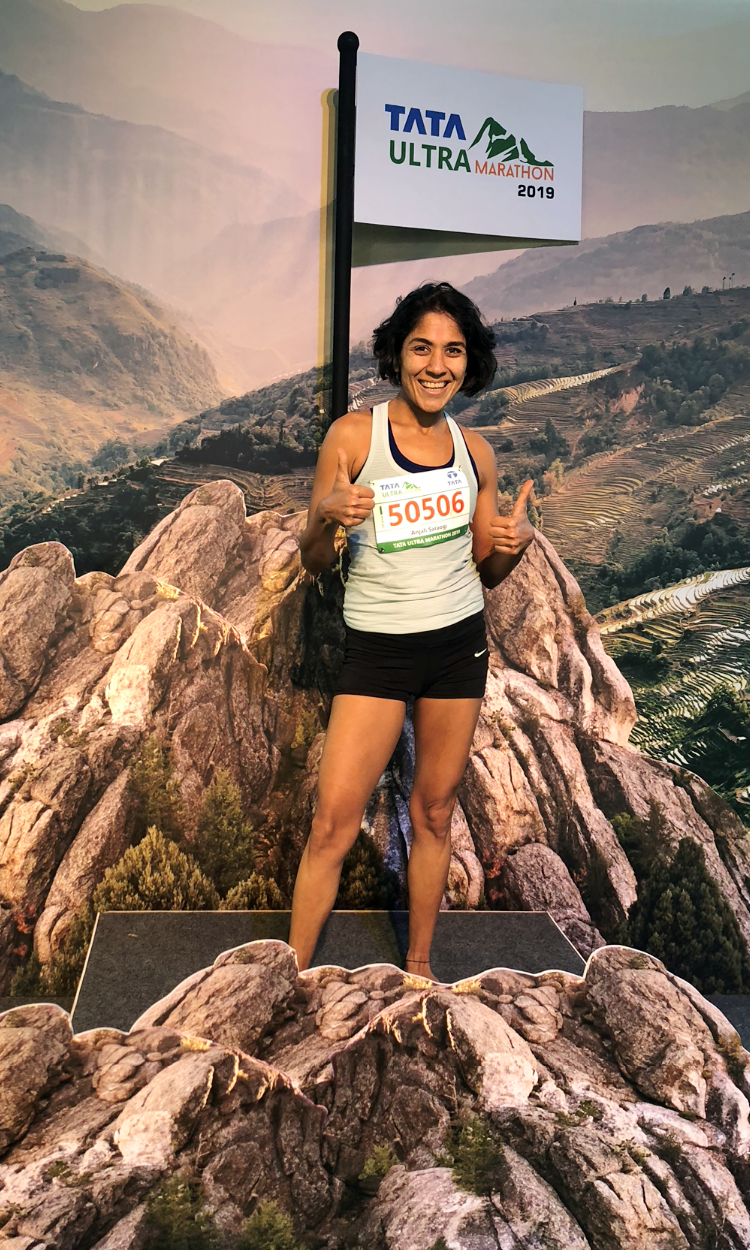
Anjali Saraogi took up running earnestly in 2016. Less than four years later, she had made it to the Indian team, set a national record in the 100K and been chosen AFI’s woman ultrarunner of the year for 2018-2019.

The 2016 edition of the Mumbai Marathon was special for featuring both the Kipketer siblings on the podium.  Hailing from Kenya, Gideon Kipketer won the men’s elite marathon in a course record of 2:08:35. His sister, Valentine, who had three years earlier set the course record of 2:24:33 (still standing as of 2020), placed third among elite women with timing of 2:34:07. Held on January 17, the 2016 Mumbai Marathon saw 40,285 registrations overall, at that time the highest in the event’s history. Somewhere among the thousands who ran that day in Mumbai, was a woman from Kolkata, roughly a year into running at events and who secured a second place finish in her age category (40-45 years) in the half marathon. That modest distance covered in 1:44:07, betrayed little of her future; she would become one of the finest ultra-runners from India.

Born into a business family, Anjali Saraogi didn’t pursue sports at school. “ I was on the heavy side and I had developed a psychological complex around it too,’’ she said. Away from her school – La Martiniere, Kolkata – she practised yoga and swam. The habit was naturally acquired; her parents were into yoga and physical fitness. “ I grew up in that environment. So I picked it up,’’ Anjali said. Upon reaching college, she studied commerce, attending classes early in the morning and CFA (chartered financial analyst) training sessions later in the day. In the middle of this, she also got married. For a brief while after marriage, Anjali ran her own leather export business. West Bengal (of which, Kolkata is capital) is not far from the eastern sweep of the Himalaya. Between the Himalaya and the plains of India is an intermediate zone of fertile flood plains. In northern India and southern Nepal, this zone is called Terai. In north east India including the northern part of Bengal, close to the Himalayan foothills, this region goes by the name – Dooars. A major crop here is tea. Anjali’s husband owned tea gardens in the Dooars. In the years following Anjali’s marriage, a phase of downturn hit the Indian tea business. Estates in the Dooars were badly impacted. The couple decided to foray in a different direction. Anjali exited the leather business she had and together with her husband, commenced a healthcare enterprise.

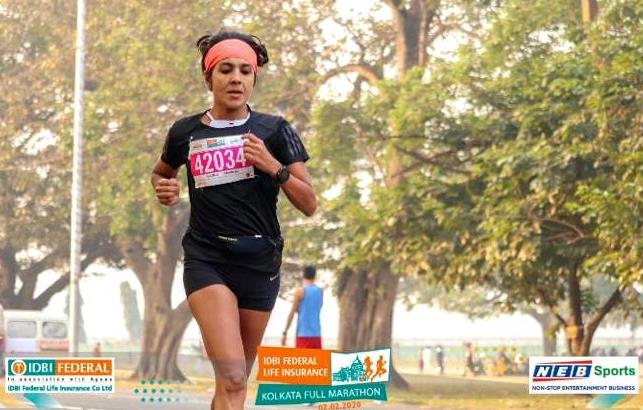
From the 2020 IDBI Federal Life Insurance Kolkata Marathon (Photo: courtesy Anjali)

“ It was a busy period. There was no time for myself,’’ she said. However she continued doing yoga; she also walked (it was a mix of walking and jogging) five kilometers every day. The combination delivered results. “ My daughter was born in 1998. Within a year after that, I shed most of the weight I had carried since childhood,’’ Anjali said. She also acknowledges that there may have been something smoldering underneath, which kept her determined to become fit. “ During my school days, we used to get television signals from Bangladesh in Kolkata. On one such occasion, the program was about the Olympic Games and it showed long distance running. Those visuals may have impressed me a lot and stayed in my head,’’ Anjali said. Room for women to pursue whatever they wanted wasn’t much those days. In endurance sports in the India, the major centers of growth have traditionally been in and around an arc from south east India to the north via the west. In its span are cities like Chennai, Bengaluru, Pune, Mumbai and Delhi with other cities partaking in the phenomenon (like Kochi, Hyderabad and Ahmedabad), located in the neighborhood. Kolkata was away from all this. “ In the early 2000s, women wearing shorts and going out for a run or workout was still a matter of debate in our generally conservative society. It was alright in parks but even there you got looked at like an oddity,’’ Anjali recalled.
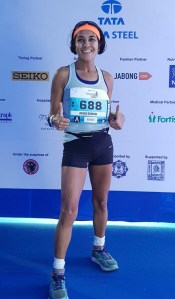
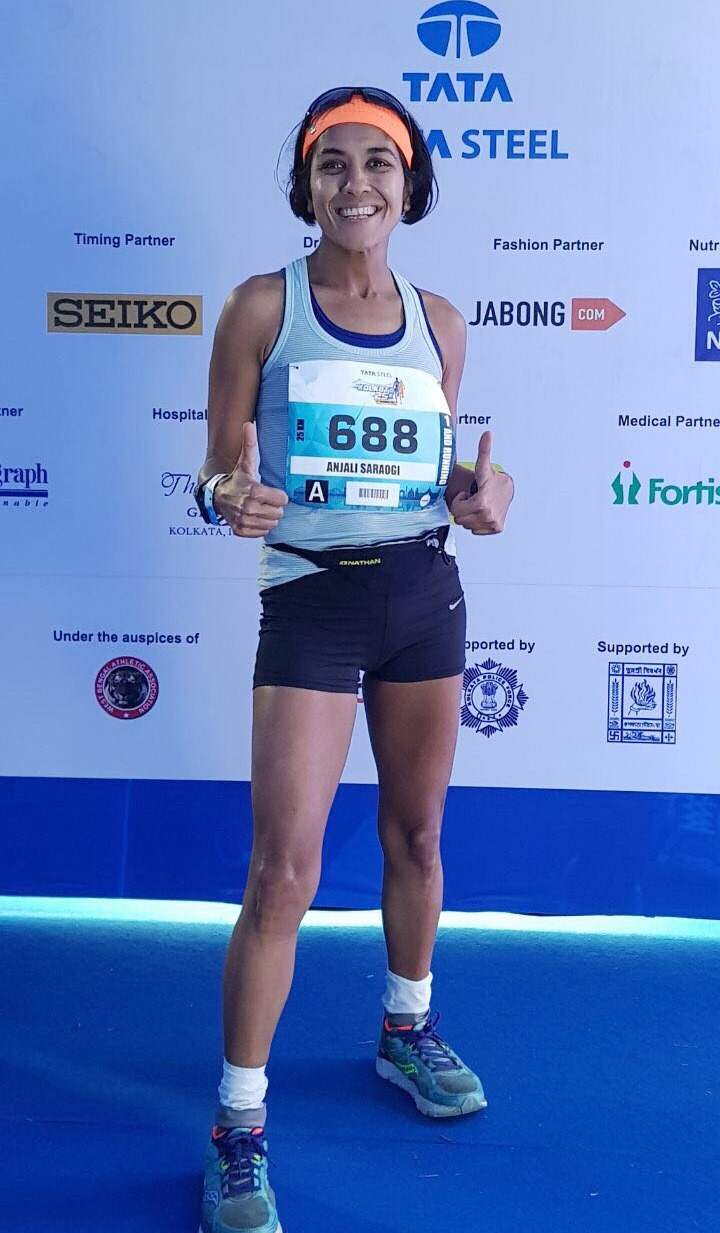
At Tata Steel 25K, Kolkata (Photo: courtesy Anjali)

In 2015, the local arm of Round Table India organized a half marathon in Kolkata. Anjali was at that time a member of the women’s wing of the Federation of Indian Chambers of Commerce & Industry (FICCI). A team of women from FICCI were due to participate in the 10 kilometer-run that was a part of the event.  Anjali weighed her options. She had been systematic on the yoga and walking front. She decided to register for the half marathon. She had no idea of running attire; she turned up for the event in a T-shirt meant for golf and leggings borrowed from her daughter. This was the start of her career in running. She covered the 21 kilometer-distance in an hour and 55 minutes; pretty good timing for a debutante. “ That first run at an event, I didn’t suffer. I enjoyed the experience,’’ Anjali said. She followed the half marathon with another, this time at the Goa River Marathon of 2015, where again she completed the course in similar time. Some months later, she was part of the thousands running the half marathon at the 2016 Mumbai Marathon, where she secured a podium finish in her age category improving her timing from previous half marathons run by almost ten minutes. “ I don’t know how that happened. I didn’t know a thing about training. All I was doing was yoga and that regular walk-run of five kilometers,’’ she said. Post this 2016 event, Anjali decided to train properly. Her husband was supportive of her decision. There was one problem. Runners who are committed to the sport typically align themselves with a good coach. Located far off to the east from the busy arc of endurance sports in India, Kolkata had neither robust distance-running culture nor coaches reputed in the sport. “ I looked up the Internet for training inputs,’’ Anjali said. It wasn’t a perfect solution by any yardstick. Proper training is real life and dynamic. The coach sees his / her ward; feedback is comprehensive and realistic. The Internet on the other hand, is rich in data. “ Just data is not good enough,’’ Anjali said. But that would be her predicament for the journey ahead. Aside from the Internet and training inputs occasionally received from fellow runners, she hasn’t had a formal coach. “ It wasn’t my choice. That’s how things turned out. If there was a good coach in Kolkata I would have joined,’’ she said.
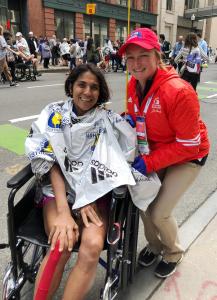
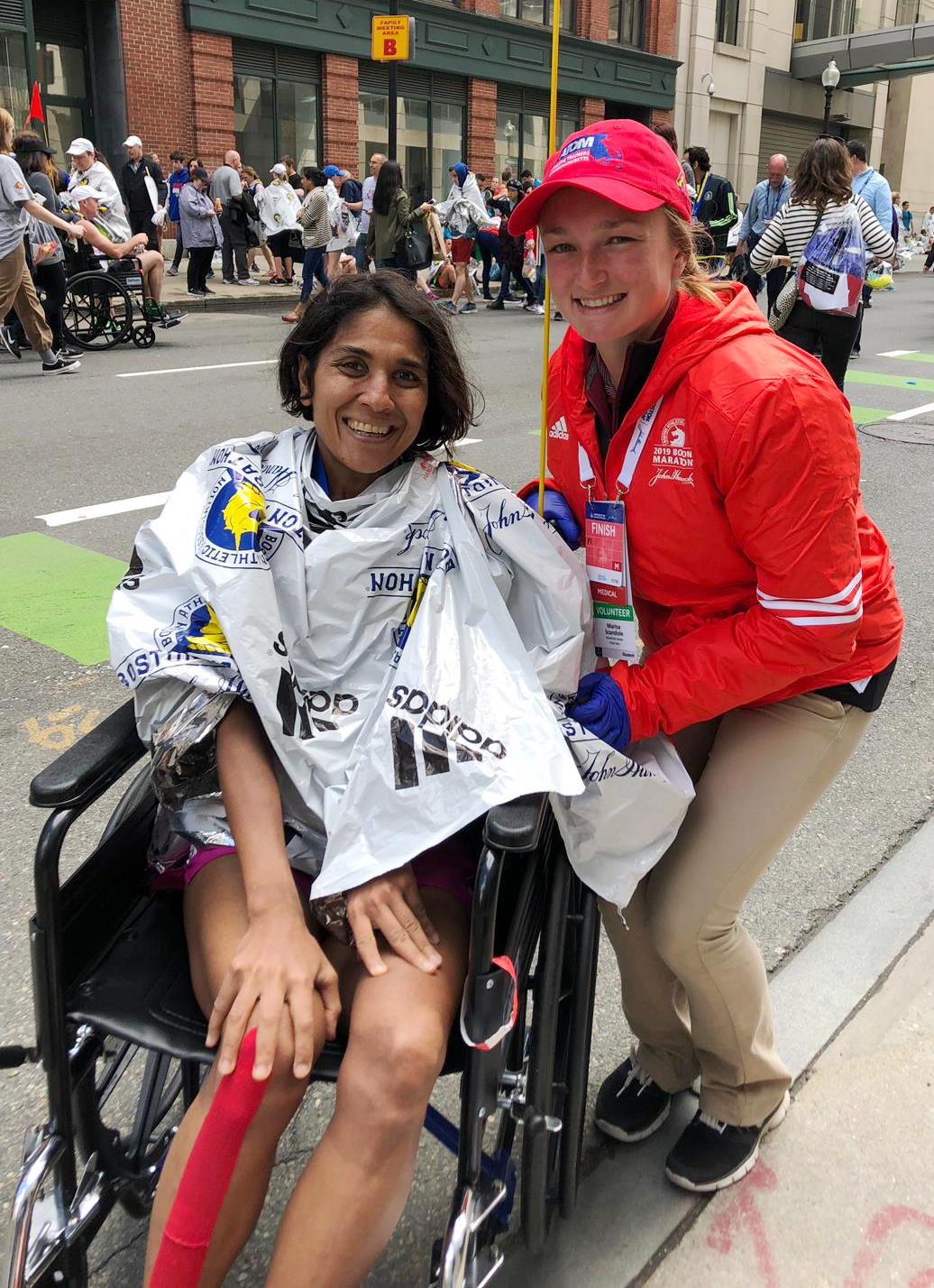
From the 2019 Boston Marathon (Photo: courtesy Anjali)

After the half marathon at the 2016 Mumbai Marathon, she ran in the 25 kilometer-category at BNP Endurathon in Mumbai.  Then, things started to gather pace. For next event, she chose the full marathon; she picked the 2016 Chicago Marathon. Having studied in Massachusetts, her husband had friends who lived in the US. On visits to Kolkata, they had spoken of the great race in Chicago. In 2016, when the group planned a reunion in the US, Anjali decided to attempt the race for her debut in the marathon. There was also a pattern seeping into the madness. As with many runners, Anjali wished to run the iconic Boston Marathon. The qualifying time for Boston that year was 3:45 hours for her age category. It became a goal to chase and Chicago seemed ideal venue to do that. She completed the marathon in Chicago – her first formal full marathon – in 3:32. The marathon debut was followed by the Airtel Delhi Half Marathon (ADHM) and the Tata Steel Half Marathon in Kolkata. Her Personal Best (PB) in the half marathon was by now 1:33 hours. For comparison try this: in 2017 Anjali would have been around 43 years old. That year she won in her age category in the Mumbai Marathon, covering the 42 kilometer distance in 3:29:12. It additionally placed her second overall among amateur women; the overall winner from amateur women registered timing of 3:17:15. At the same event, the winner among women in the open category of the half marathon finished in 1:32:02, not far from Anjali’s PB of 1:33. For the lady from Kolkata who came late to running, further shifts were underway.

On the Internet, the synopsis of the book, Dare to Run, describes it as the inspiring story of Amit and Neepa Sheth, a husband-wife duo who took up running as a sport in their late thirties. In a collection of essays written over five years, Amit takes the reader along on “ a journey of determination, discovery, courage, self-awareness and self-belief. He takes us with him from his first, almost fatal, 200 meter jog on a beach in Mumbai, to the finish line of The Ultimate Human Race: the 89 km Comrades Ultra Marathon in South Africa. Along the way, Amit uses a combination of poetry, philosophy and scriptures to explain his unique perspective on life, religion, spirituality and running. This is a book not just about running but about the need to relentlessly follow your dreams and passions, no matter what they may be, ‘’ the synopsis said.

In South Africa, for Comrades (Photo: courtesy Anjali)

It was a colleague from FICCI who told Anjali about this book and sent it to her. By the time it arrived, Anjali was down with an injury picked up in the gym. She read Dare to Run while recovering. It became her window to contemplate the ultramarathon. “ Amith Sheth’s book showed me a world I didn’t know existed. His book made me fall in love with Comrades,’’ she said. One more factor inspired her to attempt the ultramarathon. In the days spanning October 21, 2015 to May 1, 2016, Michelle Kakade from Pune had run 5968.4 kilometers along the Golden Quadrilateral, a set of major highways linking India’s major metros. Kolkata was among cities she passed through. A group of Kolkata runners crewed for her at this stage and Anjali was one among them. She was impressed by Michelle and the mission she had embarked upon. It set her thinking about the prospect of distances longer than the marathon. “ There is no point in being afraid. Hard work pays and I am a workhorse. I am not scared of failure. I have no expectations to live up to except my own,’’ Anjali said. She took the plunge. In June 2017, she ran and completed the famous 89 kilometer-ultramarathon in South Africa, Amit Sheth had mentioned in his book. At the time of writing, the time she took to complete Comrades – 8:38:23 – was still the fastest time at the event by a woman from India. Her Comrades result would become a game changer for Anjali.
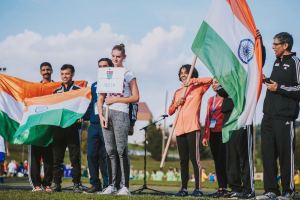
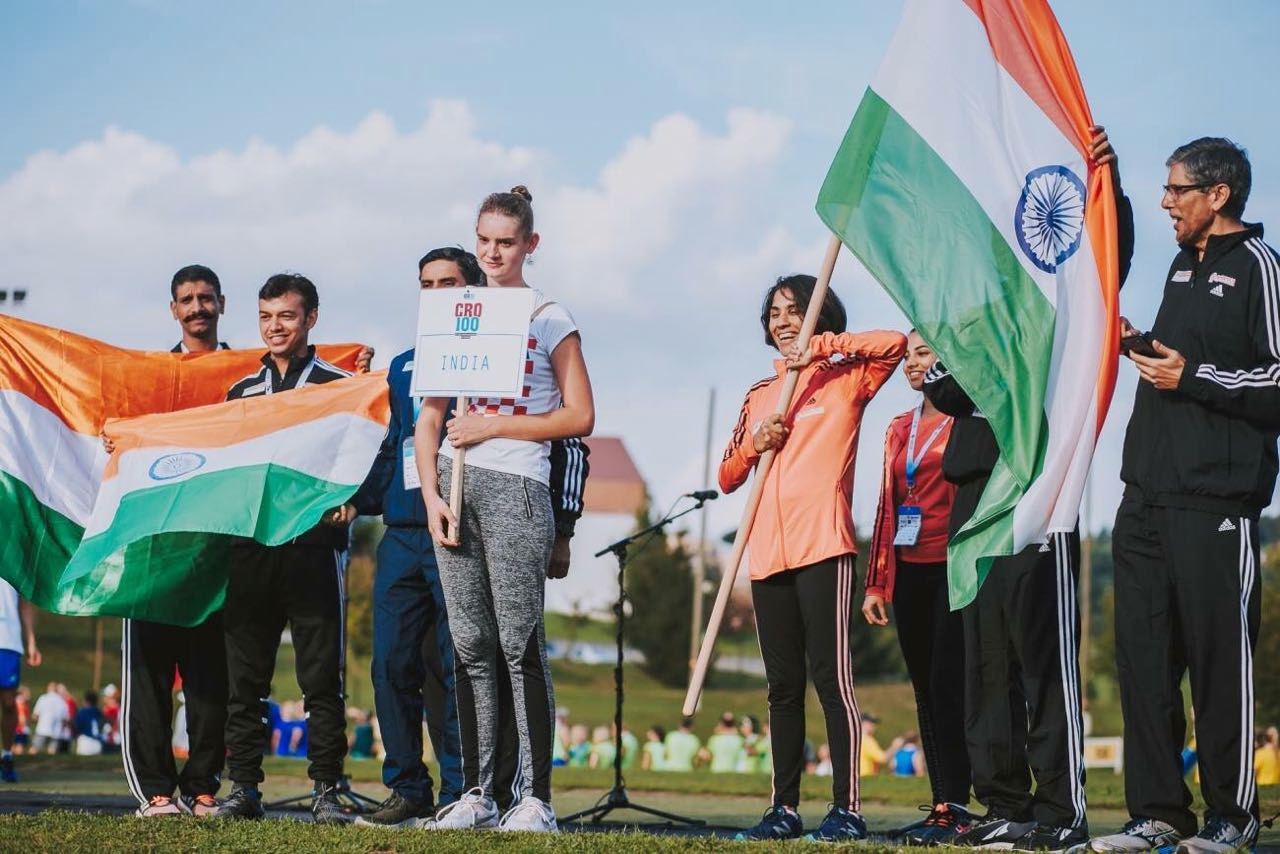
From the IAU 100K World Championships in Croatia (Photo: courtesy Anjali)

Post Comrades, she ran the Tata Steel 25K, the 2018 Mumbai Marathon and the 75 kilometer category of Garhwal Runs, where following an incident of losing her way during the race, she placed third. The major race on her agenda that year was supposed to be the 2018 New York City Marathon; it was the goal driving her training. Meanwhile in February 2017, the Athletics Federation of India (AFI) had become a member of the International Association of Ultrarunners (IAU). In July, having heard of Anjali’s performance at Comrades and Garhwal Runs, Lieutenant Commander Abhinav Jha, a naval officer and ultrarunner, contacted her on Facebook.  It was a call from the blue. The 2018 IAU 100 kilometers World Championships were due to take place in Croatia in September 2018. India was planning to send a team. At Abhinav’s suggestion, Anjali applied for a position on the team based on her performance at the 2017 Comrades. However, not long after applying, she withdrew. Her target for the year and the event she had been training for was the New York City Marathon. It was due in November. The call of July and the two events – in Croatia and New York – all seemed too close to each other for comfort. Anjali wasn’t sure she would be able to do justice. Peteremil D’Souza, an air force officer who is on the committee overseeing ultrarunning at AFI, then spoke to her. He convinced her that she would be able to do well at both Croatia and New York. Anjali understood her predicament better – in pursuit of good timing, she had been training intensely for New York; if she reduced the intensity she should be able to pull off the longer distance in Croatia. It put her back on track. Abhinav advised her on how to train. One week into training and with no more than a few weeks left for the event in Croatia, she had a bad attack of dengue. The disease took a toll on her body. She had high fever and eventually needed two instalments of platelet transfer. Time was lost to disease and recovery. It impacted training. That September in Croatia, the 100 kilometer run proved challenging. “ I was still feeling weak. But there was the high of representing the country. When I finished the race I was in a bad shape,’’ she said. At the event, Anjali covered 100 kilometers in 9:40:35. “ It was a lot of hard work. I could do that only because of Abhinav,’’ she said. Ten days before the New York City Marathon, she ran the Changan Ford Ultra Challenge 50 in China, covering the course in 4:22:22, ranking 35 in an overall field of 155. In November she ran the New York City Marathon, finishing it in 3:24:12. In July 2019, the AFI named Anjali their female ultrarunner for 2018-2019.
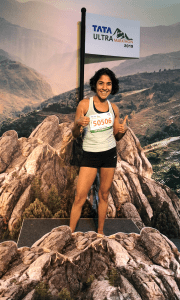
At Tata Ultra, Lonavala (Photo: courtesy Anjali)

A rather unusual thing about Anjali is her competence across distances. She still runs anything from shorter distances like the 10K and half marathon to the full and the 100K. She has had podium finishes and good timings in most of these disciplines. According to her, she considers the 42 kilometer-marathon as the foundation for her running. If you are good at it you can run the half marathon well. And if you are training systematically for the marathon, you should be able to handle the 100K as well. “ To run a 100K, you have to be good at 42. Anyone can run a 100K. But if you want to excel at 100K, then you should be good at the marathon because that is the base from which, you go longer or shorter,’’ she said. The marathon addresses all training aspects – speed runs, tempo runs, long runs and recovery runs. “ When I train for the marathon, my performance for the half and 10K improves alongside. Same holds true for the ultramarathon. When I train for the ultramarathon, I am getting better for the marathon too. People hit walls usually for a reason – typically, poor or incorrect nutrition. In a marathon, there are no mistakes. You get what you trained for,’’ Anjali said. At the same time, despite the devotion to systematic training and acknowledgement of the marathon as a process that delivers true to what effort was put in; she is not a big fan of technology. There is no great amount of math and measurement in her approach. “ I run by feel. I can only do what my body is doing. I can only run based on how I am feeling,’’ she said. In her heart, she admitted, she leans more to the 100K nowadays. That is what she would like to focus on, going ahead.
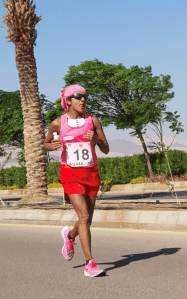
From the 2019 IAU Asia and Oceania Championships in Aqaba, Jordan (Photo: courtesy Anjali)

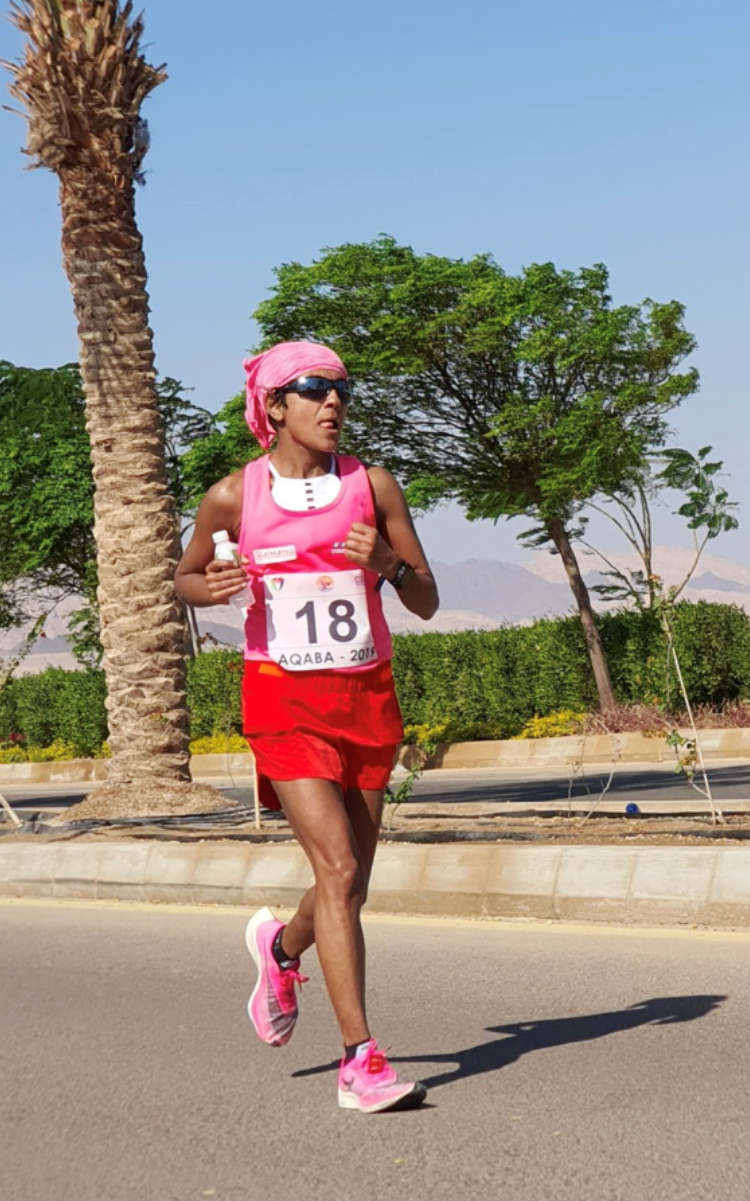
If it was dengue in the run up to Croatia, post-Croatia another nasty surprise awaited. Anjali was diagnosed with lumps on her breast. Given she had undergone platelet transfer not long ago, surgery was ruled out. Medical opinion initially said that she give up running. Luckily the tumor turned out to be benign. “ There is nobody who does not have a problem. I think perfection is making the best of what you have,’’ she said. In the months that followed, she ran the New York City Marathon in 3:24 hours, Boston in 3:14 and Berlin in 3:23. In November 2019, she set a national record in 100 kilometers at the 2019 IAU Asia and Oceania Championships held in Aqaba, Jordan, covering the distance in 9:22:03. Meanwhile as India’s amateur running movement penetrates deeper and deeper into the country, competition has been increasing. To remember alongside is also the angle that India has the biggest pool of youth in the world. The classic amateur running movement in India saw people discovering the active life in their working years and middle aged athletes registering sterling performances. In recent times, it has also meant an army of young people taking to the sport and setting new benchmarks. Even in the ultramarathon, a sport traditionally identified with experience and a slightly older crowd, youngsters have been making their presence felt. As of 2020, Anjali was in her late forties. She came late to running and had done much in the years since. But a question any observer would ask is – how much longer? “ I believe my best is yet to come. I feel there is a lot left in me as regards the marathon and the 100K,’’ she said.
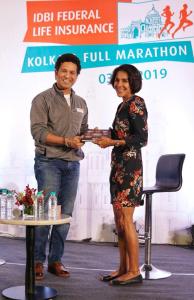
With Sachin Tendulkar at the 2019 IDBI Federal Life Insurance Kolkata Marathon (Photo: courtesy Anjali)

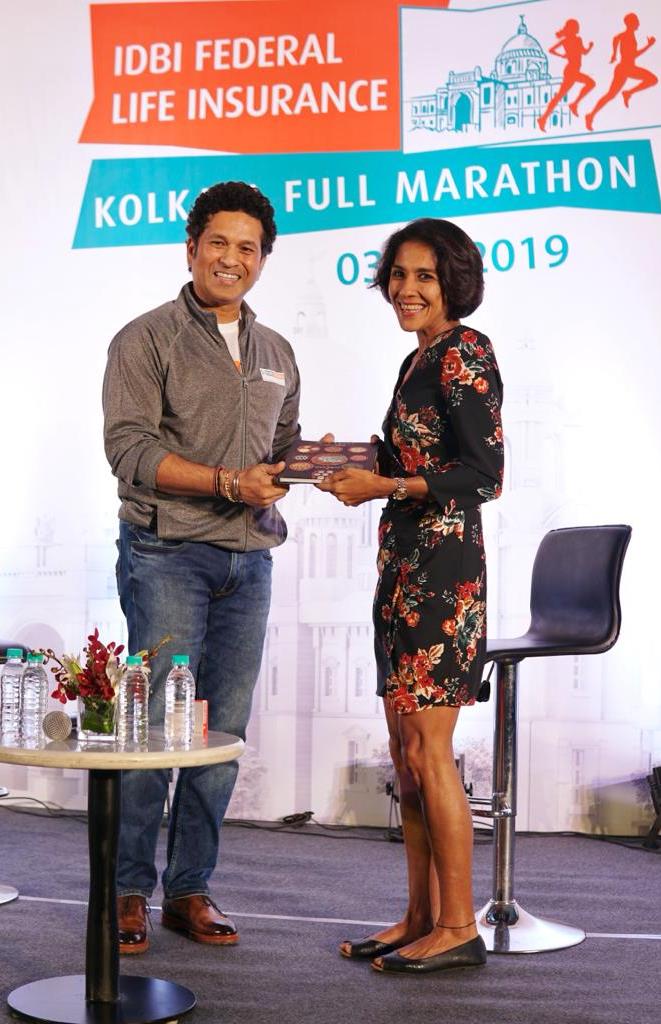
In the run up to every edition of the Tata Mumbai Marathon (TMM), the question on runners’ minds is how the weather may be on race day. In 2018 and 2019, the pleasantness of late December-early January had suddenly transformed to heat and humidity. Two days before 2020 TMM, not only was it still pleasant in Mumbai but there was also a nip in the air that evening, at the café on Marine Drive. Coffee and conversation done, Anjali left to attend a wedding reception at Trident Hotel, a short walk away. Two days later, she won in her age category of 45-49 years at the 2020 Tata Mumbai Marathon, covering the distance in 3:24:53. Among amateur woman runners of all age categories running the marathon (the fastest of the lot was clocked at 3:16:26), she placed fourth. Roughly two months later, the running scene in India ground to a halt as COVID-19 zoomed to pandemic. The situation affected Anjali too. Hemmed in by lockdown, the need to protect her family and with her own house bordered by containment zones, she decided it would be wise to pause her running till things improved. Yoga and strength training continued. Early August, this blog asked her what the impasse – complemented by the irreversible nature of time – meant to her. “ The question is meaningless to me. I don’t run for a podium finish. I run because I like to run. It is alright if right now, I must temporarily stay off running. That is a conscious decision made in view of the prevailing times of viral disease and my desire to protect my family,’’ she said.

(The authors, Latha Venkatraman and Shyam G Menon, are independent journalists based in Mumbai. This article is based on two rounds of conversation with Anjali, one in January 2020 and the other in August.)        

2020 LONDON MARATHON TO BE ELITES-ONLY

This image is from the 2019 London Marathon. It was downloaded from the Facebook page of the event and is being used here for representation purpose. No copyright infringement intended.

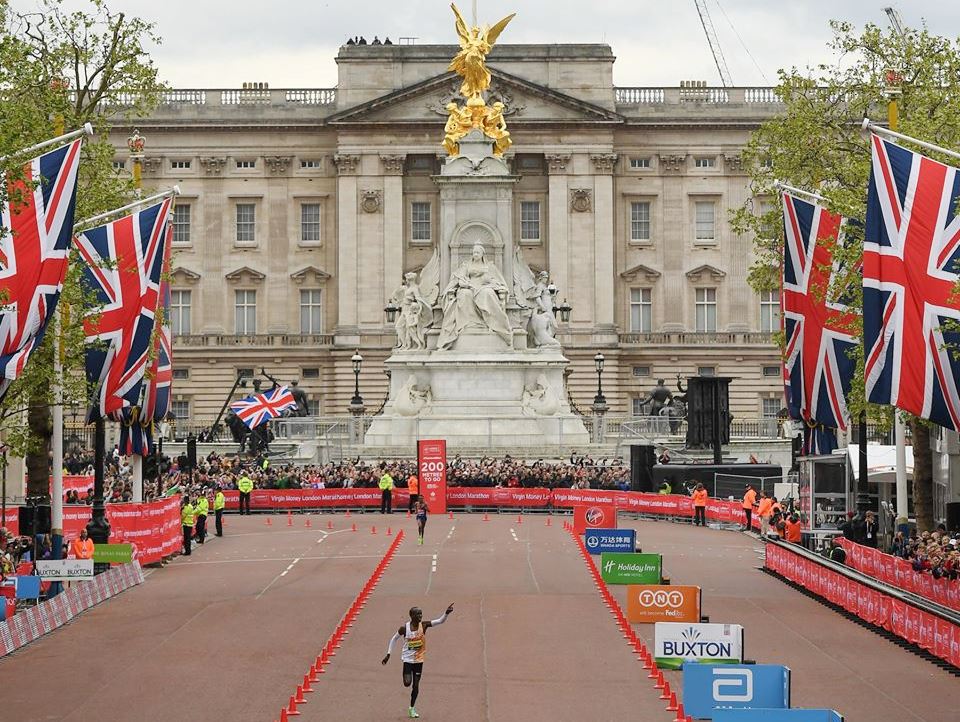
This year’s London Marathon, scheduled for October 4, will bring us the much awaited contest between marathon greats Eliud Kipchoge (Kenya) and Kenenisa Bekele (Ethiopia). But the 2020 edition of the race will be an elites-only affair.

“ After months of intensive work and consultation with London’s authorities, organisers today confirmed the plans for The 40th Race on Sunday 4 October 2020. Elite races for men, women and wheelchair athletes will take place on an enclosed looped course in St James’s Park in a secure biosphere (a contained safe environment like that of Formula 1 and England cricket) and times will be eligible for Olympic qualification.

“ The long-awaited head-to-head between Eliud Kipchoge (Kenya) and Kenenisa Bekele (Ethiopia) will headline the men’s race and world record holder Brigid Kosgei (Kenya) heads the women’s field. Manuela Schär (Switzerland) and David Weir lead the wheelchair fields. There will be no spectator access to maintain the biosphere but BBC Sport plans to broadcast eight hours of coverage during the day. (Please note: access to most of St James’s Park will be maintained for local residents and park users.),’’ an official statement dated August 6, 2020, available on the website of the London Marathon, said.

It added, “ Everyone with a place in the 2020 event will still have the chance to take part in The 40th Race by running the famous 26.2 mile marathon distance from home or anywhere in the world on the course of their choice. All finishers will receive the coveted finisher medal and New Balance finisher T-shirt. In addition, all runners and charities will also be able to defer their place to a future London Marathon – in 2021, 2022 or 2023.’’

Earlier this year in March, the 2020 edition of the Tokyo Marathon was run as an elites-only affair. That event – the first major running event to embrace the elites-only option since COVID-19 began to spread – happened some days before the disease was officially declared a pandemic by the World Health Organization (WHO). Thereafter, the issue of going elites-only for 2020 has been among formats studied by major marathons. While many chose to cancel and wait for better times, some indication of the direction London may take was available in a July 28 statement from World Athletics, wherein the apex body for athletics worldwide said that the London Marathon would be among races, athletes wishing to run the marathon at the rescheduled 2020 Tokyo Olympic Games (now set for the summer of 2021) can participate in and hope to qualify.

Thursday’s statement from London Marathon quoted Hugh Brasher, Event Director as saying, “ We have been working for months on a number of different scenarios with the health and safety of our runners, our charities, our sponsors, our volunteers, our medics, our communities and our city always our priority. We had detailed plans to deliver a socially distanced mass participation event – either a run or a walk – and we were planning to utilise new technology to do this. We were looking to use a revolutionary technology using Bluetooth and ultra wideband ranging, which is about to be launched worldwide. This would have enabled us to accurately monitor every participant’s distance from each other, work out if the participant spent more than 15 minutes within 1.5 metres (or any distance we set) of anyone else and then contact them post-event if anyone had informed us that they had contracted Covid-19 in the two weeks after the event. Despite all our efforts, the fantastic support from all of our partners and the progress that has been made on planning for the return of smaller mass participation events that are not on the roads, it has not been possible to go ahead with a mass socially distanced walk or run.

“ In parallel with the work on the plans for the socially distanced mass event, we had a team working on planning the elite races for men, women and wheelchair athletes in a biosphere environment in St James’s Park and another team creating a truly inspiring Virgin Money London Marathon which means participants across the UK and abroad can still be part of The 40th Race from their home or wherever they might be on 4 October.’’

Participants in the 2020 Virgin Money London Marathon will have 24 hours to complete the 26.2 miles, from 00:00 to 23:59 on Sunday 4 October. They can run, walk, take breaks and log their race on a new London Marathon app being developed by event partner TCS. Runners can also use their time, with appropriate supporting evidence, to apply for a Good for Age or Championship place in 2021.

In 2021, the event will move from its usual April date to Sunday 3 October to give the best chance for the mass race to return in 2021, the official statement said.

More details are available on the event website.

(The author, Shyam G Menon, is a freelance journalist based in Mumbai.)

TWO REALITIES: KHARGHAR AND KAUSANI

Chanchal Singh Kunwar (Photo: courtesy Chan)

Located in Bageshwar district, Kausani is popular for its tea gardens.

Although tea plantation was introduced many decades ago in Uttarakhand, it didn’t catch on. According to a September 2014 article in the Hindustan Times about the erstwhile standing of teas from Uttarakhand and how they languished later, tea cultivation was introduced in these parts by the British in 1835. They chose the hills of Kausani, Dehradun and Berinag to start the process. Initially, the teas of Uttarakhand did well. Subsequently, even as plantations became big business in North East India and South India, tea production in Uttarakhand plummeted. In recent times, according to media reports, efforts have been made to encourage tea growing and restore the market profile of teas from the state.

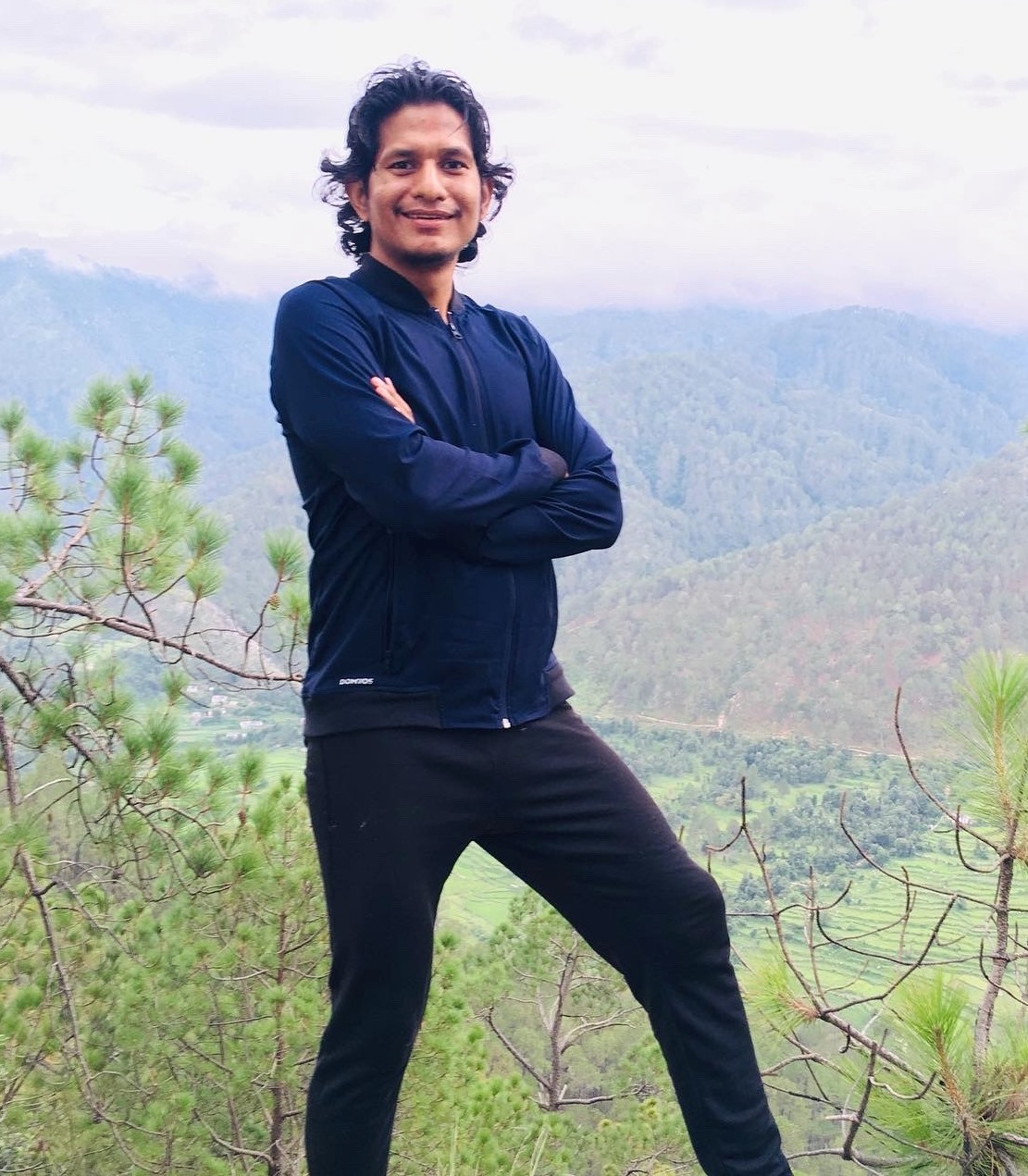
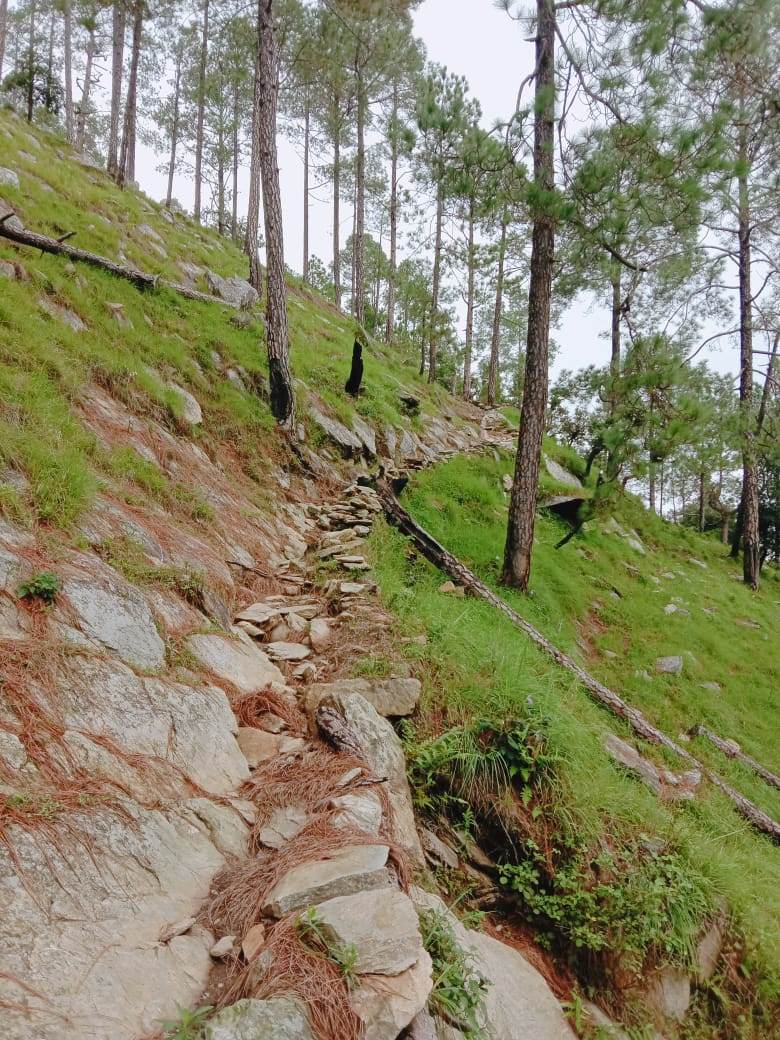
Kausani remains a small hub of tea gardens. As you come in from the Ranikhet side, the road ascends to the town, runs a bit on the ridge of the hill and then descends to the other side, which is when the tea gardens and their adjoining clutch of restaurants emerge to view. It is a popular halt for tourists, rewarding anyone making it to the spot at the right time on a clear day with great pictures of select Himalayan peaks. Kumaon is known for its panoramic view of the Himalaya. From the cafes near Kausani’s tea gardens, you see the peaks of western Kumaon. Late July, 2020 it was the season of rain in Kausani. It rained intermittently. The weather was pleasant; perfect for running. Some kilometers away from Kausani, is the village of Shauli. Early mornings and sometimes in the evening, a runner from here would take a route not normally taken by others around. While the general grain of economic development in the hills has been the tendency to trade walking trails for roads, this person – recently returned from big city – did the opposite. He traded Kausani’s roads for its quiet, forgotten trails. They wind their way along hill slopes sporting pine trees.

Kausani’s trails, July 2020 (Photo: courtesy Chan)

Until some months ago, Chanchal Singh Kunwar (Chan) was among those running regularly at Kharghar in Navi Mumbai. Navi Mumbai is a satellite city of Mumbai; it along with Thane is part of the larger Mumbai Metropolitan Region (MMR). MMR is one of the biggest urban agglomerations on the planet. An important node of Navi Mumbai, Kharghar evolved on flat land set against a backdrop of hills. The flats, roads therein and connections thereof to more roads in nearby Belapur offer adequate mileage for daily running. A five kilometer-long road leading up into the hills serves as additional tool for training. Every year as the annual Mumbai Marathon approaches, this hill road sees local runners and those from other parts of MMR, come to train. Indeed Navi Mumbai is one of the better places in MMR for a runner to be in. However, it is a bustling urban center and has been gaining vehicles and traffic by the day. The overall ambiance of your daily run is thus very much that of city.

Chan hails from Kausani. After a few years of growing up there, his family moved out to ensure better education for the children. Besides, his father worked in the Indian Navy and with any job in the defence sector, transfer is an integral part of life. Eventually, Chan found himself in MMR (at Kharghar), where as an employed adult, he worked with Star Sports. As of 2020, it was around seven years since Chan took up running. The bug got to him in Mumbai. In the initial years, he did what he could, sensing his way around in the sport and keeping an annual appointment with the Mumbai Marathon. By 2015, he was training seriously and by the following year, had graduated to attempting the ultramarathon. In 2016, he won a 50 kilometer-night run, a 75 kilometer ultramarathon in Pune and covered 96 kilometers at the annual 12-hour Mumbai Ultra. In 2017, he won the 101 kilometers category at Run the Rann, an ultramarathon organized in the Rann of Kutch in western India. That year he also won the IDBI Federal Life Insurance 12hrs stadium run in Mumbai covering a distance of 105.2 kilometers in the stipulated time; he also participated in and finished the 111 kilometer-segment of La Ultra The High in Ladakh. In 2018, he won the 50 kilometers category at BNP Ultra in Mumbai but later suffered injury while training for the Annapurna 100 in Nepal. “ As a comeback run in 2020, I bettered my course record at BNP 50 by two minutes, finishing the race with a PB of 3:56:01,’’ Chan said.

Kausani’s trails, July 2020 (Photo: courtesy Chan)

After his father retired, Chan’s parents shifted back to Kausani. The move isn’t permanent for them yet; at the time of writing his father was still undecided on whether it should be a shift for good or not. In March 2020, Chan was due to attend his Basic Mountaineering Course (BMC) at the Nehru Institute of Mountaineering (NIM) in Uttarkashi. By then he had also put in his papers at Star Sports and was looking forward to commencing something on his own in sports nutrition.  Against this backdrop, it made sense to blend his NIM trip with a visit home after the mountaineering course. After all, Uttarkashi is in Uttarakhand and Garhwal (where NIM is) and Kumaon (where Kausani is) are adjacent regions. However, the entire plan had to be cancelled following the outbreak of COVID-19 and onset of nationwide lockdown. Chan spent the first two and a half months of lockdown in Kharghar. Then, as the strict lockdown gave way to a slightly relaxed version, in mid-June, he traveled to Kausani to be with his parents.  With lockdown continuing and working remotely now an accepted way of life, he plans to make Kausani his new base.

Plains or hills, a runner cannot stay away from running. For Chan, Kausani situated at an elevation of 6200 feet, presented fresh options, especially on the trail front. He has plans to try some of the well-known trail running events of Himachal Pradesh and South India. It wasn’t long before he started exploring the trails around Kausani as potential training routes. Every day, he picks one of two windows or sometimes both; the first is in the morning around 7 AM, the other is around 4-4.30 PM. “ There has to be natural light. That is one problem in the hills. You don’t have street lights here as in the cities. But otherwise it is a vast difference between what I do here and the running I used to do in Kharghar. The weather in Navi Mumbai was always hot and humid and capable of exhausting you fast. The air was also polluted, which is the case in most urban areas. There was traffic. Here road traffic is less but then, I am not on the roads at all. I am on trails, which are frequented by very few people. It is peaceful. Yes the elevation makes you strain more than in the plains but the air is clean; you can feel good quality air in your lungs,’’ he said. As for inclines he has tonnes of it strewn around in hill country. According to him, the trails he found are a healthy mix of enjoyable running and steep, technical slopes. Incidentally, Chan is not the only one utilizing the value of Kumaon’s trails. Around the time the nationwide lockdown started, Nitendra Singh Rawat, one of India’s top marathon runners, had shifted from Ranikhet (where the Kumaon Regiment to which he belongs is headquartered) to his village in Garur. When contacted in early April, he was training on isolated trails near his village, away from people and the hustle and bustle of life. Garur is around 15 kilometers from Kausani.

Kausani’s trails, July 2020 (Photo: courtesy Chan)

As he continues his running in Kausani, Chan admitted to nursing a wish. Places like Garhwal and Kumaon have known running for long, possibly longer than it has been viewed as fitness movement or sport in the plains. The driving force for this widespread engagement with running was military recruitment. The Himalayan foothills have a tradition of sending people to the armed forces. Both Kumaon and Garhwal have regiments bearing their name. In the run up to every recruitment season (locally called bharti), the roads of Kumaon feature young men putting in the miles to stay fit. Same is the case in Kausani. “ The people here are good runners. They have the ability to do well. But they don’t have a year-round culture of running that is independent from military recruitment. They run to be recruited and when that reason isn’t there, they don’t have any incentive to continue running. I would like to do what I can to change that. I hope I am able to contribute in some way to creating a running culture here,’’ Chan said on the phone from Kausani.

(The author, Shyam G Menon, is a freelance journalist based in Mumbai. Podium finishes and timings at races are as stated by interviewee.)

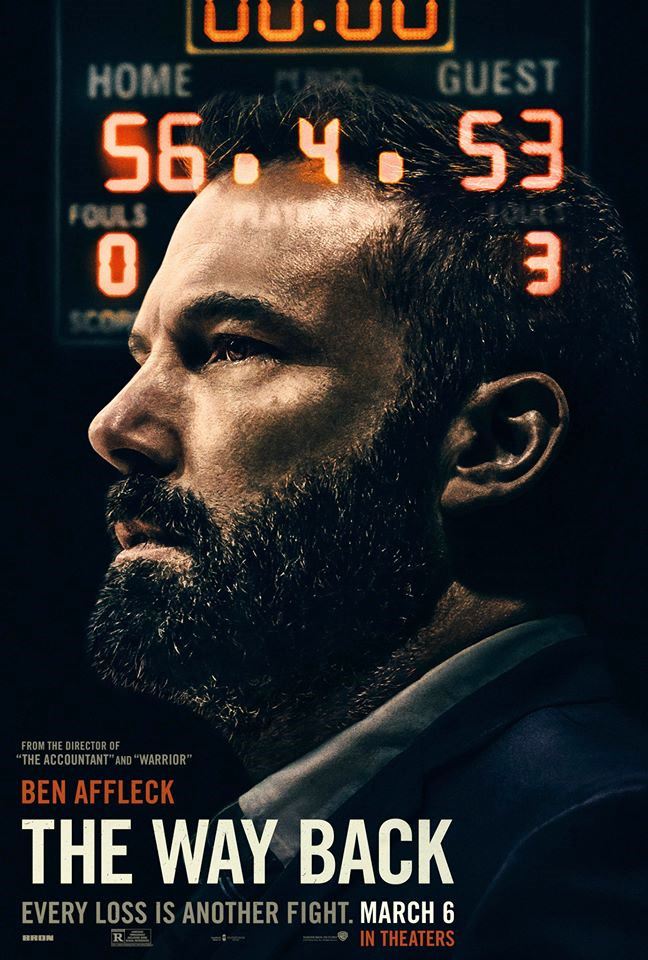
THE WAY BACK

This image was downloaded from the film’s Facebook page and is being used here for representation purpose. No copyright infringement intended.

Films on sports become memorable when they tell a unique story; tell a known story in engaging format, features great acting or hosts technical excellence like memorable cinematography.  A problem seen in this genre is herd behavior. When one model sells, others emulate by the dozen.  For instance, there is an element of fatigue brought by the innate need of these films to showcase motivation, teamwork and achievement. Even before story unfolds, you know what it’s going to be. That can be a damper.

The Way Back is a regular film anchored by the solid presence of Ben Affleck. The film revolves around a former, talented high school basketball player who has drifted off the sport and is then called in to coach a team from his old school. There is nothing new about the problems plaguing him, there is nothing new about the struggles of the young players he is asked to coach. What appears refreshing is the acceptance of known narrative and its handling with a steady hand rooted in reality. Unlike your average sports film, which tends to periodically court elation and uplifting sequences, this one remains a bit dark and grim. That is understandable because the coach has genuine problems to overcome. The bleakness of his world mixes with the goings on in the basketball court, making for an overall mood that rarely frees itself from the damage he has already done to himself and the damage yet to be. Doing so, it becomes a good document of what it means to live and be scarred by life (which in turn, makes you an effective teacher), what it takes to be a good coach and how accountable to wards and school, coaches have to be. That element of realism and ordinary world is this 2020 film’s strong point.

 Plus, Affleck turns in a convincing performance.

The film is available on Amazon Prime; worth watching.

(The author, Shyam G Menon, is a freelance journalist based in Mumbai.)  

A HIDDEN LIFE

This image was downloaded from the Facebook page of the film. It is being used here for representation purpose. No copyright infringement intended.

The human world has two camps. One finds purpose and security in clustering together. The other acknowledges the vulnerability of being alone but attributes greater value to journey by oneself.

Most of us know World War II as a contest within human cluster between the Axis and the Allies. Both sides were regimented for the task; it was a case of armies clashing and even in the case of civilian resistance, they went by their identity as a group – the Resistance. That is what makes the case of Franz Jagerstatter interesting. He was an Austrian conscientious objector. Cambridge Dictionary explains the term as: a person who refuses to work in the armed forces for moral or religious reasons. Conscientious objectors don’t count on herd for support. Their protest is typically personal and done alone.

Franz and his wife Franziska live in the village of St Radegund in the mountains of Austria. They are farmers; it is a hard but happy life. Both are devout Catholics. The life of Franz and Franziska (Fani) are the subject of the 2019 Terrence Malick film A Hidden Life.

It is the age of Adolf Hitler’s Nazi Germany; its war machine and expansionism. People are ordered to serve in the Nazi army. According to Wikipedia’s page on Franz, when Germany annexed Austria in March 1938, he was the only person in the village to vote against the move in the plebiscite held that April. Franz reluctantly undergoes a round of military training. However the surrender of France in the initial phase of World War II and the realization of Nazi objectives till then sees Franz being allowed to return home. He abhors the Nazis; he dislikes their agenda. However the war doesn’t end with France’s surrender; it continues. When his fellow villagers succumb to the general trend, justify the war effort and indulge the ruling dispensation with greetings of “ hail Hitler,’’ Franz finds himself isolated. He occasionally makes his dissent publicly evident. Such instances mark him out as a traitor, a position that is – to his detractors – worse than enemy. All this, when he is guilty of no crime and his only fault is that he doesn’t tow the Nazi line. The resultant atmosphere is like an ever tightening noose around him and family; a sense of approaching gloom constantly creeping up on them. His wife stands by him. Eventually, Franz is ordered to report for work with the army. Although very attached to his family, he is sufficiently angered by the spinelessness all around, to report for duty with the explicit intention of making his dissent known to the authorities. Lined up for inspection after reporting, he stands out from among the recruits for not saying the ritual “ hail Hitler.’’ This and what happens thereafter, form the subject of the film, a biopic.

Terrence Malick is known for his visually impressive movies, often having strong philosophical and spiritual undertones. That idiom is strong in A Hidden Life. Every frame of the film captures your attention. Each of them is a study in poignant loneliness, which is the price human beings pay for standing by their beliefs.  Even in the utterly beautiful mountain landscape that embellishes many of the frames, the loneliness and vulnerability of the main protagonists shine through. You sense the abject difference between the spiritual meaning of existence as borne by the link between self and universe and the tiered descent to compromise that happens with higher and higher levels of human organization, from self to family, community and nation. There is no judgement by the film; there is just empathy. It is a study of predicament. There isn’t one moment when the director’s art flags. For the same reason, this isn’t an easy film to watch. It moves slowly, almost at the pace of human breath. I was patient. To my mind, notwithstanding its tragic story (not an easy trajectory to handle amidst depressing lockdown), A Hidden Life is one of the best films I have seen in recent times. It is memorable for its sheer quality and the periodic balancing of its tragic narrative with the love you sense in its carefully shot frames. It is also memorable for the relevance it holds for our times in the early decades of the twenty first century, when the tendency to worship massive human formations, fancy autocratic governments and force the individual to fall in line are all back in vogue.

Be patient with this film. Your patience will be rewarded.

The film is available on Disney-Hotstar.

(The author, Shyam G Menon, is a freelance journalist based in Mumbai.)